| Pop Culture Gadabout | ||
|
Saturday, May 17, 2008 ( 5/17/2008 01:24:00 PM ) Bill S.  IN WHICH A MOCK EDWARDIAN NARRATIVE STYLE IS DEPLOYED: As in insouciantly entertaining as his twice weekly Internet comics may be, there's something extra satisfying about reading (or re-reading) David Malki's "Wondermark" strips on good ol' pulpy paper. Perhaps the visually anachronistic nature of his cartoonwork - a collage of repurposed 19th century illustrations - makes it best suited for bound paper. The new collection of Malki stripwork, Beards of Our Forefathers (Dark Horse Press) is certainly well-served by its hardbound packaging. IN WHICH A MOCK EDWARDIAN NARRATIVE STYLE IS DEPLOYED: As in insouciantly entertaining as his twice weekly Internet comics may be, there's something extra satisfying about reading (or re-reading) David Malki's "Wondermark" strips on good ol' pulpy paper. Perhaps the visually anachronistic nature of his cartoonwork - a collage of repurposed 19th century illustrations - makes it best suited for bound paper. The new collection of Malki stripwork, Beards of Our Forefathers (Dark Horse Press) is certainly well-served by its hardbound packaging.Malki's biggest jape - using Edwardian imagery in the service of absurdist 21st century tomfoolery - is nothing new, of course. Terry Gilliam was doing something very like it, after all, for Marty Feldman and Monty Python back in the 1960's. (There's even a Pythonesque "apology" joke imbedded within the collection.) But when the initial connection between image and dialog could've only come from some strange synaptic leaps in the cartoonist's brain - a strip featuring three young maidens in "poetic" dance poses is service of a fraudulent hangover cure, for instance ("I'm going to hurl all over your shoes in about three seconds," one promises) - the results can still be potently risible. To be sure, the demands of regular stripwork mean that the cartoonist will occasionally stoop to the obvious - as when a quartet of turbaned types from some doubtlessly rousing adventure yarn are put to the service of silly terrorist jokes. But, in general, Malki displays a ripe sense of grim whimsy. I'm still "patronizingly chuckling" (to use a term from the cartoonist's afterword) over his cat with a blog strip. ("It's not even wordpress or blogger, it's some crap like xanga," the cartoonist notes in his final punchline.) In many of the darker strips, Malki contrasts his found art's sentimental imagery with a mordant sense of comic despair, as when a young boy describes his depressing plans for adulthood ("First I'll flunk out of college, then I'll marry too young," he begins) to the title "In Which Marvin Is All Set." Occasionally, Malki just indulges in just plain goofiness: perching a tiny triceratops on the barrel of a soldier's rifle, for instance. In addition to his strips, Malki includes text giving the faux background story behind several colorized entries, a variety of silly features (like an "Ironic Facial Hair Citation" you can hand out to hirsute acquaintances - if you don't mind cutting up the book, that is), plus an original eight-page comic of murder and deceit entitled, aptly enough, "Treachery!" Beards also includes some "Abandoned Efforts" and four guest strips, all of which illustrate just how difficult this whole repurposing business can truly be. If I have any plaints about the current packaging, they rest in the layout of Malki's strips, which typically rest two to a page. The jokes in "Wondermark" follow a set format: humorous title (e.g., "In Which Cancer Is Faked"), one-tiered strip plus a capper one-liner beneath the strip. But as Malki has arranged his book, the lower level strips' titles (which typically would appear at the top of your browser in a web comic) are placed off to the side under the comic - disrupting the flow. But that's a niggling gripe, and a small price to pay for the privilege of being able to shelve Beards of Our Forefathers between a hardbound copy of V for Vendetta and your "DC Archives" of Wonder Woman, right? # | Friday, May 16, 2008 ( 5/16/2008 07:17:00 AM ) Bill S. WILL ELDER: I was two or three years too young to have experienced EC comics when they first came out, though I still remember reading a battered copy of one of the crime comics (the one where a mousy librarian is freak out about a serial killer) owned by a boyhood friend's older brother. But thanks to Ballantine Books' early paperback reprints of the 10-cent MAD comics (The MAD Reader, MAD Strikes Back, etc.), I quickly fell for the work of Will Elder, the hardest drawing gagman in the comics biz. To read an Elder MAD comic was to get sucked into a cyclone of sight gags, of extraneous eyeball kicks that may have occasionally come close to derailing scripter Harvey Kurtzman's sharply satiric takedowns of pop culture ("Starchie," "Ping Pong," "Dragged Net," etc.) but kept you coming back to see what other little jokes you missed the first - or fiftieth - time through. The comic's other regulars may've been slicker (Wally Wood was definitely sexier, Jack Davis was more immediately commercial), but to a pre-teen reader, Elder was MAD comics. Elder would find later comfortable success, still collaborating with Kurtzman on Playboy's "Little Annie Fanny" comics, and while I can't begrudge either man's making a good living after several commercially unsuccessful attempts at bringing the MAD comics formula into a more grown-up mag edition (Trump, Humbug, Help!), the fact remains that "Fanny" was just not as kicky those funky ol' MADs. A few years back, I had the pleasure of reviewing The Mad Playboy of Art, a biographical tribute to Elder featuring a hefty selection of rarely seen Elder work from the period between MAD and Playboy, and it couldn't help but make you wish that Willie and Harve had never gotten lured into the Playboy Mansion. Still, Elder's style, even toned down to meet the demands of Playboy's pricey color reproductions, remained purest funnybook. R.I.P. Villie Elder. # | Wednesday, May 14, 2008 ( 5/14/2008 07:17:00 AM ) Bill S. STIMULATED: Got our economic stimulus money direct-deposited yesterday: for the record, it's all going toward paying off a piece of the money we owe for getting that carpeting installed in the old house . . . # | ( 5/14/2008 06:15:00 AM ) Bill S. "SHE MADE YOU SOME KIND OF LAUGHINGSTOCK BECAUSE YOU DANCE TO DISCO AND YOU DON'T LIKE ROCK." For this week's mid-week music vid, let's return to the opening track for what's arguably the Pet Shop Boys' greatest album (Very, a.k.a. The Manhole Cover Album), "Can You Forgive Her?" (It was either this 'un or their great cover of the Village People's "Go West," but the only version I could find looked too fuzzy.) # | Tuesday, May 13, 2008 ( 5/13/2008 10:13:00 PM ) Bill S. "LET'S START THIS GAME OFF WITH 'ABANG!'" A Scrabble query from tonight's episode of N.C.I.S.: are we supposed to accept that geeky writer and Scrabble player McGee doesn't know "QI" is an acceptable word (one of the big three "Q" words that don't have a "U," the other two being "QAT" and "QAID")? And didn't that square Ziva placed her "Q" on look too light blue-ish to be a Triple Letter Score? If it's a Double, than using the letter two ways'll only give the woman 42 points, not - as our Mossad agent asserts - 62. # | Monday, May 12, 2008 ( 5/12/2008 06:06:00 PM ) Bill S. "AND THIS BIRD YOU CANNOT TAME." Ages after I caught the first film House of 1,000 Corpses, I picked up a copy of its sequel, The Devil's Rejects, from the $7.50 DVD shelves at Wal-Mart. I'd been told by more than one modern horror buff that the movie was a quantum improvement over the first film, and I wanted to see what a "good" Rob Zombie horror flick was like. Perhaps it was the circs in which I wound up watching the thing (two-thirds in, the DVD seized up, and I couldn't get to the movie's big showdown with vengeful Texas sheriff William Forsythe until after I went out and bought some DVD repair goop), but I never got caught up in the writer/director's horror vision. Rejects, which basically focuses on the first flick's family of demented serial killers as they run from the law, is a more solid movie-as-movie - the distracting visual trickery is kept to a minimum - but I may have actually preferred House for its throw-everything-into-the-visual-stew approach. It's also possible that I've become jaded in ways that keep me from appreciating the movie's horrific impact. Though the DVD box promises "one of the most depraved and terrifying showdowns in cinematic history," I found myself going eh! during the flick's protracted torture climax. I appreciated the way that Zombie momentarily messed with our sympathies during the sequence where Sheri Moon Zombie's Baby gets chased through the woods by an axe-wielding Sheriff Wydell - goes to show that as long as you show a pretty gal in serious peril, it doesn't even matter if she's a murderous psycho bitch: we're conditioned to root for her. But Rejects' big Bonnie & Clyde/Butch & Sundance finish left me cold - and not just because I'm bored with Skynyrd's "Free Bird." There are some decent moments in the flick: both unsettling (the centerpiece hostage sequence wherein our movie's psychotic trio terrorize a country-and-western band) and comic (a sequence with a self-satisfied movie expert who points out that all pseudonyms used by the movie's killers are from Marx Brothers movies, a blithely foul-mouthed scene at a chicken ranch). But in the end, the movie proved a little too straightforward for me. I missed the "what the hell" moments of the original (the Dr. Satan subplot, for instance) and I didn't get near enough of Sid Haig's demented clown shtick to suit me. I know I'm in the minority on this 'un, but it still felt like Zombie the director held himself back just a trace too much on this 'un. I know, I know: never satisfied . . . # | Sunday, May 11, 2008 ( 5/11/2008 08:18:00 AM ) Bill S. 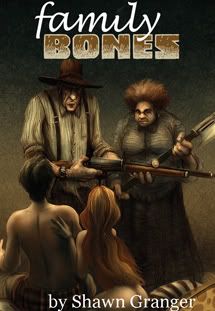 "WE'RE ALWAYS GLAD TO HAVE KIN STAYIN' IN OUR HOME." "Based on a true story," Shawn Granger's Family Bones (King Tractor Press) recounts one teenage boy's horrendous summer in the American heartland. Dumped with his grandparents by his bickering parents, young would-be punk Sean is quickly shunted off to an aunt and uncle's farm after his grandfather gets hospitalized in a hunting accident. "Staying with your Aunt Faye and Uncle Ray will be like a vacation," our hero's kindly grandma tells him, but this couldn't be further from the truth. "WE'RE ALWAYS GLAD TO HAVE KIN STAYIN' IN OUR HOME." "Based on a true story," Shawn Granger's Family Bones (King Tractor Press) recounts one teenage boy's horrendous summer in the American heartland. Dumped with his grandparents by his bickering parents, young would-be punk Sean is quickly shunted off to an aunt and uncle's farm after his grandfather gets hospitalized in a hunting accident. "Staying with your Aunt Faye and Uncle Ray will be like a vacation," our hero's kindly grandma tells him, but this couldn't be further from the truth.His first day there, Sean's ordered by his mean-ass Uncle Ray to begin clearing rocks out of the fields. When the young boy reflexively mouths back, he suddenly finds himself on the ground, eating dirt. "I don't care if yer a Jew," his uncle declares, "yer gonna pick up these rocks." Sean's Uncle Ray proves to be a tyrannical wife-beater who also is involved in something shady. Though we're not quite sure what this entails by the end of the first volume of this two-part black-and-white graphic novel series (all Sean knows for certain is it involves "funny business with some cows"), it's clear that Ray is not to be trifled with. After farmhand Robert makes some vague ultimatums demanding the money he's owed, the man disappears. Though battered Aunt Faye says the hand has "moved on," we've already been cued to disbelieve this. True crime aficionados are already ahead of the rest of us once they've read the last name on the mailbox in chapter two. Sean's relatives are Ray and Faye Copeland, the oldest American serial killers ever to be sentenced to death row. Our young punk protagonist's summer away from home will definitely be more than a simple character-building experience. All is not entirely Dickensian mistreatment down on the farm, however. Left on his own to plow the fields, our strapping young hero connects up with a rural beauty named Wendy. The awkwardly adolescent romantic interludes with Wendy are perhaps meant to show the flipside of the prairie heartland, but they also prove fraught with their own perils: Sean accidentally hits the girl with a brick that's unearthed by his tractor; a fishing trip concludes with a hook getting caught in the crotch of Sean's jeans; a trip into town turns into the inevitable confrontation with townies. If Sean's brutish relative doesn't do him in, his city boy ways could. Originally serialized in comic book form, the material in Volume One essentially covers five issues worth of prolonged build-up. The digest sized paperback includes the covers to each ish, though at least one of these - issue four's image of a nekkid Sean and Wendy being frighteningly confronted by his weapon wielding relatives - doesn't reflect anything that happens in the first volume at least. (Perhaps in the concluding Volume Two?) As with Granger's other recently published GN collection, Innocent, the art chores are parceled out to different artists on a chapter by chapter basis (though Pablo Augusti Lordi is given both chapters four and five), with one of the players from Innocent, Manny Abeleda, showing up to illustrate chapter three. Seeing the number of diverse hands on the art front, I initially wondered if it would prove disruptive for this more sustained storyline, but that didn't prove to be the case. All four of the book's main artists do an efficient job capturing Bones' hardscrabble rural world, even if Sean's girl Wendy looks too pristine to be true. At times, Granger's preparations for the concluding second volume seem a little too protracted - Sean and Wendy's fishing expedition takes up sixteen pages of story - though I suspect the story is better served by its paperback packaging than it was as a monthly comic. This is the kind of work where you quickly know that something's terribly wrong, though the full nature of that wrongness is more deliberately doled out in bits and pieces. If Volume Two is where it all hits the fan, Granger and his collaborators have done enough to get this reader happily anticipating the moment Sean learns the awful truth about Aunt Faye and Uncle Ray. # | |
|
|