| Pop Culture Gadabout | ||
|
Saturday, May 09, 2009 ( 5/09/2009 11:07:00 AM ) Bill S. SKIRTING THE ISSUE: Spent part of the blistery triple digit afternoon replacing some vinyl skirting on the ol' double-wide yesterday. A couple months back, my cowboy neighbor Clay volunteered to do a little controlled burning on the weeds in our front yard, and it briefly got away from him. I'd come home at lunch to see him getting ready to begin, mini-flamethrower in hand, and I asked if he needed any help at the time, but he indicated that he had everything in hand, thanks. Me, the only way I know to deal with weeds is with Round-Up, so I went inside and left him to it. Midway into lunch, I stepped back outside to see him frantically dipping his hat into the tiny manmade rock pond beside the house to put out the grassy conflagration. End result: six burnt and curled vinyl panels, one very embarrassed neighbor. Took me a while to get the replacement panels: you can order 'em online, but every place I looked had a prohibitive shipping cost. (In one case, I remember, the shipping was four times the cost of the skirting.) For a month-and-a-half, we used a big piece o' plywood to cover the unsightly burns: real classy look. Finally went into town to a local manufactured homes seller and bought two twelve-foot sheets plus a top rail to hold 'em in place. No shipping cost, happily. Expected the replacement to take longer than it did. The most time-devouring activity revolved around scraping dead grass and weeds out of the nooks where the panels interconnected: the stuff grows up into it and is a pain in the ass to get out. But Clay and I got it all replaced, and the front once more looks ever-so-humble. Next time, it's Round-Up weed and grass killer for me. It's not as if I have a lawn, after all.  # | Friday, May 08, 2009 ( 5/08/2009 10:18:00 AM ) Bill S. 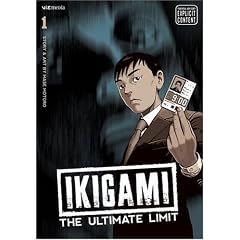 "IS THIS REALLY HONORABLE WORK?" The central idea behind Motoro Mase's Ikigami: The Ultimate Limit (Viz Media) is one that's fueled a million late-night bull sessions: suppose you learned you only had twenty-four hours to live -- how would you spend your final day? In Mase's "mature"-rated manga, this question is randomly forced on the citizens of an authoritarian society. Pursuant to the National Welfare Act, every citizen in this alternate world dystopia is immunized while they are in elementary school. The catch: .01 per cent of these immunizations contain something extra, a "special nano-capsule" set to rupture in the recipient's heart on a predetermined date, causing instantaneous death. Through a complex system, the government monitors these capsules so their doomed carriers can learn of their fate twenty-four hours before they die and be given time to get their affairs in order. "IS THIS REALLY HONORABLE WORK?" The central idea behind Motoro Mase's Ikigami: The Ultimate Limit (Viz Media) is one that's fueled a million late-night bull sessions: suppose you learned you only had twenty-four hours to live -- how would you spend your final day? In Mase's "mature"-rated manga, this question is randomly forced on the citizens of an authoritarian society. Pursuant to the National Welfare Act, every citizen in this alternate world dystopia is immunized while they are in elementary school. The catch: .01 per cent of these immunizations contain something extra, a "special nano-capsule" set to rupture in the recipient's heart on a predetermined date, causing instantaneous death. Through a complex system, the government monitors these capsules so their doomed carriers can learn of their fate twenty-four hours before they die and be given time to get their affairs in order.Our entrance into this disturbing world is a young functionary named Fujimoto, who we first meet undergoing orientation training in the Ministry of Welfare and Health as a deliverer of the official death notices called Ikigami (Death Paper). New to the job, Fujimoto struggles with the morality of his job, which basically involves delivering horrible news to innocent people. The government rationalizes its seemingly random series of death sentences by noting that the uncertainty hovering over every citizen's life "makes them value life more and increases social productivity," though Fujimoto has his doubts. He doesn't voice these reservations too openly, however, since, as he's repeatedly reminded, "Social miscreants will be injected with the capsule." Grim stuff, though readers looking for a new version of the ultra-violent, pulpy Battle Royale or Death Note may be disappointed. Having established his oppressive system, Mase instead hands much of the first volume to two recipients of an Ikigami, detailing how each responds to the news that their hours are numbered. First is a high school dropout still nursing poisonous grudges over the brutal mistreatment he received at the hands of his classmates; the second is a former street musician who's sold out his considerable songwriting ability to be the lesser half or a vacuous pop duo. Though the first episode contains harsh violence (including a mildly explicit sexual assault), Mase strives to make each story end on a cautiously upbeat note, even if we're not sure we entirely believe it. While we're told that the National Welfare Act inspires citizens to appreciate life more, in both cases that doesn't appear to have applied; both Ikigami recipients appear to gotten stuck in a rut when they receive their death notices. The first, Yosuke, is stuck in a dead-end job and living with his parents; the second, Torio, has abandoned his muse for a shot at short-term fame. (We know his egotistical singing partner will abandon him as soon as the duo gets hot.) Yosuke responds to his Ikigami by revisiting two of his former classmates, Torio by attempting to go through his final day as if nothing has changed. "Isn't that what it means to be a pro?" he asks himself. "Isn't that what it means to be an artist?" Mase depicts these two stories in a fairly straight-laced style: no visual shorthand or sudden bursts of cartoonishness, but fairly realistic renderings of place and character that wouldn't look out of place in a classic serialized American comic strip ("Mary Perkins On Stage," for instance). A few flashback sequences can be initially confusing: the artist doesn't always border them as is the convention, and, in a few instances, I found myself having to backtrack just to get what I was reading. But the art generally suits Mase's blend of the dark and the occasionally sentimental. As a serialized story, Ikigami has had an extended run in its native land -- along with the inevitable movie adaptation -- so one hopes that Fujimoto, who's essentially treated as a vessel for establishing the house rules in this volume, has a more active role as the storyline progresses. The first volume plants the seeds of Fujimoto's ultimate disillusionment with the system that employs him, though I'm betting that it'll take another four or five volumes before he decides to do anything about it. In the meantime, there's still that intriguing question at the series' center to ponder. Labels: sixty-minute manga # |Wednesday, May 06, 2009 ( 5/06/2009 07:51:00 AM ) Bill S. MID-WEEK MUSIC VIDEO: It's the Raveonettes' "Aly, Walk With Me, a great proto-psychedelic/surf song, with an equally cool video done by an artist's collective known as ohhmarymary. Love the JAMC guitar noise in the middle. # | Tuesday, May 05, 2009 ( 5/05/2009 06:08:00 PM ) Bill S.  "NOW FOR THE FIRST TIME IN COMICS -- THE WIDE ANGLE SCREAM!" Safe to say that comic books would've been a whole lot different were it not for Joe Simon and Jack Kirby. If they weren't, as Mark Evanier notes in one of the interconnecting essays contained in The Best of Simon And Kirby (Titan Books), the first writers and artists to take advantage of the visual possibilities of a comic book page, they were arguably the first true giants. Bringing an unmatchable boyish energy to the medium, Simon & Kirby produced comics that popped right off the page. "NOW FOR THE FIRST TIME IN COMICS -- THE WIDE ANGLE SCREAM!" Safe to say that comic books would've been a whole lot different were it not for Joe Simon and Jack Kirby. If they weren't, as Mark Evanier notes in one of the interconnecting essays contained in The Best of Simon And Kirby (Titan Books), the first writers and artists to take advantage of the visual possibilities of a comic book page, they were arguably the first true giants. Bringing an unmatchable boyish energy to the medium, Simon & Kirby produced comics that popped right off the page.Spanning the duo's career as two of the hardest working talents in the comics biz, the 240-page Best opens with their groundbreaking superhero work from the early forties, then takes us through examples of the twosome's various genre comics (s-f, war, romance, crime, western, horror and sick humor) from the forties and fifties. With perhaps the exception of the Mad-styled humor entries -- closer to Al Feldstein's Panic imitations than to the divine insanity that was Harvey Kurtzman's creation -- each section shows two artists at the top of their game, finding new ways to expand the medium. Much of the earliest work presented in this handsomely produced coffee table book collection is the hero stuff: Captain America, Sandman, and the Vision. With the oldest pieces you can see the two struggling to see how far they can push the parameters of comic book tier storytelling -- the Vision entry, for instance, contains a page where one of the panels seems to slip out of the sequence altogether -- though the learning curve is pretty steep. In the Sandman adventure, created a year after the Vision story, we're provided a full-page brawl between NYC cops and Viking gangsters that practically kicks you in the face. In the Stuntman episode from 1946, the two are producing the kind of panoramic shots that Kirby would make his trademark in the sixties Marvel comics. Compare the panel displaying the story's circus performance with a similar image in an early Hulk comic introducing the Ringmaster and His Circus of Crime. If anything, the Stuntman panel is even more dynamic. Per Evanier's essays, it's difficult to tell where the two writer/artists begin and end, though plenty of the visual compositions that they developed were carried on by Kirby when the two ended their partnership. To readers who grew up on the jaunty blend of wisecrackery and post-adolescent angst that characterized Kirby's work with writer Stan Lee in the Marvel Age of Comics, the superhero scripts, in particular, can read as stiff as too much of the comics work from the Golden Age. The art has more personality than most of the heroes, though for Kirby fans that's probably sufficient. It's in their other genre work where the real surprises come. Simon & Kirby basically invented the romance comic in the late forties, and they did it with heroines who were a far cry from the weepy ingénues who'd later dominate the form. These were sturdy women in the mode of the best movie tough gals, and their stories reflected this. Reading 1950's "The Savage in Me," for instance, you can imagine Barbara Stanwyck playing the missionary's daughter in love/lust with a scoundrel; the moment when she lets her hair down is sexy in a way that a later generation of romance comics would never dare to be. The war comics prove equally revelatory, most specifically in an atom bomb cautionary from 1947 that ends with New York City under a mushroom cloud. It's as strong as anything EC would've produced in one of its apocalyptic fantasies. In terms of uncompromising storytelling, the duo's "true crime" comics are as commendably ruthless as any Warner Bros. gangster epic. Their take on "Scarface," for instance, contains the killing of an underling that's as startling as Al Capone's murder of a fellow gangster in Brian DePalma's Untouchables. The collaborators' horror comics also prove atypical for the era in which they were produced. Where other horror comics creators worked to duplicate the grisly pulpishness of The Crypt of Terror, Simon & Kirby focused on more psychological frights, producing a book focused on recreating and analyzing its protagonists' nightmares. EC returned the flattery by later devoting a comic to Psychoanalysis, though The Strange World of Your Dreams got there first. If the more subdued approach wasn't as unsettling as the all-out horror comics of the fifties, the samples in Best have some great visual moments: the dream depiction of an "old and dismal town," for instance, visually anticipates the monster comics Kirby would later be producing with Lee -- as well as his even more personalized "Fourth World" series for DC comics. Titan Books' collection features work done for big name companies like Timely (later: Marvel), DC, Archie and Harvey, as well as long-forgotten entities like Hillman and Prize. While the DC and Marvel work is somewhat familiar to comics aficionados (Captain America has had several archive collections published over the years), the lesser-known material definitely deserves to be rediscovered. My interest has been particularly piqued by the Stuntman, a former circus high-wire acrobat named Fred Drake who turns out to be a double for the fatuous actor and self-proclaimed amateur detective Don Daring. Together, the two solve crimes in a Hollywood setting, and you can see this show biz milieu sparking the excitement of its movie mad creators. Though the full story isn't reprinted in the collection, the book's hardcover features an opulent two-page spread from that series, showing our hero in costume on the set of a Robin Hood movie. According to the introduction by the still-vital Joe Simon, the complete tale will be reprinted in a second upcoming collection from Titan, The Simon And Kirby Superheroes. Reason enough to reserve a copy of that rascal. Labels: golden age goodness # |Monday, May 04, 2009 ( 5/04/2009 10:06:00 AM ) Bill S. BOOK STUFF: Been spending a good part of the weekend working on some advanced promo material on Measure By Measure, the romantic size acceptance epic written by wife Becky Fox and yours truly. Planned publication date is mid-June, though this, of course, could change since our small-press publisher Pearlsong Press has been experiencing computer problems. For me, the first time I actually started feeling like this publication bizness was real occurred when publisher Peggy Elam emailed us some possible covers -- and the sample covers contained a UPC code on the back. Anyhoo, if you're interested, the first draft promo flyer can be found here. Labels: measure by measure # | |
|
|