| Pop Culture Gadabout | ||
|
Saturday, September 10, 2011 ( 9/10/2011 09:09:00 AM ) Bill S. 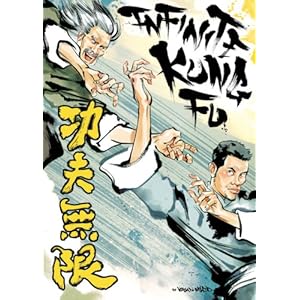 “BIG THINGS ARE HAPPENING, MAN.” A bit fat round-up of martial arts madness and seventies drive-in delirium, Kagan McLeod’s Infinite Kung Fu (Top Shelf Productions) is a massive 464-page graphic novel crammed full of chopsocky goodness. Set in an alternate Martial World, the sprawling epic centers on Yang Lei Kung, a low-level soldier in the wicked emperor’s army who is recruited by one of the Eight Immortals to become a “spiritual fighter.” “BIG THINGS ARE HAPPENING, MAN.” A bit fat round-up of martial arts madness and seventies drive-in delirium, Kagan McLeod’s Infinite Kung Fu (Top Shelf Productions) is a massive 464-page graphic novel crammed full of chopsocky goodness. Set in an alternate Martial World, the sprawling epic centers on Yang Lei Kung, a low-level soldier in the wicked emperor’s army who is recruited by one of the Eight Immortals to become a “spiritual fighter.” In the Martial World, we’re told, there are two main paths to mastery: the first, Poison Kung Fu, is efficient but corrupts its practitioners; the second, more enlightened path requires the student to take a long journey of self-discovery. In the book’s opener, we see two students -- one of whom will become a major villain in the piece -- fight zombies using the forbidden poison techniques; as a consequence, they’re left to fend for themselves as the army of undead grows more plentiful. As the first chapter ends with generation after generation of fighting corpses surrounding the twosome, the reader’s left thinking, “Maybe that ‘infinite’ in the book’s title isn’t an exaggeration, after all.” As for our hero Lei Kung, he’s forced to un-learn his brutish soldier ways and advance in the emperor’s army at the same time. The ultimate goal of this is to stop the emperor from destroying the universe in his pursuit of ultimate power. Along the way, writer/artist McLeod introduces us a colorful crew of secondary characters. Foremost among these are Moog Joogular, a former funk guitarist who looks like he could’ve played for Parliament and who tells Lei Kung the first time they meet that he’s seen the student’s king moves in the future, and Windy, a tough girl general who strives to fight for right within the emperor’s army. Primary antagonist is Li Zhea, a second general who not incidentally was one of the two students we saw getting corrupted by Poison Kung Fu in the opener. With his porn star ‘stash and penchant for laughing long and villainously, you can readily imagine him commandeering an outdoor movie screen as his poorly dubbed laughter crackles through the speakers. None too surprisingly, Infinite Kung Fu contains a ton of fights between human opponents, supernatural ones, and a squadron of robotic bronze statues. McLeod plays this genre mix-and-match relatively straight. Unlike more obvious seventies inspired send-ups (Greg Houston’s Vatican Hustle, for instance), McLeod lets the material stand for itself without falling back on excessive cartoonishness. Which is not to say his art is deadly serious: at times, there’s a sense of EC Era Jack Davis in his expressions and brushwork, which helps keep the artist’s tribute grounded in its comic book frame. In crafting the Infinite Kung Fu “movie” of his dreams, Kagan McLeod has created one entertaining slam-bang comic. (First published on Blogcritics.) Labels: modern comics # |Monday, September 05, 2011 ( 9/05/2011 10:04:00 AM ) Bill S.  “A GIRL DIDN’T WANT TO OVERSTAY HER WELCOME.” Like a good many professional storytellers, Lawrence Block has written under more than one name over the years: perhaps the most startling nom du plume is that of “Jill Emerson.” The authoress of seven prior novels that include “sensitive lesbian fiction” and “candid erotica,” the pseudonymous Miz E. has now crafted a Hard Case Crime novel entitled Getting Off. Subtitled “a novel of sex and violence,” the pulpy thriller tracks a shapely serial killer who goes by many names, traveling across the country to pick up unsuspecting men that she can bed, kill and bed again. A creepy character, to be sure, but Block/Emerson make her an enticing one. “A GIRL DIDN’T WANT TO OVERSTAY HER WELCOME.” Like a good many professional storytellers, Lawrence Block has written under more than one name over the years: perhaps the most startling nom du plume is that of “Jill Emerson.” The authoress of seven prior novels that include “sensitive lesbian fiction” and “candid erotica,” the pseudonymous Miz E. has now crafted a Hard Case Crime novel entitled Getting Off. Subtitled “a novel of sex and violence,” the pulpy thriller tracks a shapely serial killer who goes by many names, traveling across the country to pick up unsuspecting men that she can bed, kill and bed again. A creepy character, to be sure, but Block/Emerson make her an enticing one.Our anti-heroine has gone for years, living off horny dupes, and she’s only had five male survivors throughout her murderous career. When a chance remark gets her thinking about the Ones Who Got Away, she decides to track each one down to achieve complete closure. The bulk of Getting Off, then, follows our gal on her man-by-man quest, turning this book into a twisted variation on Cornell Woolrich’s The Bride Wore Black. You can see Block having fun with his diverse crew of victims: one of ‘em, for example, turns out to be a recovering sex addict in a 12-step program, which allows the writer to fiddle around with the tenets that bolster his more famous recovering alcoholic hero, Matt Scudder. In another, the murderess cleverly makes use of her victim’s religious beliefs to slay one of her targets by proxy. Befitting its non-too-subtle title, Off is open in its sexual content -- unsurprising for a writer known for earlier works of “candid erotica” -- and in considering its protagonist’s twisted sexuality. As she embarks on her quest, she connects with a slightly older, somewhat shapelier dame named Rita. The two attach to each other by talking progressively more sexually (lots of use of the “c-word”), and as the relationship builds, both our anti-heroine and the reader begin to wonder. If these two consummate their relationship, will Rita have to become the next victim? To test this out, our inquisitive killer starts to frequent lesbian bars, looking for a suitable hook-up. Block/Emerson deliver this material in a suitably lean style not much different from Block’s usual Scudder work. In this, we can see “Emerson” as an heir to pulpish women pioneers as Leigh Brackett, who had her hands in the first movie adaptation of The Big Sleep and was herself adept at tough-as-nails narration. While you can understand the commercial reasons for doing so, in a way blowing Block's cover takes away some of the fun in this book: seeing his bearded visage on the back dust cover, you can't help wondering how it might've read if we still believed this wonderfully seedy exercise was written by a real "Jill." Though portions of this episodic book originally appeared as short stories in a quartet of noir collections, the full novel is making its debut as part of the Hard Case Crime series. A line of new and reprint pulp crime novels that originally appeared in paperback form, Hard Case now appears to be affixed to British publisher Titan Books’ hard cover catalog. Got to admit that seeing Gregory Manchess’ suitably seedy cover (nekkid girl holding a knife suggestively down her backside while another femme -- Rita, perhaps -- undresses the duo’s impending victim) attached to a hardback dust cover was a little bit odd, but it’s great to see this sturdy line of crime fiction enduring in print form. More Hard Cases, please. (First published on Blogcritics.) Labels: pulp fiction # | |
|
|