| Pop Culture Gadabout | ||
|
Tuesday, May 07, 2013 ( 5/07/2013 10:10:00 PM ) Bill S.   SAVIOR OF THE UNIVERSE: I sometimes joke that Flash Gordon was in part responsible for my becoming a godless heathen. Back in the sixties when I was a nerdly teen, WGN Chicago ran showings of the Universal Flash Gordon serials from the 1930’s on Sunday mornings. In those benighted days before video or digital recording, if you wanted to watch something on television, you had to watch it right then. Flash Gordon was broadcast at the same time that my family typically attended mass – given a choice between having to sit dutifully through a Sunday service or staying at home watching Flash Gordon Conquers the Universe, which would you think appealed to a somewhat ADD teen? The Larry “Buster” Crabbe serials were adaptations of a classic newspaper Sunday strip, of course. Written by Don Moore and illustrated by Alex Raymond, “Flash Gordon” wasn’t the first sci-fi swashbuckler to appear in newspapers – that honor belongs to “Buck Rogers,” which debuted in 1929 – but it was inarguably the greatest. Credit artist Raymond, who attacked his subject with a detailed fervor unrivaled in its day. Additionally, he was one of the sexiest strippers of his time: whenever an exotic alien princess (and there were a lot of them) set her lusty eyes on blond hunk Flash, you believed it.
British publishing company Titan Books has recently initiated a reprint series of this classic strip; first volume, Flash Gordon: On the Planet Mongo Moore and Raymond’s strip opened in a rush: first panel we see is a newspaper headline trumpeting “World Coming to End” as a strange new planet appears to be on the verge of colliding with planet Earth. When Yale grad and “world renowned polo player” Flash and comely brunette Dale Arden survive a plane crash near the lab of mad scientist Hans Zarkov, the accidental couple are forced to board a rocket designed to deflect the planet from its collision course. (How this actually is supposed to work is never made clear.) The trio land on the planet Mongo, which proves to be as populated with as large a population of feudal humanoids and hybrid creatures as Edgar Rice Burroughs’ Mars. Evil overlord of Mongo, of course, is emperor Ming the Merciless, a “yellow peril” inspired Fu Manchu type who would be a more racist creation if he weren’t established as an alien. Ming instantly lusts for our heroine Dale (“The beauty of the female pleases me. . .”), but muscular Flash quickly seizes the attention of Ming’s daughter Princess Aura, who impulsively follows him down a trap door into a pit packed with “hideous water dragons.” As a Sunday strip, “Flash Gordon” episodically zipped along, typically ending each Sunday with a cliffhanger in the final panel. The structure made it ideal movie serial fodder, though at times reading several months of continuity in a single sitting, you can’t help wishing that writer Moore slowed down enough to tie up all his loose ends. If its storyline ever appears to be finding new ways to unravel, Raymond’s art is a model of control. It truly becomes splendid in the summer of ’34 once he breaks away from the initial four row structure and starts moving in closer to his characters. The larger panels gave the artist room to show off the planet’s varied kingdoms – whether it’s the airborne city of the Hawkmen or an undersea coral kingdom of merfolk – with a grandeur that neither the Depression Era serials nor the Camp Era 1980 feature film could fully capture. Titan Books’ reprint shows off this justly lauded art to good advantage, the one editorial glitch being a duplication of strips on August 18 and 25, 1935, that fortunately doesn’t screw up continuity. It’s a small flaw in a beautifully mounted volume that – had it been available when I was a teen – might’ve kept me from whining about my churchly obligations.
(First published on Blogcritics.) Labels: classic comic strips # |Sunday, July 22, 2012 ( 7/22/2012 02:20:00 AM ) Bill S.   “JOLLY GOOD OF YOU NOT TO LAUGH AT MY AMATEUR MARKSMANSHIP, SENHOR GOMEZ.” The third volume in Titan Books’ omnibus reprints of the James Bond comic strip, The James Bond Omnibus Volume 003 presents the British-made newspaper series at the point where all the original Ian Fleming stories had been adapted -- and scripter Jim Lawrence was forced to start producing original material for the comics. Though Fleming’s name remained on the strip (rather like Walt Disney did with the Mickey Mouse and Donald Duck strips), the only adapted tale in this set proves to be Kingsley Amis’ pale pastiche Colonel Sun, which amusingly is still credited as being “by Ian Fleming.”
The shift to original spy tales in 1968 appears to have gone fairly smoothly: scripter Lawrence, having cut his teeth on six of the Fleming stories, had his core cast and the series formula down. Each of the seven episodes included in this book features our hero hooking up with a suitably comely Bond Girl -- most memorably a former MI-6 agent who’s been framed as a traitor and an Algerian anti-imperialist beauty who gives 007 mouth-to-mouth after he fakes a near drowning -- along with the requisite over-the-top baddies. If some of Lawrence’s plots aren’t as grandiose as the ones in Fleming’s novels, they prove more involving than the low-thrill perils of the written “Spy Who Loved Me.” Though she isn’t a major presence in these strips, the lady leader of a revived S.P.E.C.T.R.E. puts in an appearance, though not as the primary antagonist. She shows in the volume’s most engagingly outlandish offering, however: “The Golden Ghost,” which centers on the hijacking of a nuclear-powered dirigible, which we’re told “will open a new era in aviation.” Pretty steam-punk for 1970. Lawrence collaborator, artist Yaroslav Horak continues to capture the dapper agent and his exotic world, though at times the slightly smaller size of the omnibus package (7-1/2 by 9-1/4 inches as opposed to the 9-1/2 by 11-1/ 2 trade size of your average Modesty Blaise collection) seems to lead to some line loss. The artist is particularly strong in his use of blacks and shadows, which adds to the strip’s overall tone of pulp seriousness. This is not your pop-colored James Bond (as we sometimes got in the movies) but a deadly serious secret agent man. If a few of Bond’s single-entendre quips fall flatter than they would in the flicks, that’s arguably truer to Fleming’s original creation. Lawrence and Horak would continue to produce original Bond strips for the next six years: not as impressive a run as Peter O’Donnell’s “Modesty Blaise,” but still a testament to the character’s enduring appeal. Hard-core Fleming fans will most likely favor the first two omnibus sets, but I’m thinking many of ‘em will also count this snappy set as an enjoyable bit of Bondiana. (First published on Blogcritics.) Labels: classic comic strips # |Sunday, June 24, 2012 ( 6/24/2012 03:59:00 PM ) Bill S.   “WHAT’S A LITTLE KNOCKOUT BETWEEN FRIENDS?” The latest entry in Titan Books’ snazzy ongoing chronology of “Modesty Blaise” strips, Modesty Blaise: Live Bait places our full-lipped adventuress in the late eighties, fighting an old enemy from her days as head of the criminal Network, taking on Soviets as well as a scummy snuff filmmaker held up in South America. Writer Peter O’Donnell and artist Eric Badia Romero (who started his second run with the character in the previous volume Million Dollar Game) retain a firm hand on our ageless heroine -- while the adventures prove as snappy as ever. The strip introduces a new recurring character in the first entry, “Samantha and the Cherub,” a scrappy lower class girl named Sam who Willie has been training as a part of a youth martial arts class. Not too surprisingly, Modesty sees a bit of herself in this young sparkplug, though O’Donnell thankfully doesn’t push this piece of subtext too hard. A consummate storyteller, Blaise’s creator knew to keep his focus on the action, of which there is plenty in these three strips. Which doesn’t mean there aren’t some thoughtful aspects to these high-flying tales: in the snuff film tale “Milord,” for instance, Modesty and her faithful companion Willie Garvin have an ethical disagreement when the story’s bad guy placed in the hands of the women he has been abusing. There’s not too much debate about it -- in fact, the situation is “resolved” rather quickly -- but that O’Donnell would even bring the issue up in what’s meant to be an “escapist” comic strip is worth noting. Badia’s art is, as ever, up to the demands of O’Donnell’s storytelling. To these eyes, he drew the most visually convincing Modesty: exotically sexy yet thoroughly no-nonsense, you believe she could have once led a band of cut-throats just as much as you believe in her reformation. By my estimation, we’ve got eleven more volumes in this series before we arrive at the strip’s final entry in 2001. I’m looking forward to them all. (First published on Blogcritics.) Labels: classic comic strips # |Sunday, June 10, 2012 ( 6/10/2012 01:05:00 PM ) Bill S.   “I WONDER WHERE ARCHIE WILL STRIKE NEXT?” Appearing as a part of “The Library of American Comics,” Archie's Sunday Finest (IDW) is a handsomely packaged selection of Sunday color pages from the strip’s first years. After initially debuting in comic books five years earlier, the enduring teen comic has had a strong run as a newspaper strip as well, starting in 1946. All the primary elements of the Riverdale Saga were in place by the time cartoonist Bob Montana started drawing gags for the McClure Newspaper Syndicate, though a few of the characters would be visually tweaked over the years. The main character to undergo a bit of smoothing out is our title hero, Archie Andrews, who as presented in the earlier Sundays as buck-toothed and slightly more goofy looking. (“Why don’t you dress like an Easter rabbit?” Jughead notes early on. “You’ve got the teeth for it!”) Even as a kid reading the comics books in the late fifties, I remember wondering how a guy like Archie managed to snag the attentions of two high school babes like Betty and Veronica -- looking at him in the 1946 funnies, it’s an even bigger puzzle. The central components of the series -- the triangle between Archie, blond Betty Cooper and brunette Veronica Lodge; our hero’s friendship with the asexual Jughead Jones; his rivalry with slick-haired Reggie Mantle -- are already established in the strip, though Reggie seems to receive less attention than he does in the comics books. Whether this is matter of selection by editor Dean Mullaney or a reflection of the snarky Reggie’s lesser status in the early years is unclear.It’s just as likely that Reggie’s minor role in the early years is due to the fact that he isn’t all that necessary. Archie doesn’t really need an antagonist: he’s his own worst enemy. Many of the Sundays lead to our hero either getting black-eyed or facing a pissed-off Riverdale-ian (in one, we even see an angry Jughead preparing to dunk Archie in a barrel of wet cement). Despite his propensity for bringing calamity on his friends and adult authority figures like rotund high school principal Mr. Weatherbee, Archie is essentially a good-hearted sort, which may be a key to his appeal with both Betty and Veronica. It doesn’t explain why both he and the equally clumsy Jughead keep getting invited to swanky soirees at the Lodge estate, though, as the results prove as deadly as the Three Stooges’ adventures among the “hoi polloi.” One Sunday sequence even revolves on a gag that I’m pretty sure the Stooges did first: Jughead wreaking havoc at a Lodge party when he wears a tuxedo that originally belonged to a magician. But if the gags aren’t always as fresh as they once might’ve been, Montana’s art remains a treat. If Archie initially seems a bit rabbity and Jughead a bit too reminiscent of Bowery Boy Huntz Hall, the look of forties era Riverdale is evergreen. Its two female leads remain pristine all-American pin-up gals, even if Betty’s hair does seem a mite ginger-y in the first couple Sundays. Montana’s skill with expressions saves more than one lesser gag, while the vibrantly reproduced color in IDW’s reprint definitely gets you longing for the days when newspaper comics were presented on the page with respect. For many readers, the world of Archie and the gang is one of homespun small-town values, and while it’s true that the comics were initially inspired by the Andy Hardy movies, occasional elements of comic subversiveness sneak into the Sundays. In addition to the class-based Lodge party kerfuffles, there are two strips devoted to Archie’s dad and his fears of losing all his money -- a very real worry for a post-war audience that still recalled the Great Depression – along with several moments where different male cast members run afoul of the law. So it went in the world of America’s Typical Teenager. (First published on Blogcritics.) Labels: classic comic strips # |Saturday, December 03, 2011 ( 12/03/2011 05:22:00 PM ) Bill S.  “MY HOME IS THE REGIMENT.” The eighth volume in Titan Books’ continued reprint of the hard-nosed British war comic, Charley's War: Hitler's Youth  opens with an intriguing plotline. Chronicling the Great War adventures of young Charlie Bourne, serving as an assistant sniper on the Western Front at this point in the storyline, the series imagines a young Adolph Hitler as a corporal in the regiment on the other side of No Man’s Land. Moving between Charley’s unit and the Germans, delving into the psychology of the future Nazi who self-reportedly survived several major attacks during WWI, the strip works to avoid the cartoonish portrayal of Hitler that has characterized so many boys’ war comics – and to a large extent succeeds. As reported in an intro by Steve White, the facts behind Hitler’s actual participation in the Great War have since become clouded by propagandistic efforts to either elevate or debunk his involvement along with the Gestapo’s destruction of many paper records from the first war. Still, research-minded scripter Pat Mills’ treatment of this monster-in-training rings believably. Though Titan Books’ description of the set gives the impression that our hero Charley will have a confrontation with the man, this never really happens: instead, we’re treated to sequences depicting Hitler as a fierce young soldier. When the rest of his fellow soldiers take advantage of a Christmas armistice celebration, for instance, the corporal remains behind, hunting rats in the trenches, stubbornly refusing to fraternize with the enemy. Even with the temporary truce, Mills does not let the reader forget the grim realities of war; despite its appearance in a weekly boys’ war comic, “Charley’s War” decidedly did not indulge in gung-ho fantasizing. Thus, as both sides return to their trenches, the strips narration notes each soldier who won’t make it out of the war alive. “1918 would be the last and most terrible year of the war,” we’re told before the strip leaves Hitler and young Charley to follow the latter’s brother Wilf as he serves as P.B.O. (Poor Blinking Observer) for a half-mad bi-plane pilot named Morgan. Artist Joe ("Johnny Red") Colquhoun clearly relishes the opportunity to get out of the mud: his flying battle sequences and lavished with loving boyish detail and explosive impact. In writer Mills’ hands, the world of the P.B.O.s and their glory hungry pilots has its roots in the British class system, with observers being treated as expendable proles in the air. Captain Morgan, we’re told, has already lost three observers, and we get to see a fourth fall to screaming death in the course of battle. Just another poor blinking observer. . . “Charley’s War” first appeared in three-page installments as a part of the black-and white British comic magazine Battle from 1979 – 85, a remarkable run for so unglamorous a war comic. This current volume ends with two sequences returning to our title hero in the trenches. Hitler’s regiment, we’re told, has left, but there are still plenty of Jerries to fend off. To add to Charley’s woes, he’s also accidentally roused the enmity of a former comrade recently raised to officer’s rank. “He’s jealous of my success,” this new antagonist thinks, “the way I worked my way up from the ranks!” At times, it seems like the Bourne Boys’ war is less against the Germans and more against undeserved rank and privilege. (First published on Blogcritics.) Labels: classic comic strips # |Thursday, October 06, 2011 ( 10/06/2011 08:21:00 AM ) Bill S.  “I WAS THINKING IN A SOFT-PEDAL MODE.” With the latest entry in Titan Books' ongoing series of “Modesty Blaise” reprints, Million Dollar Game, Spanish artist Enric Badia Romero returned to the strip after Britisher Neville Colvin's six-year stint. The largest running artist to assay Peter O'Donnell's adventuress, Romero was also the most unabashedly sexy. His Modesty was more voluptuous and exotic, with eyes that in particular hinted at realms of experience to which we were never privy, and he wasn't the least bit reluctant when it came to drawing either his heroine or any other comely damsel topless. Which still remains startling to American readers unaccustomed to this sight in a newspaper comic strip format. The three offerings in Game come from 1986-7, and though the strip was over twenty years old by this time, Blaise creator O'Donnell's enthusiasm still showed no signs of flagging. These are solid little action yarns, ranging in setting from Tangier to the American West to Transylvania. In the America story, our heroine and her loyal knife-throwing companion Willie Garvin run up against a modern gang impersonating the Butch Cassidy band; in “The Vampire of Malvescu,” O'Donnell combines Transylvanian lore with a would-be terrorist plot. (If you find yourself mentally hearing Lionel Atwell's voice in bad guy Sebastian Clegg's dialog in the latter story, you're not alone.) The title yarn teams an old flame up with our gal to take on a ruthless gang of poachers. Most intriguing from a character stand-point is the vampire tale, which introduces us to a former member of Modesty's old crime network, a techno wizard named Hans Braun who is married to Hilde, a sweet young thing so innocent that it temporarily rubs off on our hard-nosed heroine. “Somehow Hilde and guns don't mix,” she says, placing herself at a momentary disadvantage when she comes up against her kill crazy antagonists in Europe's Fist. Fortunately, Modesty snaps out of it. “A really lovely girl with a really lovely nature, like Hilde, just isn't the right company for bad types like us,” she finally tells Willie. And though we may disagree with this reformed crime chief's self-characterization as a “bad type,” we can see her point. If there's any flaw in this zippy set of three, it's in the antagonists' reliance in two separate stories on impersonating classic villains. You'd think that these guys'd want to be a little more surreptitious with their dastardliness, but, then, in the still-potent pop world of Modesty Blaise, a little flamboyance is definitely part of the show. (First published on Blogcritics.) Labels: classic comic strips # |Friday, June 17, 2011 ( 6/17/2011 05:06:00 AM ) Bill S.  “SOLVE THE EASY BITS FIRST.” The latest volume of “Modesty Blaise” strip reprints from Titan Books, The Double Agent opens with plenty of plaudits for creator Peter O’Donnell, the man who guided the adventuress/agent through nearly forty years of prose and newspaper comics adventures. Many of the comics lights that you’d expect to see in a tribute to the man show up -- Neal Gaiman, Greg Rucka, Walt Simonson -- but to lovers of this incomparable pulp heroine, all the reader need ask is, “Where does this collection stack up against earlier Blaise books?” So let’s just note that old pro O’Donnell, writing these strips in the mid-eighties, hadn’t started flagging yet. The three adventures collected in Agent show both the writer and his heroine continuing to play to their strengths: Modesty is as sexy-tough as ever; loyal comrade Willie Garvin remains his canny blade-wielding self, and the villains in the strip continue to be some of the believably thuggish in all of newspaper comics. Two of the stories in this outing hinge on plots against intelligence higher-ups -- French “cloak and dagger chap” René Vaubois and British intelligence head Sir Gerald Tarrant -- with former international criminal Blaise being the only one capable of foiling the dastardly plots against ‘em. We wouldn’t expect anything less of her. Of the three tales included herein, I’d give the edge to the title piece, which involves a plot by a vengeful Russian agent to frame our heroine for Sir Gerald’s murder, using a Russian-trained body double, a circus bear and a sinister clown. When Willie sees the faux Modesty for the first time, he immediately recognizes her for a fraud. “She had the wrong aura, wrong essense, wrong vibes,” he explains to his sometime girlfriend Maude Tiller. Definitely an of-its-era explanation. The remaining entries -- Blaise and Garvin’s battles against a Corsican bandit and a revived Thuggee cult -- also have their genre pleasures: straight-ahead action yarns set in exotic locales and told without a hint of ironic self-consciousness. As a storyteller, O’Donnell had too much respect for his series lead to undermine her, though he wasn’t averse to tossing in a comic secondary character for back-up. In this volume, it’s twittish good Samaritan Doctor Giles Pennyfeather. All three strips in Agent represent the last “Blaise” work done by artist Neville Colvin, who was on the job for six years. A skilled pen-and-ink man who we’re told initially was somewhat nervous about drawing an action heroine, Colvin quickly warmed to the task -- as beautifully demonstrated by the final fight scene ‘tween Modesty and her drug-enhanced doppelganger. One panel showing the twosome flying around each other proves particularly memorable. Also worth noting: a showdown in an earlier tale between a wounded Modesty and a brutish gangster known as the Wild Boar. As captured by Colvin, the mismatch reads as physically challenging as James Bond’s battle against the hulking Odd Job. Bond, we should probably note, at the time of these strips was appearing in his last ragged Roger Moore flick -- alongside a title heroine who seemed more than a little inspired by our Modesty. Still, the former crime leader, described by one French inspector as a “better class of criminal” than the “men without souls” currently overseeing the criminal world, has it all over Bond’s Octopussy. Ten years after her last original strip, Modesty Blaise remains Willie Garvin’s “princess” -- and ours, too. (First published on Blogcritics.) Labels: classic comic strips # |Sunday, May 29, 2011 ( 5/29/2011 11:20:00 AM ) Bill S.  “CRAZY . . .THAT’S WHAT HE IS!” A hard-edged British war comic developed by the co-creator of Judge Dredd, “Darkie’s Mob” ran in the pages of the black-and-white comics mag Battle Picture Weekly from 1976 – 77. Set in Burma, 1942, the strips depicted the wartime adventures of a battered group of soldiers stranded behind enemy lines in the jungle. Their commanding officer dead and their numbers depleted down to twenty, the demoralized Britishers are reconciled to death until a mysterious figure calling himself Captain Joe Darkie steps out of the undergrowth. Taking command with brutish authority, the thuggish Darkie rouses the band into guerilla action against the enemy. “If you stay with me, I’m going to give you hell,” Darkie pronounces at the end of the introductory episode. “You’ll curse me and hate me! But I promise you one thing . . . you’ll kill Japs!” Darkie is a right bastard, alright, in the tradition of other Wagner hard-case quasi-heroes like Joe Dredd. The story of his mob is told through a small bloodstained notebook “found at the scene of a brutal jungle,” its writer nowhere to be found, so we know at the start that the story of Darkie and his crew will not end with the cast happily returning home to receive their medals of commendation. Instead, we get to see the mob take on the Japanese in three- and four-page episodes, their own numbers dwindling as the series progresses. The notebook’s author, nice-guy Private Shortland, makes it to the end of the series, of course: our primary lens, he also is the first to realize that the self-proclaimed Captain Darkie is not what he claims to be. Darkie’s past proves a minor mystery that by and large gets shoved to the side until the last two episodes: the emphasis is on short, quick skirmishes with what seems like an inexhaustible amount of ammunition until midway into the series when our mob is provided a cache of old British weapons by some grateful Burmese villagers. Occasionally, we get a few panels where one of the gang bridles at Darkie’s harshness, but these mini-rebellions don‘t last long. On the one hand, it’s clear that Darkie is their only hope of surviving the Burmese jungle, even if he does have a propensity for pushing them into dire mortal combat. Over the series’ run, we also see more than one character – the hulking Sergeant Samson, most notably – adapt to Darkie’s vicious ways. Only Private Shortland has his doubts. Wagner’s ultra-rough-and-tumble storytelling is ably supported by artist Mike Western, also know for handling the art on the soccer comic “Roy of the Rovers.” He’s particularly strong in capturing the brutal nature of one-on-one combat, and if occasionally his renderings of Japanese soldiers comes close to WWII era caricature, it’s not as if he’s all that sparing with his Englishmen either. In Wagner and Western’s hands, war is a dehumanizing experience for both sides. Those who might be offended by wartime racial epithets are advised to skip this new hardcover collection of the complete run, though it’s also worth noting that when we finally learn the title lead’s story, he himself has experienced life-changing racism. A dark and rousingly violent series, “Darkie’s Mob” proves to be more psychologically ambiguous than you might expect from a mid-seventies British lad’s war comic: an undeserved obscurity that hopefully will find a larger audience today through Titan Books’ hardbound resurrection. (First published on Blogcritics.) Labels: classic comic strips # |Saturday, April 02, 2011 ( 4/02/2011 07:21:00 AM ) Bill S.  BONDNIBUS: “Based on the novels that inspired the movies,” the cover states -- which is a bit of a stretch since only four of the seven stories could reasonably be called novels. But I was intrigued by the second volume of Titan Books’ collection of James Bond comic strips since the set opens on one of my favorite 007 flicks, the much debated On Her Majesty’s Secret Service. Titan Books must have been aiming for readers like me with this attractively packaged 344-page trade, as they plaster that story’s ironic tagline, “We’ve got all the time in the world,” prominently on the back cover. Reprinting newspaper strips from 1964-68, the omnibus represents an era in Commander Bond’s career that -- let’s be blunt -- could be pretty damn variable in terms of storytelling. Service and its follow-up, You Only Live Twice, are strong enough, but things quickly grow dicey with original author Ian Fleming’s Man with the Golden Gun -- which manages to bobble a great opening premise (amnesiac Bond has been brainwashed by the Russkies!) with one of the most rushed resolutions possible. By the time you get to the book’s last entry, The Spy Who Loved Me, you can’t help wondering whether Bond’s creator had just grown tired of it all. The story reads like something Fawcett Books would have rejected back when it was pumping out cheesy soft boiled novels like the Matt Helm books. Too, those Bond fans primarily familiar with the movies will definitely be nonplussed by the stories which “inspired” them. “The Living Daylights,” for instance, is a no-frills short story about our hero’s mission to stop an assassination attempt, while the plot of “Octopussy” only appears as a back story in the movie. There’s nary a trace of the flick’s cult of octopus tatted femmes in the original story or strip. Looking for Tattoo in “Man with the Golden Gun”? Sorry. That noted, the strips collected herein do capture the essence of the written 007. Scripters Henry Gammidge and Jim Lawrence (who’d ably take the strip into original stories in a few years) have a firm hold on the personality of their ruthless hero, though their treatment of the villains can be variable. Big-name baddy Blofeld shows up in the first two installments, of course, along with his burly henchwoman Fraulein Bunt, and they’re both fun. But golden gun holder Scramanga proves much less menacing in his comic strip incarnation, while the remaining collection of antagonists barely register. Of the Bond Girls, the only one to make an impression is the doomed Tracy Draco, but that’s probably as it should be. John McLusky and Yaroslav Horak’s art does a strong job capturing both action and locale -- two essential ingredients in any Bond tale -- though occasionally the newspaper strip format can get a bit confining. The McLusky drawn ski chase in “Secret Service” is neatly recreated (though, as with the movie, it stints a bit on the avalanche aftermath), while Horak’s treatment of the skin diving scenes in “Octopussy” and “Hildebrandt Rarity” provide examples of how comics can trump movie storytelling: where the movies’ underwater scenes can come across a bit sluggish, the comic strip can imply more frantic movement. As for the artists' rendering of our hero, though the range of stories cover the history of Bond actors, the face the strip most recalls is one-shot George Lazenby. Seems apt to this Secret Service loyalist. Third volume in the omnibus series, set for later release in 2011, begins collecting Lawrence’s original stories, along with an adaptation of Kingsley Amis’ one book attempt to carry on the franchise after Fleming’s death, Colonel Sun. As I noted in a review of a later collection of Lawrence and Horak Bond strips, the non-Fleming strips are enjoyable even if they do occasionally stretch the bonds of credibility. For purists, though, the first two volumes in this Bondnibus are the way to go. (First published on Blogcritics.) Labels: classic comic strips # |Wednesday, March 02, 2011 ( 3/02/2011 06:58:00 AM ) Bill S.  “JOHNNY RED STRIKES LIKE THE WIND OF THE STEPPES!” A gritty, if at root implausible, war comic from the British comic mag Battle Picture Weekly, Tom (“Roy of the Rovers”) Tully and Joe Colquhoun’s “Johnny Red” tells the tale of a Liverpool lad who winds up flying against the Nazis on the Russian front. Discharged from the RAF for angrily hitting a classist commanding officer, the scrappy Brit quickly hooks up with the Falcon Squadron of the Soviet Air Brigade, a rough-and-tumble crew of Russkies who all amazingly appear to speak English. In the snow and ruins of war-torn Russia, our hero is given the opportunity he was denied in his native land: to fly and fight against the enemy. Presented in three- and four-page installments, the black-and-white WWII strip goes heavy on the airborne action, light on the characterization. The only thing we really know about our scruffy hero is he has a temper and is a great flyer; his battle mates in the Falcons are largely indistinguishable but for Dimitri Yakob, a burly flyer who quickly becomes Johnny Redburn’s biggest booster. The rest of Johnny's Russian comrades primarily prove to be proletarian fellow-fighters or authoritarian pricks. In the first volume of Titan Book’s hardbound reprint series of this classic war comic, Johnny Red: Falcon’s First Flight, the title lead runs afoul of two Russian officers. The first, Major Kraskin, is a brutish type given to having his own soldiers shot for misperceived cowardice; the second, glory-hungry Colonel Yaraslav, proves to himself be chicken-hearted and wary of Johnny discovering an undisclosed secret from his own past. Whether you’re in the RAF or the Russian Air Brigade, it seems, a simple fighting man can’t get a break from the brass. It’s the battle scenes that, I suspect, kept this British boy’s strip a viable property for ten good years. Artist Colquhoun had a knack for emotively rendering both air and ground fights -- and for believably depicting the harsh winter setting where Johnny Red fights his war. Both our hero and his fellow Air Brigadiers are, of course, outmatched in their battered old planes, but that doesn’t keep ‘em from kicking Nazi tail. In an amusing appreciative intro, comics writer Garth Ennis (himself no slouch when it comes to crafting war comics), notes how Johnny’s Hurricane, the plane he’s initially “borrowed” to save his mates on a besieged catapult ship, takes an amount of punishment that no real plane could have survived. Tully and Colquhoun may’ve been fairly unstinting when it came to showing the brutality of war, but, in the end, you’ve still got to keep your hero and his plane intact to fly in next week’s installment. (First published on Blogcritics.) Labels: classic comic strips # |Friday, January 07, 2011 ( 1/07/2011 07:11:00 AM ) Bill S.  “GEE, HOW I LOVE THIS KID.” For most of us who grew up with it, Chic Young’s “Blondie” stands as an example of the unwavering comic strip institution: repetitious riffs on American idle class home and work life centered on the hapless family man and his lithe-limbed homemaker wife. But as Blondie: The Courtship and Wedding (IDW/Library of American Comics) illuminates, the eighty-year-old strip initially was a different concoction from what we now take for granted. A screwball continuity series more in tune with Bringing Up Baby than the B-pic domestic features starring Arthur Lake and Penny Singleton, the early “Blondie” focuses on young Dagwood Bumstead and his girlfriend Blondie Boopadoop as their romance is repeatedly thwarted by Dagwood’s class-bound parents. Young, who previously had assayed a flapper strip entitled “Dumb Dora,” writes the title heroine as a spirited and ditsy young girl: a lot of the strip’s early punch lines feature her comically misunderstanding something while the rest of the cast fall over backwards or otherwise display an exclamatory overreaction. Her other-half-to-be, Dagwood, lacks the characteristic haircut that we associate with him today -- he keeps his hair slicked down -- and as a scion of wealth is a privileged layabout. At times, you can understand his parents’ reluctance to let him marry “beneath his station” and go out into the working world alone. The guy makes Bertie Wooster look like a model of manly competence. The other two major cast members in the strip’s early years turn out to be Dagwood’s parents (while Blondie’s ma makes some token appearances, she barely registers as a character). Pa Bumstead is a hot-tempered railroad magnate -- in some ways a precursor to Dagwood’s rageaholic boss Mister Dithers -- and a control freak, while Mom proves to be a fat matriarch with social pretensions. (Reading her word balloons, I couldn’t help imagining Margaret Dumont delivering the lines.) Young slathers on the fat jokes and the class jokes in the first year, though the former thankfully lessen as the strip progresses. Instead, we get storylines focused on our hero and heroine’s unsuccessful attempts to woo the rest of the stuck-up Bumstead clan (most memorably, Grandma Bumstead, an even more imposing dowager), then turning to our hero’s fumbling attempts to prove himself by holding down a job and going to college. There’s a curious sequence where Miss Boopadoop gets a job without ever finding out what her bosses do to make money and several storylines where one of the twosome temporarily breaks up with the other. Blondie, none too surprisingly, gets pursued by several eager young lads, though she always inexplicably returns to Dagwood. Though the early strips are snappily told, “Blondie” struggled to find its audience in its early years, a fact that Brian Walker in the book’s intro largely attributes to Depression readers’ lack of interest in its upper class milieu. A big issue in these early strips lies in the character of Dagwood: as a rich kid, he’s a major wuss. It’s rather telling that when the boy finally does successfully stand up against his parents, it’s through that most passive act of civil disobedience, a hunger strike. While Gandhi might have approved, you’ve gotta wonder how well this played with its Depression battered American readership. In the end, the couple’s upcoming transformation into beleaguered bourgeois couple-dom may have better suited them both. It certainly made Dagwood a more sympathetic comic figure. Still, reading Young’s early take on a comedy of manners can be fascinating for those of us who only know his strip’s more familiar incarnation -- kind of like learning about all the dumb and wild-ass things your parents once did back in the day. As usual with IDW’s “Library of American Comics,” the hefty collection of three years’ worth of dailies is beautifully packaged with clean reproduction (though one strip appears to be printed out of order). If at times, the art seems stiffer than it’d be in the days of Dagwood/mailman collisions, the slightly stodgier drawing style is suited to its nouveau-riche world. In the end, the Bumsteads’ release into middle-class home life seems to have ultimately been liberating for the cartoonist as well. (First published on Blogcritics.) Labels: classic comic strips # |Tuesday, November 09, 2010 ( 11/09/2010 06:58:00 AM ) Bill S.  “BEETLE’S ALWAYS RESPONSIBLE IN THE END.” Depending on your PoV, the sixty-year success of Mort Walker’s “Beetle Bailey” either displays the vital comic life of its clearly drawn characters or demonstrates how you can sustain a career in comics telling the same jokes over and over. I’ve swung between both points over the years, but I have to admit to getting a kick out of Titan Books’ year worth of strips, Beetle Bailey: 1965. It helps that the volume collects daily and Sunday strips from its peak teen years -- when some of the jokes are a wee big fresher and the Walker/Jerry Dumas big foot art contains enough hints of its period to provide a pleasing retro glow. Much of the series’ basic cast had already been established by 1965 (two notable exceptions: the always-good-for-a-horny-guy joke Miss Buxley and the seemingly unflappable black Lieutenant Flap), with at least one character, oldster soldier Pop, on his way out. As in more recent strips the battle between slacker Bailey and his thuggish nemesis Sgt. Snorkle provide a recurring source of gags, so we get the requisite Beetle-ducks-out-of-work strips, plus panels where the latter hauls off on the former. Some set-ups remain evergreen: I’ve always dug the strips where Sarge hangs off the side of a cliff, clasping onto a bush with the world’s toughest roots, and the squeaky chair battles between Snorkle and the terminally dweebish Lt. Fuzz. Slightly more stuck in their time are strips devoted to Private Rocky, the former hood turned rock-‘n’-roller, and a series of strips about beatnik protesters that closes out the volume. (A few more years and they’d be hippies.) Too, an extended sequence where Beetle and the gang travel across country for Thanksgiving provides a refreshing change of scene from timeless ol’ Camp Swampy – and some nice simple cartoon images of small-town America. Per Mort’s son Brian, some readers “who were accustomed to getting their laughs in daily installments” apparently didn’t like the more extended sequences, but it works in book form. As a joke-teller, Walker and his assistant Dumas had a working rhythm firmly established by ’65. Per the book’s intro, each week began with the two of ‘em bringing in ten gags apiece for “Bailey” and “Hi and Lois” (Walker’s other successful strip at the time) then culling 14 for the week ahead. (That doesn’t take into account the more disposable jokes that were often included in the first two panels of the Sunday strips.) Seven-out-of-ten-jokes doesn’t leave much margin for un-funniness, yet Walker and his assistant managed to make it work for a lonnng time. Labels: classic comic strips # |Saturday, September 25, 2010 ( 9/25/2010 03:31:00 PM ) Bill S.  “YOU’RE NO SALLY ARMY GAL!” Reading the 17th volume of comic strip reprints, Modesty Blaise: Death in Slow Motion (Titan Books), I recalled a moment from Pulp Fiction where we see John Travolta’s hitman reading a hardbound copy of one of Peter O’Donnell’s Blaise novels. “What would Tarantino do with a Modesty Blaise flick?” I wondered. The lady certainly could’ve kicked Vincent Vega’s ass. Death collects three strips from 1983, twenty years from the series’ debut, and by now author O’Donnell pretty much had his groove set: pitting the reformed dangerous dame in crisp conflict against terrorists, vengeful villainesses and vicious hard drug runners. (Even when she was running her own criminal network, we’re reminded more than once, Modesty stayed away from drugs. “I’m just against slow mass murder in cold blood,” she bluntly explains to a boyfriend.) All three offerings prove to be strong entries in the series, though to these eyes, the most entertaining is the opener, “The Balloonatics.” In it, our heroine is persuaded into participating in a balloon race with a smarmy Italian journalist named Guido Biganzoli. While they’re airborne, the two happen upon a terrorist convention at a palazzo pretending to house the Society for the Preservation of Ancient Customs. The owner of the estate, Anglo-Italian Count Orlando Smythe, proves to be an obsessive madman in the grand tradition. He’s managed to turn his passion for 17th century Europe into a cover to bring in terrorists from Bader-Meinhoff, Red Brigade, IRA and elsewhere -- all pretending to be creative anachronism types interested in dressing up in period costume. From the air, Modesty and Guido witness the sword slaying of an Italian undercover agent, an act our heroine can’t ignore. As usual, Modesty is aided by her knife-wielding right-hand man Willie Garvin, who has been following the balloon by car with rat-faced Guido’s improbably gorgeous girlfriend Aniela. (Artist Neville Colvin gives us more than one panel of her leaning over in the car with her shapely rump prominently featured.) The relationship between Modesty and Willie remains one of the series’ more fascinating linchpins. Though characters are shown with short-term partners -- in the Bahamas set “The Alternative Man,” both of them hook up with figures who have an interest in the area’s drug running -- it’s clear that theirs is the enduring partnership. “You never seem . . . upset by her boyfriends,” a friend in British intelligence says to Willie at one point in the story. “Because they’re only temporary -- what I mean to the Princess is permanent,” Willie replies. Good thing in this case, since our heroine’s latest fling proves to be a full-blown nutcase. This is the third volume featuring artist Neville Colvin’s take on the character. He has an eye for action, exotic setting and characterization that broaches caricature without fully succumbing to it. Like graphic artist Steve Epting, who writes an intro appreciation of Colvin’s art for this volume, I first came upon the “Modesty Blaise” strip in a series of fannish paperback produced in the early eighties. Though the books a strong flavor of what O’Donnel and his artists Colvin and Jim Holdaway were offering, the size and print quality of these earlier collections couldn’t catch all the wonderful fine pen work. Titan Books’ larger sized, cleaned-up editions prove an ideal showcase for Modesty and company. Which is precisely what this pop pulp princess deserves. (First published on Blogcritics.) Labels: classic comic strips # |Thursday, July 08, 2010 ( 7/08/2010 06:35:00 AM ) Bill S. 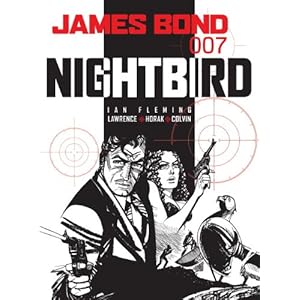 “PERHAPS OUR GUEST WOULD BE MORE RESPECTFUL IF HE SAW HOTSHOT IN ACTION!” Though author Ian Fleming’s name appears below the title of “Nightbird (Titan Books), the latest collection of James Bond newspaper strips from the 1970’s, the fact is that it’s less a byline than it is a brand name -- like Walt Disney -- at this point. Though the earliest Bond strips were devoted to adapting Fleming’s spy novels into comics, at this stage in the game the story work was in the hands of solid British comics pro Jim Lawrence. Nightbird contains three Bond tales (plus a snippet of an uncompleted one for the fanatics) from 1976-77, more than a decade after Fleming’s death. All three full stories fit comfortably within the James Bond world, however, even if two of ‘em strain credulity almost as much as the movie version of Moonraker. Opening tale, “Hot-Shot,” is arguably the most successful in this set. It even features the return appearance by one of 007’s first egomaniacal antagonists. (Though the story’s intro acts as if there is a big reveal, in actuality, one of the bad guy’s henchmen speaks his name three days into the continuity.) The still-current storyline features the evildoer’s attempt to foment Middle Eastern unrest by using a heat ray to down a plane carrying the U.S. Secretary of State and blaming it on Palestinian Arabs. Our hero hooks up with a shapely Palestinian agent who’s main role is to get kidnapped and dangled over a tank full of sharks. In the best 007 tradition, the story ends with Bond victoriously holding the girl and promising to “delve into certain aspects of the Palestine situation.” Some things remain evergreen. The remaining two entries, the title story and “Ape of Diamonds,” prove less believable even by the loose standards of double-oh storytelling. In the title tale, a criminal mastermind engineers fake alien abductions to enact revenge on the lab responsible for his Phantom of the Opera disfigurements. Why fake aliens? Because . . . um . . . I don’t know? In the last, a villain uses a large gorilla to capture an OPEC mover and shaker, leaving the reader to wonder whether scripter Lawrence had been watching an old Monogram horror flick the night before he started outlining this rascal. Though he struggles to provide a convincing explanation for the super-smart beast’s abilities to pull off the kidnapping, we never really believe it. If the last story proves fairly silly, Lawrence and artist Yasolav Horak (with a brief guest stint by “Modesty Blaise” artist Neville Colvin) never give into the urge to wink at the reader. The Bond strips were clearly aimed at a less prudish readership than you’d get in the U.S. The violence is fairly straightforward (in the ape story, for instance, we see a woman get tossed from a hotel window without -- as in the movie Diamonds Are Forever -- landing in a pool), while the Bond Girls aren’t afraid to appear topless on-panel. The character of Bond is true to Fleming, while Horak’s penwork captures the more serious version of the character beautifully. Even at their most contrived, these resurrected strips remain a treat for fans -- certainly more fun to experience than the “funny” version of Casino Royale. (First published on Blogcritics.) Labels: classic comic strips # |Saturday, July 03, 2010 ( 7/03/2010 08:17:00 PM ) Bill S.  “I WASN’T EXPECTING ALL THIS AGGRO WHEN I TOOK ON THIS JOB!” In a canny attempt to ride the World Cup wave, British publishers Titan Books recently released a collection of the beloved British football comic, “Roy of the Rovers,” as a World Cup Special. Centering on the exploits of Roy Race, stalwart player/manager for the fictional Melchester Rovers, “Roy of the Rovers” ran from the fifties until the early nineties, first as a serialized two or three-page strip in the weekly comic magazine Tiger, then as its own weekly title in the seventies. Aimed at a young boy readership, the strip maintained a clean-cut veneer that’s exemplified by its hero’s blanket disavowal of football violence in the 1970’s (in one reprinted outing from that period, we’re told that the Rovers “held the distinction of being the only club in the league which was almost totally free of football hooliganism”). While this may have ultimately contributed to the series’ demise in the more jaded nineties, I suspect it’s one of the selling points for Titan’s current series of “Roy” reprint collections. Though it’s subtitled the World Cup Special, in reality, none of the stories featured in this large trade paperback actually occur at that fabled competition. In the opening story (from 1966), in fact, Roy misses a chance to play for Britain after he gets a “nasty knock” on his ankle during a charity event. To make up for this disappointment, the whole team of Rovers is sent to Australia on a soccer tour (since, apparently, playing soccer down under isn’t as physically risky as it is at the World Cup), where our hero meets his long-lost rancher uncle Cappy Cuttle. Cappy gets the lads involved in a less formal World Cup of immigrant soccer players from around the globe, then secretly bets his ranch that the boys to win the competition. Unknown to both Cappy and Roy, jealous nephew Dick Cuttle has been trying to sabotage the Rovers’ chance at winning, at one point sneaking a boxing kangaroo into the team’s training quarters. Of course, Roy and company ultimately come through for Cappy, but not without some rocky moments. In a later story, Roy uses his vacation time from the Rovers to manage a “B Squad” of footballers in a home international tourney. His big nemesis proves to be the leader of the American team, Harvey Dallas, who has a grudge against Roy for turning an offer the year before to coach the U.S. World Cup team. Calling it an “insult to Uncle Sam,” Dallas vows to humiliate Race’s squad, dooming Roy’s hope for a “relaxed and friendly” soccer competition. Those boorish Yanks’ll do it every time. Titan’s collection of “Roy” tales, interspersed with photos and articles written to appeal to the football-mad boy, is appealingly produced. The earliest stories, including a three-page curiosity where Roy dreams about competing at the World Cup, are predominately printed in black and white, while the later tales -- from a time where Roy was finally given his own weekly comic book title -- are in color. Though the volume doesn’t clearly annotate its stories (the only ones to receive writer and artist credit are Tom Tully and Brit comics pro Mike White in the final tale), you can usually gauge when they were published, at least, by the length and cut of Roy’s hair. To a newcomer to the series, the rest of Roy’s teammates are a largely indistinguishable crew, though a couple of newcomers are provided their own quick plotlines. In one tale, the Rovers’ newest goalie turns out to be a spitting double for the king of the south American country of El Manador (to the west of El Humidor right?); in the last, Roy considers offering a clownish B Squadder a place on his beloved Rovers, but will the boys back home tolerate his goonish hi-jinx? Couldn’t tell ya, since the book ends before Roy introduces him to the rest of the Rovers. What’s important is whupping them upstart Americans -- and you can be darn sure that takes place. (First published on Blogcritics.) Labels: classic comic strips # |Sunday, September 13, 2009 ( 9/13/2009 11:26:00 AM ) Bill S. 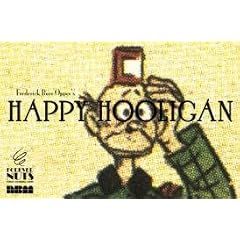 "IT'S THEM BLOOMING 'OOLIGANS AGAIN!" The hapless lead of Frederick Burr Opper's classic newspaper strip, "Happy Hooligan," is a clownish figure: dressed in patched-up beggar's clothing, a soup can impossibly perched on his large melon head, he's the first great comic strip sad sack. Created in 1900, Opper's "Hooligan" was a popular feature in Hearst papers until the strip's demise in the thirties, though the figure has occasionally cameo-ed in later artists' works. Jules Feiffer, during the Ford Administration, drew the then-president in Hooligan garb right down to the soup can on his bald noggin. Issued as a part of NBM's "Forever Nuts" series of classic screwball strip collections, Happy Hooligan features a selection of Sunday strips circa 1902-13. Unlike the series' Bringing Up Father collection, the book doesn't contain a complete year-plus run -- perhaps because the strip's greater age (the first "Hooligan"s predate "Father" by a decade) makes it more difficult to complete. Opper's early strips were restricted to Sundays, so the entries here are in full or two-color form, depending on the source newspaper. The Sunday strips -- at least in the period repped here -- held to a fairly rigid formula. Our hero Happy is a goodhearted stumblebum whose intentions are regularly misread by the world around him. Attempting to help a city official place a wreath on a statue of George Washington, for instance, he tips the statue onto one of Opper's oversized coppers, who responds by clubbing him on the head and flattening his undislodged tin can chapeau. "The city ain't safe while you're loose," the officer states as the fuming official threatens to have our unlucky hero jailed. Happy's tramp appearance and low-class status contribute to his role as a steady scapegoat, though, to be sure, his clumsiness and clownish air of obliviousness also work in his disfavor. If there's a large rock on the ground, he'll stumble over it; if he's given a shovel or a board, you known he'll turn around without checking to see if there's anyone in the vicinity he might whack on the head. Part of the fun of many of Opper's entries resides in trying to anticipate in the first half of the two-tiered strip just how our hero is gonna get in trouble. "I can see big bunches of trouble coming," brother hobo Gloomy Gus says at one point, and the pessimistic sibling's predictions usually prove spot on. Opper's protagonist, then, proves a precursor to such misunderstood movie comic underdogs as Chaplin's Tramp, Laurel & Hardy, and The Three Stooges. (Our man even speaks in an NYC accent reminiscent of the Howard/Fine team.) As the series progressed, Opper added two siblings to the cast: the aforementioned Gus and an improbable British brother named Montmorency. The latter was as frequently misjudged and mishandled as Happy, though the shiftless Gus usually came out on top for ironic contrast. When the trio take a trip to England, Opper milks weeks of comedy from their unsuccessful attempts to see the King of England. In one particularly screwy Sunday, all three enter the palace, asking a royal guardsman to see the king, and are attacked by a gorilla who's been hiding behind a life-sized portrait of Richard III. Who knew that Buckingham Palace used 'em as bouncers? Also part of the strip were three nephews who often served as a comic chorus ("Uncle Happy's hoited!" they chant on more than once occasion) and an unlikely love interest named Suzanne. Happy would later marry this statuesque beauty, but at this point in the series, we see him unsuccessfully trying to win over a disapproving guardian -- and squashing one of Suzanne's hats during a disastrous picnic. Still, the bulk of the cartoons here have little to do with romance and more to do with our hobo hero's ill-fated attempts at being a Samaritan or (occasionally) holding down a job. The stinging joke imbedded in the series -- as it often is in slapstick of this ilk -- is the ease with which the authorities jump to the worst possible conclusions about Happy's mishaps. During the trio's tramp through Europe, for instance, the Swiss police even accuse Happy and Montmorency of "trying to steal a mountain," Opper taking the authoritarian tendency to exaggerate their culprit's misdeeds to a comically outlandish level. As a pioneering cartoonist, the prolific Opper is frequently credited with establishing many of the conventions of comics storytelling (he was, for example, the first cartoonist to consistently utilize word balloons, though he didn't invent them). His art is energetic and goofily expressive, while his precise handling of the mechanics of slapstick would later prove a major influence on cartoonists like Rube Goldberg. NBM's scans of these old, old strips are clean and crisp -- with the exception of a poorly cropped offering from 1912 -- and the "Forever Nuts" book does this rarely seen comic strip proud. It's a good read, not just for students of early comic art, but for lovers of an enjoyably rough-hewn, low-brow American brand of humor. Labels: classic comic strips # |Tuesday, July 21, 2009 ( 7/21/2009 04:09:00 PM ) Bill S.  "JUMPING JETS!" For many of us outside the United Kingdom, the comic series "Dan Dare" is mainly known for its influences on British rock. Pink Floyd, Bowie and Elton John have all included lyrical refs to the character, while the punk band Mekons memorably took their name from the sci-fi series' primary villain. Yet for many young UK readers in the fifties and sixties, Frank Hampson's "Dan Dare" was a major gateway into science fiction. Serialized in the weekly comic Eagle from 1950 to '67, the series recounts the adventures of the "Pilot of the Future" and his friends, most notably his rotund batman Digby and the inevitable nosy boy tagalong (Flamer, so named for his red hair, not any theatrical behaviors). Dare's gosh-wow adventures, set in the far-off world of 1997, were serialized in two-page chunks in Eagle, with storylines lasting up to a year. While Hampson's strips were clearly aimed at a kid audience ("Golly!" and "Crumbs!" are the most intense interjections uttered in the strip), they were complex enough to engage older readers, while the art (courtesy of Hampson and a studio known as the Old Bakehouse) was meticulously detailed in its renderings of a futuristic Britain. (Hampson reportedly had scale models of many of the ships and cities built so they could be used as references in the actual artwork.) Beautifully realized and colored, the Dare strips are a pleasure just to pore over by themselves. Titan Books has been reprinting these classic strips in handsome hardbound editions over the last few years, and their latest reissue, The Phantom Fleet, captures Hampson's penultimate Dan Dare adventure. (He left the series in 1959.) The story centers on two aquatic alien races, the Cosmodes and the Pescods, who come to Earth from a "system beyond Earth's scientific knowledge" after their own planet I-Cos starts drying out. The Cosmodes, who are shrimpy enough to stand on an adult human's hand, appear to be friendly, while the larger-sized Pescods are right bastards from the get-go. Utilizing a vaporized acid called the Crimson Death, they plan to conquer Earth and make its oceans their home. The Cosmodes regularly reiterate that their intentions are honorable, though even our hero has his moments of niggling doubt about this — while some of the more bombastic members of the governing Space Ministry want to Kill 'Em All And Let God Sort It Out. Once the nasty Pescods actually begin their invasion, though, we quickly learn where the Cosmodes' sympathies lie. "Phantom Fleet" is designed to follow its weekly two-page structure, with many of each week's concluding panels breathlessly telling readers that they sure don't wanna miss next week's "terrific thrills." At times, Hampson oversells the excitement to come, though the story does contain its share of neat moments, particularly in a sequence when our heroes come aboard the aliens' ships for the first time. Young Flamer demonstrates a remarkable facility for sneaking on board just before the big battles, natch: a transparent kid ploy that never would've worked for this reader even back in 1958. As an eight-year-old, I never was much invested in kid sidekicks; I'd much rather focus on the grown-up comic relief like Digby. As a bonus, an eight-page Christmas trifle, "Operation Plum-Pudding," is included in the volume. Centering on Digby's thwarted desires for a big ol' holiday feast, it's pretty slight, though, again, young Flamer sneaks aboard Dan's space ship Swiftstar, this time with Digby's aid. The kid was incorrigible. As for our stalwart lead, he's straightlaced and upright in the classic boy's adventure mode, though the "satanic" squiggle in his eyebrows hints at something darker. As a well-known pop culture figure in Britain, Dan Dare has inspired more than his share of satiric piss-takes (one written by Grant Morrison), though the version we get here is the real straight arrow. This is as it should be: you're gonna name your hero Dan Dare, then he'd better be as forthright and true as they come. Though later attempts to revive the character would foolishly try to make him edgier, Hampson's Dare is the model that deservedly endures. Labels: classic comic strips # |Tuesday, July 14, 2009 ( 7/14/2009 08:16:00 AM ) Bill S.  "DON'T MAKE ANY BREAKS TONIGHT." The image on the cover to George McManus's Bringing Up Father (NBM) is a familiar one to readers of the long-running newspaper comic strip. In it, our title hero is being conked on the head by a rolling pin, an image that cartoonist used to cap many a gag in his forty years drawing the popular strip. Yet in the new hardcover collection covering the strip' first two years from 1913-14, the reader will look long and hard for any well-aimed kitchen utensils. Though hero Jiggs gets bruised and battered more than once, it's more from his predilection for getting into Popeye-styled fracases than any domestic disputes. The story of an amiable working class mug and his ambitious wife -- who suddenly find themselves catapulted into the moneyed class -- "Bringing Up Father" captures an America in the throes of class and social assimilation. Hero Jiggs (sometimes spelled "Giggs" in these early strips) and his wife Maggie come from Irish-American stock, and while the latter wants to cast off all trace of that humble background, Jiggs continues to embrace it. While Maggie attempts to pull her reluctant husband up through the more rarefied upper crust, Jiggs defiantly sneaks out for a bucket of beer and a plate of corn beef and cabbage with his cronies, half of who appear to be named "Dinty." This conflict, between honest proletarian living and bourgeois aspiration, is what fuels the strip, but no consideration of McManus's creation is complete without considering the sexual division in it, too. Though we're shown that Jiggs and Maggie have two adult children in the strip's entry, fact is that son Ethelbert (note the feminized name) rarely appears in the strip. Instead, it's Maggie and her incongruously lovely daughter Nora (called "Katy" in the early strip) who gang up on dad, pushing him to behave "appropriately." In this, they're doomed to fail, of course: Jiggs is too satisfied as himself to want to follow the fickle fashions of the nouveau riche. He yam what he yam. Thus, a lot of the entries in the strip's first two years follow the same basic formula: Maggie, anticipating the appearance of a group of stuffed shirts, tells Jiggs that he must be on his best behavior; Jiggs -- whether innocently or passively aggressively -- foils this request by doing something innocuously "offensive" like appearing in front of company in his undershirt, smoking a pipe or getting caught carrying a bucket of beer into the house. Maggie reacts with a "horrors!" (she's not yet at the rolling pin throwing stage in their marriage, remember), while all the rest of the stuffed shirts look suitably dismayed. Repetitious, yes, though it should be noted that McManus wasn't yet producing these strips on a daily basis, rather alternating them with several other ongoing features, so they might not have appeared as redundant to the regular newspaper reader. Still, when McManus takes Jiggs, Maggie and daughter (no trace of the invisible son) on an extended trip to Europe, we're grateful for the change in scenery and the amusing Innocents Abroad storyline. Just as intriguingly, when the threesome return to the states, McManus devotes a series of gag strips to the growing news of war in Europe. Though Jiggs tries to avoid getting caught up in the news, he's unable to do so. In this, he could stand in for much of 1914 America. If "Bringing Up Father" has its formulaic elements, they were well overcome by McManus's art, with its elegant line work, and sharp sense of contemporary fashion and furnishings. One of the early comic strip era's most accomplished comics draftsmen, McManus captures his era with wit and assuredness. The strips are a joy to look at (especially the Europe entries) even if you don't bother reading the word balloons. Bringing Up Father is the third in a series of early comic strip collections being released by NBM as the "Forever Nuts" (first two in the series: Early Years of Mutt & Jeff and Happy Hooligan). The reproduction is strong, though I spotted one strip where part of the hand lettering had to be replaced by mechanically produced letters, while the art is crisp. McManus's beautifully spotted blacks are particularly well-served: when Jiggs goes out in his suit coat, it needs to be richly black. As an aid to those readers who may not catch the strip's occasional era-specific references, the book includes an appendix of annotations by comic historian Allan Holtz. The asterisks aiming the reader to these annotations could be more immediately accessible to the reader, but this is a small grouse. I found myself going through the appendix after I finished my first reading of the book and looking back to the references they explicate. In many cases, these notes were necessary -- I knew from The Untouchables about the practice of bringing beer home in a bucket -- but they did occasionally illuminate a gag, as when Jiggs busts up what he thinks is a collapsible top hat. As a prime example of early American strip work, "Bringing Up Father" is not a comic for those who might be bothered by its sexist parameters and occasional ethnic caricatures. (Though they're not in a lot of strips, the occasional big-lipped darkie servant does appear in the first two years.) McManus himself was of Irish-American descent, so his take on his beer-swilling lug of a hero was anything but critical. If anything, Jiggs' fight to stay his illiterate, fun-loving self has a comic nobility to it -- one that McManus fruitfully and successfully mined for decades. UPDATE: Alan Holtz notes in comments that the mechanical lettering change I spied in one strip was originally made by the newspaper when it was first printed, not by NBM. Labels: classic comic strips # |Tuesday, May 12, 2009 ( 5/12/2009 04:33:00 PM ) Bill S. 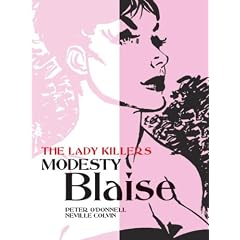 "CAPTAIN, I'M NOT A NICE LITTLE GIRL." Over the weekend, one of the cable movie channels was running a marathon of James Bond flicks. The classic Sean Connery outings were broadcast, and, as much as I love 'em, I have to admit that all they suffer from a certain over-familiarity. Still, seeing that they were on put me in the mood for some spicy international intrigue. So where does one go for a fresh fix of Russian spies, exotic action locales and dangerous dames in bikinis? One possible answer: Modesty Blaise. Forget the thudding Joseph Losey cinematic campfest from 1966 starring a too-blond Monica Vitti as the title lead. The Modesty Blaise to follow is the heroine of a long-running (1963 - 2001) British comic strip and series of novels by Peter O'Donnell. The strip is currently being reprinted by Titan Books, the most recent volume entitled Modesty Blaise: The Lady Killers. I devoured this rascal in less time than it takes for James Bond to get from Switzerland to Fort Knox. Featuring three crime and spy stories from 1980, the collection showcases the first offerings by artist Neville Colvin, who worked on the strip until '86. While not as smoothly chic as Jim Holdaway, the man who established the glamorous Miz Blaise's look and stayed on the strip until his untimely death in 1970, Colvin is suited to the series' tough no-nonsense heroine. For those unfamiliar with O'Donnell's creation, Modesty is an ageless (at least she never got any older in thirty-plus years of newspaper comics) adventuress. Onetime head of a criminal organization known as The Network, she has retired on her amassed wealth to provide occasional service for British Intelligence and help out friends in need. Self-possessed and fashionable, she's balanced by her Man Friday, Willie Garvin, a rough-hewn former soldier who speaks in an unpolished manner and is particularly skilled with throwing knives. He's fiercely loyal to Modesty, who he calls "Princess." Though clearly connected to each other and active sexually, the duo do not share a physical relationship: in the stories featured in Lady Killers, for instance, we see Modesty involved with a former C.I.A. agent named Steve Taylor, while another story features Willie's perennially frustrated girlfriend Maude Tiller. (O'Donnell made a running joke out of the fact that Willie and Maude are regularly interrupted before they're able to do anything.) Still, Modesty and her second have an enduring companionability. At the end of the title story, for instance, they're shown resting together post-adventure while Modesty reads about the death of the story's baddie. "Never mind the light stuff, Princess," Willie says. "What's 'appening to Rupert Bear today?" The book's three adventures are prime Blaise: pulpish action/adventure yarns with our self-possessed heroine taking on a variety of enjoyably nasty miscreants. In the first, a group of mercenaries attempt to steal the research Modesty's boyfriend is conducting on a trio of dolphins in the Gulf Coast; in the title tale, our heroine rescues a young girl kidnapped for ransom by a vicious conman and a group of North African female revolutionaries called the Daughters of Freedom. This leads to a string of women's lib cracks that probably read more dated back in 1980 than they do today where the events play as if they're happening in some timeless Cold War Era. If the first two tales are hard-nailed exercises -- Modesty taking on vicious Mexican mercenaries who think nothing of shooting a dolphin to get what they want, Modesty and Willie sneaking into an abandoned Foreign Legion compound to take on an army of Amazonian terrorists -- the third entry, "Garvin's Travels," is a little more willfully outrageous in the manner of the old Avengers teleseries ("The House That Jack Built," for instance). In it, Willie and his secret agent paramour Maude are captured by Russian scientists to be subjects in a brainwashing experiment. This involves drugging the couple and seemingly shrinking them down to Lilliputian size. Unsure about the nature of their consensual hallucination, they struggle to make their way across an outsized kitchen, threatened by the sight of giant spiders and a ravenous rat. It's all outlandish but not winkingly so. O'Donnell and Colvin tackle this material with the same straight-faced commitment that director Jack Arnold brought to The Incredible Shrinking Man. As a writer, O'Donnell was economical and suitably twisty. "Lady Killers," for instance, starts out as a whole different adventure -- our protagonist helps an old friend oust a gangster running a protection racket in Tangiers only to learn that said gangster was the intermediary in the delivery of a kidnapping ransom -- before turning into a rescue plot. Once our heroine gets to the young girl held by the faux extremist Zahki, the kidnap victim resists her saviors; the charming conman has won over the young girl even as we know he intends to have the little dupe killed once he gets his money. "Modesty Blaise" had a limited run in American newspapers, though the strip perpetually ran afoul of the censors in the States. O'Donnell and his artists weren't averse to tossing in occasional nudity -- one of our gal's regular tactics (which she called "The Nailer") used to distract henchmen was to flash her breasts and take advantage of their understandable bedazzlement. Modesty doesn't utilize the Nailer in this volume, but the equally shapely Maude does, and we do get a sequence where Miz Blaise goes undercover as a topless waitress. As more than one joking reference to the enduring British kiddie comic strip makes clear, this was definitely not "Rupert Bear." We wouldn't have it any other way. Labels: classic comic strips # | |
|
|