| Pop Culture Gadabout | ||
|
Wednesday, October 30, 2013 ( 10/30/2013 06:57:00 PM ) Bill S.   “I JUST THOUGHT YOU MIGHT LIKE TO KNOW WHAT’S ACTUALLY IN THE HOT DOG.” If you’re the kind of reader who takes the text of the Bible as the inviolable Word of God, chances are Mark Russell’s God Is Disappointed in You (Top Shelf Productions) will not be your cup of myrrh. If, however, you’re a liberal smart-ass like myself – or just a more open-mindedly spiritual person – then this book will be a hoot. An attempt to condense every book of the Bible into modern language and with jokes, Disappointed provides an entertaining trek through a tome that many readers (myself included) have found a chore to actually wade through. “I JUST THOUGHT YOU MIGHT LIKE TO KNOW WHAT’S ACTUALLY IN THE HOT DOG.” If you’re the kind of reader who takes the text of the Bible as the inviolable Word of God, chances are Mark Russell’s God Is Disappointed in You (Top Shelf Productions) will not be your cup of myrrh. If, however, you’re a liberal smart-ass like myself – or just a more open-mindedly spiritual person – then this book will be a hoot. An attempt to condense every book of the Bible into modern language and with jokes, Disappointed provides an entertaining trek through a tome that many readers (myself included) have found a chore to actually wade through.The project stemmed, Russell explains in an afterword, from a three-paragraph summary of the Book of Job that he’d written for a friend. At the encourage of cartoonist Shannon Wheeler (Too Much Coffee Man), the writer decided to do the same for all the other books of the Bible, though he quickly realized that three paragraphs would not suffice for a majority of the books. As a result, the summaries – each accompanied by a suitably snarky Wheeler cartoon – range from two- to seven-pages long. Using modern vernacular and witty contemporary metaphors (e.g., describing Adam and Eve’s days in Eden as “a lot like living at a Grateful Dead concert”), Wheeler captures all great and appalling stories from both Old and New Testaments – along with all the tedious exhortations and yowls from Paul and the rest of the Epistle writers – and retells them with a humorist’s eye toward the sometimes dickish (see King David) human behavior that’s described in them. One of my favorite moments comes in a retelling from the Book of Samuel of the prophet Elisha’s confrontation with a group of boys who had made fun of his baldness; in retaliation for this act of childish rudeness, Elijah summoned up a team of wild she-bears who mauled all of the boys to death. “Nobody knows why Elijah didn’t just summon up a whole head of hair,” Russell wryly concludes. In a few books, Russell gets even more playful with the material: Psalms, for example, is written like a K-Tel commercial for King David’s Greatest Hits; Jeremiah’s Lamentations is written to read like a high school emo kid’s bad poetry (“Ode to a Failed Prophet [Gravel Face]”); Song of Solomon is presented in the voice of a twitterpated teenage girl. When he gets to the New Testament, he describes Jesus as a “notorious shock preacher” to the Pharisees. Summarizing Christ’s take on the afterlife (itself a controversial concept at the time), Russell writes from the Gospel of Matthew, “As Jesus described it, Hell is simply a place where shallow people don’t know what to do with themselves because there isn’t a Pottery Barn.” Though Russell is attempting to retell the Bible in its own terms, there is no way he can avoid dealing with a work as open to so many interpretations without occasionally falling into interpretation yourself. This can be most fully seen in his take on Revelation, inspired by Elaine Pagel’s Revelations “not as predictions of events thousands of years in the future, but rather, as the prayer of a man who had witnessed the destruction of everything he loved and thought the end of the world was at hand.” Sure messes with my appreciation of that Sleepy Hollow show, though. Packaged in a faux leather cover with gilded paper and a red ribbon place keeper, God Is Disappointed in You has the look of a more conservative religious work – until you note the Shannon Wheeler cover cartoon of a giant hand reaching down to flick away an unknowing kneeling worshipper. Russell’s publisher calls his approach both irreverent and faithful, and if you believe that both attitudes can co-exist in a consideration of this most influential of works, then you’ll probably laugh at much at it as I did.
(First published on Blogcritics.) Labels: cultural commentary # |Thursday, November 01, 2012 ( 11/01/2012 07:29:00 PM ) Bill S. A QUICK POLI-THOUGHT: Voted by mail last week on the year’s election and have started fantasizing about a new technological innovation: one that provides teevee viewers with the opportunity to tell their cable/satellite service that they’ve cast their ballot and thus don’t need to watch any more political ads. The subsequent aired ads could then be screened and replaced with spots more relevant to the no-longer-needing-to-be-persuaded viewer: disposable douche commercials, perhaps . . .
Labels: cultural commentary # |Sunday, July 22, 2012 ( 7/22/2012 12:20:00 PM ) Bill S. THE SILICON CHIP INSIDE HIS HEAD: Some events are so over-the-top incomprehensible that just about the only response one can have is a “holy” followed by a string of obscenities. I have to admit that was my first response when I heard about this week’s incident in a movie theater in Aurora, Colorado, where a gunman wound up shooting into the audience at a showing of the latest Dark Knight movie. A night of summer entertainment turned into a real-life episode of Criminal Minds. Like most people, whenever I hear or read of an event like this, one of my early responses is to personalize it. We have friends who live in the Aurora Colorado area, so we had to contact them to make sure they were all right. (They were.) Next, I started egocentrically imagining myself in the seats of that theater. Though disposable income has been at a premium for far too long in our house, I’ve been an avid moviegoer in the past -- and The Dark Knight Rises is just the kind of entertainment that I would’ve been eager to see in a crowded movie house. If I’d been in that theater and seen the gunman coming down the aisles, would I have recognized the danger, I wonder, or simply assumed that his appearance was a stunt of some sort? Somebody playing at being a character in the movie like some Rocky Horror Picture Show fan perhaps? I believe in a measure of gun control, though I don’t necessarily think that stricter gun regs would have kept the horrific events here from taking place -- any more than tougher DUI laws have prevented drunk driving. To those who say that giving everyone access to firearms is the answer to the problem, I can only offer myself as a rebuttal. I’m a major klutz who can’t go through the week without stubbing something. Give me a gun, and I’m liable to shoot my right foot off by accident. You definitely don’t want me packing. Living in a state where open carry is practically a religion, though, I can’t help wishing that a greater degree of common sense was brought to the discussion (seriously, guys, let’s have open guns on college campuses?) But I don’t expect that to happen any time soon. I do expect to hear spokesfolk from both sides of that debate to try and spin the event to their own pre-set conclusions -- and for at least one idiot politician to try to drum up alarmist concerns that President Obama Is Going to Use This to Take Away All Our Guns! As a self-professed religious liberal, I also find myself wondering after an event like this if there’s a way to fathom it in a larger sense. I always fall short in my attempts to place this in any sort of fuller context. I can comprehend moments of despair that lead to nihilistic thinking, but the impulse that leads someone to violently lash out against a theater full of innocents is beyond me. My thoughts go out to the family and friends who have been affected by this horrible act, though -- and I hope that they all have something or someone that will help them through it. Labels: cultural commentary # |Saturday, June 30, 2012 ( 6/30/2012 07:09:00 PM ) Bill S.   PEAK GEEK-ERY Though I’ve been a comic book lover for decades and have attended my share of midwest and east coast conventions, I’ve never been to the grandest con of them all, San Diego’s Comic-Con. All things financial considered, I don’t see myself attending it any time soon in the future either, but like many stay-at-home fans, I won’t stop reading the on-line reportage once the event kick-starts. PEAK GEEK-ERY Though I’ve been a comic book lover for decades and have attended my share of midwest and east coast conventions, I’ve never been to the grandest con of them all, San Diego’s Comic-Con. All things financial considered, I don’t see myself attending it any time soon in the future either, but like many stay-at-home fans, I won’t stop reading the on-line reportage once the event kick-starts.
Timed for release ahead of this year’s Comic-Con, Rob Salkowitz’ Comic-Con and the Business of Pop Culture Accompanied by his wife Eunice -- herself a fan with her own distinct interests -- Salkowitz takes us on a day-by-day trek through the 2011 Comic-Con, describing its functions as an archival celebration of comics history, a p.r. hub where Hollywood and game companies unleash their promo hounds for an ultra-critical fan audience, a marketplace where artists and dealers try to score big sales (and discerning collectors try to score that one item that’ll make their collection complete -- at least for a moment) and a forum where industry folk and their readers consider the future of the medium they love. As Salkowitz repeatedly makes clear throughout his book, at this point in history, comics’ flagship format -- the 32-page floppy -- is struggling to stay alive. Currently dependent on the gasping direct market as repped by funky little comics shops across the U.S. along with the big bucks optioning of Hollywood studios, the “mainstream” comics industry is in a tenuous position. As with the rest of the publishing industry, the digital wave of tablets and e-readers has made the business end of the industry confusing. And as Salkowitz points out, the major comics companies -- perhaps feeling cushioned by their movie moneys -- have been calamitously cautious about embracing the digital. To be sure, there are doubtless members of the alt comics community with little allegiance to the mainstream that wouldn’t be bothered by a future without the big guys. But those of us who value greater diversity in our comics -- or still hold a nostalgic attachment to the Marvel and DC comics of our youth -- will doubtless find it troubling. To be sure, a good number of the current Comic-Con attendees would. But Comic-Con and the Business of Pop Culture is not just devoted to potential doom-y scenarios. It also takes in the con’s celebratory nature: the costumes, the near encyclopedic appreciation of favorite titles and creators, plus other manifestations of nerd culture. “My aim in this book is to balanced color and insight, personal passion and analytical observation,” Salkowitz notes at the outset, and to a large extent he succeeds. He describes the most visual aspects of the event without indulging in any cheapshot caricaturizing. Through the course of the book, we get to meet several major creative players in the field (superstar comics writer Grant Morrison, witty indy creator Batton Lash, former underground comix publisher Denis Kitchen, the Inevitable Stan Lee) along with thoughtful comics bloggers like Heidi MacDonald. The book takes in as much of the scope of Comic-Con as it can, so its fannish beginnings as a celebration of nearly forgotten Golden Age artists is recognized alongside panel presentations on web comics. And, of course, we can’t forget the other major manifestation of Comic-Con: its role as a publicity springboard for upcoming comic-tied movie and game releases. Salkowitz has some fun at the expense of Hollywood beautiful people all coming out to woo the fans, rhapsodizing about their perhaps invented early geek love of comics, though he’s clear-sighted in considering both the pros and cons of this cross-media relationship. More than anything, the Hollywood connection has been a factor in Comic-Con’s growth, though there are doubtless some old guard con-goers who look fondly back to the good old days. For them, the writer offers one of four possible futures for Comic-Con 2017: one in which “the digital thing went bust and Hollywood moved on,” yet comics survived and “returned to the people who love it.” That’s a pretty picture for many of us geezerly geeks, but whether we make it to Earth-One, -Two, -Three or -Four is dependent on market and economic variables that even the most thorough futurist can’t fully predict. For those who want to ponder the foreseeable possibilities, Comic-Con and the Business of Pop Culture makes for some entertainingly thoughtful reading. (First published on Blogcritics.) Labels: cultural commentary # |Thursday, July 02, 2009 ( 7/02/2009 10:05:00 AM ) Bill S. THE GOLDEN CARP: Last year, as a part of its "Big Read" project, the NEA presented Rudolfo Anaya's Bless Me, Ultima as its recommended work. In my area, copies of the novel were given away in several scheduled book events throughout the last four months of 2008, all as a part of the Big Read's program to encourage reading in our country. The novel's selection was not without its controversy, at least within the heavily religious communities of Safford and Thatcher, AZ. At public issue were the book's occasional profanities and a scene where the book's seven-year-old narrator Antonio Márez spies on one of his brothers in a whorehouse, though I suspect that many of the loudest critics had a different agenda in condemning Anaya's novel. Ultima is set in WWII Era rural New Mexico: as such, it makes an intriguing companion piece to Richard Bradford's Red Sky at Morning, though where Bradford made his hero a transplanted southern white boy, Anaya's Antonio grows up in a bi-lingual Chicano home with a strong Catholic heritage. While both novels excel at portraying the workings of their young boys' minds and contain some very funny scenes centered on their school and friends, Antonio's story ultimately proves darker and occasionally frightening. The Ultima of the title is an elderly herbal healer who is staying with Antonio's family. Though many in the area -- most particularly, a vicious thug named Tenorio -- believe her to be a bruja, in practice we see that she's a benevolent figure, a curandera or healer. Still, her presence in the Márez home proves a lightning rod for Tenorio, who attempts to kill Ultima and our hero in the book. During the first attempt, an owl that we're told is connected to Ultima's spirit blinds Tenoria in one eye. The presence of the monstrous Tenorio in the town -- coupled with the fact that he's able to brazenly get away with dark deeds that seemingly go unpunished -- spurs the young Antonio into asking one of faith's big questions: if there's a God, why does he allow horrid things to happen? One of the strengths of Anaya's story rests in the way he captures both Mexican Catholic and Southwestern Indian religious traditions and depicts how these might commingle in a young boys' mind. Representing the latter is a local legend, the Golden Carp, who resides in a nearby river. While Antonio's mother harbors dreams of him eventually becoming a priest, the boy finds himself just as attracted to the nature-driven aspects of the region's Pueblo-based religions as he does the Virgin Mary. This is captured in the book through a series of dreams where the two religious symbols, Virgin Mother and Big Fish, are given equal voice. By the end of the novel, our young narrator has begun to work toward reconciling these two religious beliefs, toward blending them into a personalized spirituality. It's this aspect of the book, more than its occasional real-life English and Spanish obscenities, which made the book a target in my neck of Arizona, I suspect. Graham County is a largely religiously conservative area with a strong LDS population and a goodly amount of evangelically driven churches. The core theme of Bless Me, Ultima -- that affords similar weight to Christian and non-Christian religions -- is not one that sits well with the Harry Potter Is Evil bunch. Though the curandera Ultima takes great pains never to counter Antonio's very Catholic mother's take on things, her existence as a force for good in the community stands as a symbol of a different cosmology. For many hard-core religionists, even the suggestion that there might be more than One Way is reason enough to try to get this beautifully written and engaging story pulled off school library shelves. Me, I'm glad the controversy pushed the novel into the public dialog enough to nudge me into picking up one of the Big Read's free paperbacks and ultimately digging into it. Though it doesn't always work this way, the alarmists got me reading a pretty damn good book. Labels: cultural commentary # |Monday, March 23, 2009 ( 3/23/2009 11:00:00 AM ) Bill S. 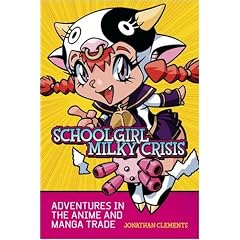 MILKY GOODNESS: To begin with, the title to Jonathan Clements' Schoolgirl Milky Crisis (Titan Books) is a running gag: a three-word non sequitur that sounds like it should be the poorly translated title to some Japanese cartoon but isn't. Instead, it's the faux title the writer uses whenever he wants to protect the guilty in one of his industry stories. He uses that madeup title a lot in this very readable collection. MILKY GOODNESS: To begin with, the title to Jonathan Clements' Schoolgirl Milky Crisis (Titan Books) is a running gag: a three-word non sequitur that sounds like it should be the poorly translated title to some Japanese cartoon but isn't. Instead, it's the faux title the writer uses whenever he wants to protect the guilty in one of his industry stories. He uses that madeup title a lot in this very readable collection.Subtitled, "Adventures in the Anime and Manga Trade," Clements' grab bag of anecdotes, critical commentary, historical pieces and interviews with influential creators provides an entertaining intro to one large part of the monolithic world of Japanese pop culture. Author Clements has worked in the anime biz as a translator and voice guy -- and is co-author of The Anime Encyclopedia -- so he clearly has an inside track to the subject. In his native country England, he has also written novelizations and audio scripts for a variety of well-known British characters (Judge Dredd, Dr. Who) along with columns and presentations on the anime field. The guy knows whereof he writes. In America, perhaps one of the closest comparison I can make is to Mark Evanier, the California-based comics and television writer who has, for years, written about the fields in the which he's worked from both a fannish insider and a historian's perspective. Both share a chatty love of their respective areas with a clear-sighted sense of humor about the flaws and often-dubious actions of each biz's bigwigs. They love to wax positive about their favorite creators, but also like to regularly shine the spotlight on those lesser-known figures in the industry. For years, Evanier wrote his insights in a column entitled "PoV" for the Comic Buyers Guide; Clements produced a comparable feature for the now-defunct anime and manga mag Newtype USA. Evanier ultimately collected his best pieces in a trio of entertaining paperbacks; Clements hits us with his best scattershots in this book. SMC makes no claims of being a comprehensive look at the anime and manga industry, though it's packed with plenty of juicy historical tidbits. If occasionally, his insider stories don't provide a lotta insight (gosh, some foreign anime distributors don't know a damn thing about their product!), his experiences doing voice work for Anglicized dubs of anime series provide plenty of telling detail. Clements' appreciations of major manga figures like Keiji Nakasawa (author of the Hiroshimo memoir Barefoot Gen, one of the first manga series to get published in the U.S.), Katsuhiro Otomo (Akira), Miyazaki and more are also really fine, displaying both a historian's and an aficionado's eye. Elsewhere in the book, the transcript of a presentation on erotic anime proves both amusing and informative (we learn, for instance, how the infamous images of tentacles in sci-fi and horror erotica rose from a desire to circumvent Japanense censorship laws), while a series of reviews of some lesser-known manga series (Golf Lesson Comic, two different manga adaptations of Harlequin Romances, a manga mag entirely focused on making big bucks at pachinko!) displays just how far-ranging the manga audience is. Additionally, we're provided informative pieces on two classic rubber monster series (Godzilla and Mothra) and brief glimpses of the Chinese and Korean markets. His one-page column on the Death Note controversy in China is a concise look at that particular teapot tempest, though I have to wonder whether Clements was familiar with the entire series, which he mis-categorizes as a blend of "The Ring meets The Equalizer." Clements' book could use a little tighter editing. Occasionally, he can needlessly repeat a point that he's made in an earlier column, while at times he'll make an assertion that I wish he'd elaborate. (What is it, for instance, that makes the manga version of Ghost in the Shell "right wing in the extreme"?) Still, his breezy writing style and ability to place the works he discusses within their cultural contexts makes Schoolgirl Milky Crisis a good entry gate into a world that's had a prominent influence on Western storytelling in the past decade. The book is wittily illustrated by Steve Kyte in a comic pastiche of Japanese cartoonery, though some readers may be taken aback by the book's cover of the bovine breasted big-eyed heroine of Clements' imaginary anime/manga title. Me, I wouldn't mind perusing at least one episode of that imaginary series. Labels: cultural commentary # |Sunday, January 25, 2009 ( 1/25/2009 07:57:00 AM ) Bill S. "SOME MEN JUST WANT TO WATCH THE WORLD BURN." Gotta admit that when I read some columnist in the Wall Street Journal attempted to use Chris Nolan's The Dark Knight as a metaphorical valentine to G.W. Bush and the War on Terror, it got my fanboy back up. Putting the Decider and the Caped Crusader on equal levels struck me as reflective of agenda-driven criticism at its most ludicrous -- it's freakin' Batman, folks! Then I got the DVD for Xmas in a chintzy "collector's edition" (a teeny comic collecting two Golden Age origins that've been reprinted multiple times, plus a replica of a Two-Face coin -- yawn) set, and I could see where the poli-pundits got the urge, at least. Dark Knight wants us to make a connection to the WoT, though it isn't as clear-cut in its endorsement of hard interrogation tactics as some would have you believe. Instead, it raises questions without emphatically coming down on one side or the other. Thus, we get two older actors articulating two opposing perspectives on the Anything Goes approach to terrorist fight: Michael Caine's Alfred, who ruefully reminisces from his Burma War Years about the necessary evils men do in wartime, and Morgan Freeman's Lucius Fox, who draws back after being asked to set up a Big Brother surveillance system. He does what Bruce asks him to do, but immediately destroys the system once it's been deployed for its single purpose. To keep the system going, he believes, would put too much power in the hands of just one man. I bought this even-handed approach -- at least until we got the movie's conclusion where our hero is given a choice between a.) acknowledging that one of Gotham City's symbols of civic virtue has been driven mad and corrupted and b.) taking the blame himself for that symbol's mad actions. It seemed too obvious a set-up for the next flick, while the line used to defend Bruce's ultimate decision ("Sometimes the truth isn't good enough. Sometimes people deserve more.") struck me the kind of patronizing rationalization that has driven too much of our 21st century politics. Too, I find it hard to believe that two smart guys like Bruce Wayne and Jim Gordon couldn't have come up with yet a third choice. Maybe they could've blamed Al Qaeda? UPDATE: Poli-blog satirist Roy Edroso (who can be a sharp pop critic when he's not dissecting the more insane conceits of ultra-right bloggers) has an even deeper take on TDK -- though he gives the Joker's red herring father story more weight than I do. Labels: cultural commentary # | |
|
|