| Pop Culture Gadabout | ||
|
Saturday, November 09, 2013 ( 11/09/2013 06:14:00 PM ) Bill S.   “IT’S BETTER THAT THE WORLD GO TO THE DOGS THAN A LOT OF SCHEMING RATS!” The latest entry in Titan Books’ handsomely mounted “Simon & Kirby Library,” The Simon & Kirby Library: Science Fiction looks to the start of this groundbreaking duo’s history as comic book collaborators and then jumps to its final years. If the results aren’t as smooth as the material in S&K’s Crime collection (where all the work came from the late forties), it does provide a good lesson in the evolution of comics visual storytelling, particularly as it was practiced by Jack Kirby. “IT’S BETTER THAT THE WORLD GO TO THE DOGS THAN A LOT OF SCHEMING RATS!” The latest entry in Titan Books’ handsomely mounted “Simon & Kirby Library,” The Simon & Kirby Library: Science Fiction looks to the start of this groundbreaking duo’s history as comic book collaborators and then jumps to its final years. If the results aren’t as smooth as the material in S&K’s Crime collection (where all the work came from the late forties), it does provide a good lesson in the evolution of comics visual storytelling, particularly as it was practiced by Jack Kirby.The volume opens with early solo work by each of the collaborators, both of which turn out to be build around space cops battling alien menaces and space pirates and both of which, amusingly feature the word “Solar” in their title (“Solar Patrol” and “Solar Legion”). Looking at both works – rather mild space operas in the mold of “Buck Rogers” and “Flash Gordon” – you can see hints of the greatness that was to come (note the explosion-packed panels in Kirby’s “Legion”), though their visual debt to the newspaper strips that inspired them proves a distraction. Looking at Joe Simon’s and Kirby’s early solo work, though, does provide a clue as to who was the greater innovator when it came to comics page layout: Simon’s “Patrol” remains hemmed by its more strictly tiered panels, while Kirby already is striving expand and play with them. It’s with their first full partnership, 1941’s “Blue Bolt,” that comic book history was made. Blending superhero comics with Alex Raymond’s “Flash Gordon,” the series centers on Fred Parrish, a Harvard football star who becomes a “human lightening streak” thanks to benevolent mad scientist Dr. Bertoff (note the similarity to Dr. Zarkov). Bertoff has transformed our hero to combat the Green Sorceress, Empress of the Hidden Green Empire, a subterranean kingdom packed with monstrous beasties. The shapely sorceress uses a combination of magic and strange science to realize her dream of conquering the outer world, though of course she’s repeatedly thwarted by our hero. Science-Fiction reprints “Blue Bolt” entries from his comic’s first ten issues, and you can see the duo’s distinctive slam-bang style grow over those ten pieces, most notably in a two-parter pitting BB and the Sorceress against a lumpy faced gangster named Rocky Roberts. If the Blue Bolt tales aren’t quite as sexy as the Raymond strips which inspired them, these are, after all, comics meant to appeal to a predominately younger boy readership. The volume skips through the bulk of the forties – when the pair were primarily concentrating on superhero fare like Captain America, the Vision and the Sandman – into the mid-fifties when capes had briefly become passé and the space race had become the had become the big deal. Simon, who primarily worked as the writer in the team, succeeded in packaging several anthology titles for Harvey Comics in the fifties, bringing Kirby along as artist. Under titles like Alarming Tales and Race for the Moon, S & K produced a series of engaging old-style s-f tales that showed the influence of both straight pulp titles like John W. Campbell’s Astounding Science-Fiction and George Pal’s Destination Moon. While not as groundbreaking as some of their other work (EC’s Weird Science got there first), the s-f comics prove playful and inventive, and in several pieces you can see Kirby developing visual ideas that would later show up in his work for Marvel and DC. To these eyes, the more appealing entries from this period are those that take average shmoes and place them in fantastic situations – as in “Hole in the Wall,” where a elderly fired newsman finds a hole that takes him to another dimension. Reading these, you can’t help wondering whether Rod Serling (or another Twilight Zoner like Richard Matheson) hadn’t picked up copies of the ten-cent comics off a city newsstand. In entries like “The Fireballs” (where “great balls of fire” that appear in the country woods turn out to be intelligent life forms), you can also imagine a struggling Stan Lee looking at the results and saying, “I’ve gotta get Jack penciling some Tales to Astonish for me.” Simon and Kirby severed their long-standing working arrangement in the late fifties, though the former continued to work packaging s-f comics into the Kennedy years. The last sixty pages of comics in Science-Fiction are devoted to works from this period, and a case could be made that the bulk of them don’t really belong in a “Simon & Kirby Library” as only a couple of these (“Lunar Goliaths” and “The Great Moon Mystery”) appear to have been penciled by Jack, while none of the eleven tales appear to have been scripted by Simon. Still, the art that is displayed in these pieces by period greats like Wallace Wood, Reed Crandall and Al Williamson is so choice that I, for one, can’t complain. Most old school fans primarily go to Simon & Kirby for the superhero stuff, but the fact of the matter is these guys produced top-of-the-line work in whatever genre they chose. Heartily recommended to lovers of good, basic comic book storytelling.
(First published on Blogcritics.) Labels: golden age goodness # |Monday, December 26, 2011 ( 12/26/2011 04:41:00 PM ) Bill S. 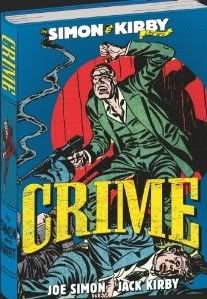 “JUSTICE TRAPS THE GUILTY!” The latest entry in Titan Books’ “Simon & Kirby Library,” Crime is a hefty 320-page collection of work predominately produced in the forties for the era’s “true crime comics.” Having already amassed an impressive body of comic book work in the super-hero genre (creating, among others, Captain America), Joe Simon and Jack Kirby turned to other genres when it looked as if costumed crime fighters were losing their young audience. Initially inspired by the success of Lev Gleason’s Crime Does Not Pay, these pre-Code comic books -- saddled with evocative names like Real Clue Crime Stories and Justice Traps the Guilty -- attempted to straddle the line between exploitation and moralizing much as earlier Depression Era gangster flicks reveled in the exploits of their anti-heroes. If S&K’s work for these titles lacks the over-the-top irony and bloody mindedness of later comics like EC’s Crime and Shock Suspenstories, they remain crackling entertainments. “JUSTICE TRAPS THE GUILTY!” The latest entry in Titan Books’ “Simon & Kirby Library,” Crime is a hefty 320-page collection of work predominately produced in the forties for the era’s “true crime comics.” Having already amassed an impressive body of comic book work in the super-hero genre (creating, among others, Captain America), Joe Simon and Jack Kirby turned to other genres when it looked as if costumed crime fighters were losing their young audience. Initially inspired by the success of Lev Gleason’s Crime Does Not Pay, these pre-Code comic books -- saddled with evocative names like Real Clue Crime Stories and Justice Traps the Guilty -- attempted to straddle the line between exploitation and moralizing much as earlier Depression Era gangster flicks reveled in the exploits of their anti-heroes. If S&K’s work for these titles lacks the over-the-top irony and bloody mindedness of later comics like EC’s Crime and Shock Suspenstories, they remain crackling entertainments.Kirby’s pugilistic art is one of the big draws, of course: the guy had a knack for serving up believably ape-like thugs and cheeky dangerous dames, in particular -– in addition to his dynamic action images. There are plenty of wonderful panels in this opulently packaged color collection: one of my faves accompanies the flight and final gun fight of Babyface Nelson, who thinks nothing of running over one of his own men in his flight to escape the feds. One panel, showing a hunted John Dillinger surrounded by floating eyes, looks downright Steve Ditko-esque. The stories in this collection shift between obvious fictions (e.g., an incomplete series featuring a dapper hero named the Gun Master, as well as another series of tales narrated by “Headline Comics’ super-duper snoop ‘Red Hot’ Blaze”) and quasi-historical retellings of famous criminal exploits. A few of the latter (as with the story of Chicago serial murderer H.H. Holmes and his infamous murder mansion) are predominately accurate, while others (“The Last Bloody Days of Babyface Nelson,” for instance) are as true as to the facts as Brian de Palma’s version of The Untouchables. Crime writer/comics fan Max Allan Collins touches on a few of scripter Joe Simon’s factual filigrees in his intro to this collection, but he doesn’t try to catch ‘em all -– nor should we expect him to. Best to treat the whole she-bang as an outsized display of two great comics creators working at their boyishly most exuberant. (First published on Blogcritics.) Labels: golden age goodness # |Sunday, October 24, 2010 ( 10/24/2010 11:52:00 AM ) Bill S.  “THE NEW CHAMP OF SPLIT-SECOND ACTION.” Though two of their more enduring creations -- Captain America and Sandman -- were featured in Titan Books’ opening entry to the “Simon & Kirby Library,” follow-up Simon & Kirby Superheroes focuses on the prolific creative team’s less familiar heroes. Featuring comic book work from the forties and fifties, the hefty beautifully packaged 480-page collection gathers lesser-known supertypes like the Stuntman, Fighting American, Captain 3-D and the Shield into a spiffy digitally remastered hardcover. For admirers of Jack Kirby, in particular, the book provides an enjoyable overview of this inventive comic artist’s ever more dynamic compositional sense. “THE NEW CHAMP OF SPLIT-SECOND ACTION.” Though two of their more enduring creations -- Captain America and Sandman -- were featured in Titan Books’ opening entry to the “Simon & Kirby Library,” follow-up Simon & Kirby Superheroes focuses on the prolific creative team’s less familiar heroes. Featuring comic book work from the forties and fifties, the hefty beautifully packaged 480-page collection gathers lesser-known supertypes like the Stuntman, Fighting American, Captain 3-D and the Shield into a spiffy digitally remastered hardcover. For admirers of Jack Kirby, in particular, the book provides an enjoyable overview of this inventive comic artist’s ever more dynamic compositional sense.If the first Simon/Kirby collabs, a trio of tales from the early forties starring a forgettable costumed detective named the Black Owl, seem more than a little conservatively hemmed in, the next set of works from 1946 prove much more action-packed. Starring the Stuntman, an acrobatic hero who body doubles for a wannabe detective movie actor, the series (which was frequently credited as a “Simon & Kirby production”) put many of its mysteries in show biz settings to good effect. Scripter Joe Simon, writing for a young boy readership, balanced action and comedy deftly in this series, which unfortunately only lasted two issues before dying in the midst of the era’s publishing glut. (Superheroes includes stories from an unpublished third issue, along with a couple of two-page splashes for unfinished stories.) To these eyes, the Stuntman stories are some of the best superhero material this pair ever produced. More interesting from a social history perspective -- if not exactly a story one -- is the guy who receives the most space in Superheroes, Prize Comics’ Fighting American. A Cold War creation, the series centers on commie hater and radio commentator Johnny Flagg, who dons the fighting tights to take on the red menace. Initially written by Simon as a straight-faced fifties era super comic, Fighting American slid into broader and broader satire, making the Russian baddies grotesques who wouldn’t look out of place in Dogpatch. In one of the last Fighting American adventures, for instance, our hero and his boy companion Speedboy tackle Super-Khakalovich, a Russian “superman” whose primary power is his overwhelming body odor. Perhaps writer Simon was gearing up for Sick Magazine, the Mad imitation he’d be editing in the 1960’s, but the results are still a bit much. Much more successful are those comics where the humor was better modulated. In The Vagabond Prince stories from the forties, for instance, greeting card poet Ned Oaks takes on crooks who prey on the inhabitants of a city slum or the greedy manufacturer of interior automotive deaths: a social crusader with a penchant for spouting doggerel. One thing that many of the proponents of camp criticism never seemed to get was the extent to which comic book writers like Simon were intentionally complicit with their readership, winking instead of nudging ‘em in the gut with their elbows. It was easy to miss because his artist Kirby was so boyishly serious about his own visual outlandishness. In Captain 3-D, Simon and Kirby imagine a superhero who steps out of the mystical Book of D to take on hostile feline cat people. (The original comic, which was printed in green and red to work with 3-D glasses, has been refitted into regular color comics format for this book.) If ever there was a comic book artist suited to the eye-popping compositions of 3-D, it was Jack Kirby, and you can see him modifying his increasingly more kinetic style to make maximum use of the format. With the exception of one comic published in 1966, the material in Superheroes predates Kirby’s ascent into graphic arts royalty through his collaborations with Stan Lee in the 1960’s and his solo groundbreaking “Fourth World” expansions done for DC in the seventies. One thing that Superheroes makes clear, though, is how much Kirby owed to his former collaborator when it came time for him to begin scripting his own comics: his writing voice was much closer to Simon’s than it was the chattier Stan Lee. None of the material in Superheroes is as enjoyably grandiose as comics would later become in Kirby’s free-wheeling hands -- these are six- to twelve-page stories written by Simon as self-contained little adventures for a young readership, after all -- but they still remain a treat for fans of All in Color for a Dime storytelling. (First published on Blogcritics.) Labels: golden age goodness # |Tuesday, May 05, 2009 ( 5/05/2009 06:08:00 PM ) Bill S.  "NOW FOR THE FIRST TIME IN COMICS -- THE WIDE ANGLE SCREAM!" Safe to say that comic books would've been a whole lot different were it not for Joe Simon and Jack Kirby. If they weren't, as Mark Evanier notes in one of the interconnecting essays contained in The Best of Simon And Kirby (Titan Books), the first writers and artists to take advantage of the visual possibilities of a comic book page, they were arguably the first true giants. Bringing an unmatchable boyish energy to the medium, Simon & Kirby produced comics that popped right off the page. "NOW FOR THE FIRST TIME IN COMICS -- THE WIDE ANGLE SCREAM!" Safe to say that comic books would've been a whole lot different were it not for Joe Simon and Jack Kirby. If they weren't, as Mark Evanier notes in one of the interconnecting essays contained in The Best of Simon And Kirby (Titan Books), the first writers and artists to take advantage of the visual possibilities of a comic book page, they were arguably the first true giants. Bringing an unmatchable boyish energy to the medium, Simon & Kirby produced comics that popped right off the page.Spanning the duo's career as two of the hardest working talents in the comics biz, the 240-page Best opens with their groundbreaking superhero work from the early forties, then takes us through examples of the twosome's various genre comics (s-f, war, romance, crime, western, horror and sick humor) from the forties and fifties. With perhaps the exception of the Mad-styled humor entries -- closer to Al Feldstein's Panic imitations than to the divine insanity that was Harvey Kurtzman's creation -- each section shows two artists at the top of their game, finding new ways to expand the medium. Much of the earliest work presented in this handsomely produced coffee table book collection is the hero stuff: Captain America, Sandman, and the Vision. With the oldest pieces you can see the two struggling to see how far they can push the parameters of comic book tier storytelling -- the Vision entry, for instance, contains a page where one of the panels seems to slip out of the sequence altogether -- though the learning curve is pretty steep. In the Sandman adventure, created a year after the Vision story, we're provided a full-page brawl between NYC cops and Viking gangsters that practically kicks you in the face. In the Stuntman episode from 1946, the two are producing the kind of panoramic shots that Kirby would make his trademark in the sixties Marvel comics. Compare the panel displaying the story's circus performance with a similar image in an early Hulk comic introducing the Ringmaster and His Circus of Crime. If anything, the Stuntman panel is even more dynamic. Per Evanier's essays, it's difficult to tell where the two writer/artists begin and end, though plenty of the visual compositions that they developed were carried on by Kirby when the two ended their partnership. To readers who grew up on the jaunty blend of wisecrackery and post-adolescent angst that characterized Kirby's work with writer Stan Lee in the Marvel Age of Comics, the superhero scripts, in particular, can read as stiff as too much of the comics work from the Golden Age. The art has more personality than most of the heroes, though for Kirby fans that's probably sufficient. It's in their other genre work where the real surprises come. Simon & Kirby basically invented the romance comic in the late forties, and they did it with heroines who were a far cry from the weepy ingénues who'd later dominate the form. These were sturdy women in the mode of the best movie tough gals, and their stories reflected this. Reading 1950's "The Savage in Me," for instance, you can imagine Barbara Stanwyck playing the missionary's daughter in love/lust with a scoundrel; the moment when she lets her hair down is sexy in a way that a later generation of romance comics would never dare to be. The war comics prove equally revelatory, most specifically in an atom bomb cautionary from 1947 that ends with New York City under a mushroom cloud. It's as strong as anything EC would've produced in one of its apocalyptic fantasies. In terms of uncompromising storytelling, the duo's "true crime" comics are as commendably ruthless as any Warner Bros. gangster epic. Their take on "Scarface," for instance, contains the killing of an underling that's as startling as Al Capone's murder of a fellow gangster in Brian DePalma's Untouchables. The collaborators' horror comics also prove atypical for the era in which they were produced. Where other horror comics creators worked to duplicate the grisly pulpishness of The Crypt of Terror, Simon & Kirby focused on more psychological frights, producing a book focused on recreating and analyzing its protagonists' nightmares. EC returned the flattery by later devoting a comic to Psychoanalysis, though The Strange World of Your Dreams got there first. If the more subdued approach wasn't as unsettling as the all-out horror comics of the fifties, the samples in Best have some great visual moments: the dream depiction of an "old and dismal town," for instance, visually anticipates the monster comics Kirby would later be producing with Lee -- as well as his even more personalized "Fourth World" series for DC comics. Titan Books' collection features work done for big name companies like Timely (later: Marvel), DC, Archie and Harvey, as well as long-forgotten entities like Hillman and Prize. While the DC and Marvel work is somewhat familiar to comics aficionados (Captain America has had several archive collections published over the years), the lesser-known material definitely deserves to be rediscovered. My interest has been particularly piqued by the Stuntman, a former circus high-wire acrobat named Fred Drake who turns out to be a double for the fatuous actor and self-proclaimed amateur detective Don Daring. Together, the two solve crimes in a Hollywood setting, and you can see this show biz milieu sparking the excitement of its movie mad creators. Though the full story isn't reprinted in the collection, the book's hardcover features an opulent two-page spread from that series, showing our hero in costume on the set of a Robin Hood movie. According to the introduction by the still-vital Joe Simon, the complete tale will be reprinted in a second upcoming collection from Titan, The Simon And Kirby Superheroes. Reason enough to reserve a copy of that rascal. Labels: golden age goodness # | |
|
|