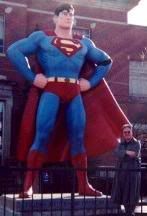
| Pop Culture Gadabout | ||
|
Saturday, December 17, 2011 ( 12/17/2011 11:31:00 AM ) Bill S. 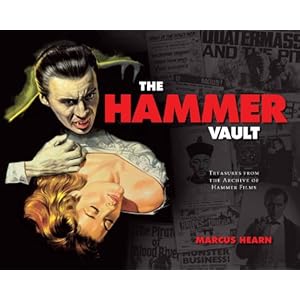 “BLOODTHIRSTY VAMPIRE LIVES AGAIN!”Though it doesn’t by any means claim to be a definitive history of the influential British horror film company, Marcus Hearn’s The Hammer Vault (Titan Books) serves as a tantalizing overview of Hammer Films. Following the company’s releases chronologically -- from its earliest sci-fi releases (Quatermass Xperiment, X - the Unknown), its bloody gothic remakes (Curse of Frankenstein, Horror of Dracula, et al) and their multitude of sequels through later hits like the Raquel Welch break-out One Million Years B.C., Hearn’s coffee table book devotes two pages apiece to depicting publicity material, script pages, and props to each film, with text providing historical context for each release. “BLOODTHIRSTY VAMPIRE LIVES AGAIN!”Though it doesn’t by any means claim to be a definitive history of the influential British horror film company, Marcus Hearn’s The Hammer Vault (Titan Books) serves as a tantalizing overview of Hammer Films. Following the company’s releases chronologically -- from its earliest sci-fi releases (Quatermass Xperiment, X - the Unknown), its bloody gothic remakes (Curse of Frankenstein, Horror of Dracula, et al) and their multitude of sequels through later hits like the Raquel Welch break-out One Million Years B.C., Hearn’s coffee table book devotes two pages apiece to depicting publicity material, script pages, and props to each film, with text providing historical context for each release.While much of the company’s oeuvre looks tame today, it’s amusing to see how much outrage they generated among British film critics back in the day. Hammer cannily took advantage of this notoriety (placing the letter “X” prominently in two of its earliest title, for instance), later making a practice of hiring Playboy playmates as heroines in their films -- and trumpeting this fact in their promo material. Among the collectibles included in this book, Hearn amusingly includes some scathing contemporary reviews. 1957’s Revenge of Frankenstein, for instance, drew a newspaper piece lamenting its release -- and ending with a plea for gentler movies (“the films longest remembered are the ones in which truth is coupled with the warmth of kindness.”) Though the company made periodic bids for critical respectability (e.g., the Bette Davis stage-based black comedy, The Anniversary), its origins as a manufacturer of gory gothics repeatedly worked against it. Prudishly critical nay-sayers aside, to lovers of old-fashioned horror, just the Hammer brand name conjures up a body of richly filmed genre works. The company made the careers of Peter Cushing and Christopher Lee, who both appeared in its first two gothic remakes, Frankenstein and Dracula. That first is particularly noteworthy for the way scriptwriter Jimmy Sangster treated Cushing’s Baron Frankenstein, changing him from an obsessive misguided scientist to an amoral s.o.b., a reconfiguration that would characterize Hammer’s anti-hero through a number of sequels. Going through Vault, I was happily reminded of some lesser-known flicks that I first saw as a teen at the drive-in (Plague of the Zombies, Countess Dracula, Vampire Circus) and took note of some that as far as I can tell never saw release in the states (The Brigand of Kandahar?) Though its primary reputation resides in its horror fare, Hammer regularly put out other types of genre works: pirate movies, H. Rider Haggar-styled adventures (including the Ursula Andress version of She), prehistoric women yarns and black-and-white girl-in-peril suspensers. There was even a misguided attempt at creating a white Shaft (named Shatter) starring Stuart Whitman that went nowhere -- plus a fiscally disastrous stab at blending vampire flicks with Shaw Brothers kung-fu entitled Legend of the 7 Golden Vampires. Vault covers ‘em all, but the image that inevitably achieves cover prominence is a poster shot of Christopher Lee’s fanged Dracula hovering over a comely damsel. At times, Hearn’s accompanying text seems to focus more on production minutia than necessary -- occasionally at the expense of telling the reader what each movie is actually about. We’re never told the meaning behind the title of Satanic Rites of Dracula, for instance, though the book notes that screenwriter Sangster was apparently drafted to craft the film’s base storyline and today has no memory of that commission. There’s a nice photo of Rites heroine Joanna Lumley smoking a cigarette between takes, though, looking very Ab Fab. Though the company went through a period of prolonged invisibility, more recently it has re-emerged with a trio of stylish horror films (Wake Wood, The Resident and Let Me In) that has brought back fans’ attention. Considering this resurrection, I found myself recalling a droll poster that was used in America to sell the 1968 movie Dracula Has Risen from the Grave: featuring a photo of a full-breasted girl with two pink Band-Aids on her neck, the poster followed the movie title with a smaller lettered “Obviously” parenthetically included underneath it. In horror films, nothing stays dead forever . . . Not even horror movie companies. (First published on Blogcritics.) Labels: psychotronic psinema # |Thursday, April 08, 2010 ( 4/08/2010 09:42:00 PM ) Bill S.  THE JUXTAPOSITION BETWEEN “THE VERY DOMESTIC AND THE VERY EXTREME”: At one level, the idea of putting together a big book on the making of a movie that hasn’t been shown yet is a profound act of hype ‘n’ hubris. The finished product hasn’t been released for public evaluation, and here we’re expected to be fascinated by the minutia of its creation? It’s not like we’re talking about The Making of Citizen Kane or something -- this is basically a big beefy promo pack for an r-rated superhero flick. THE JUXTAPOSITION BETWEEN “THE VERY DOMESTIC AND THE VERY EXTREME”: At one level, the idea of putting together a big book on the making of a movie that hasn’t been shown yet is a profound act of hype ‘n’ hubris. The finished product hasn’t been released for public evaluation, and here we’re expected to be fascinated by the minutia of its creation? It’s not like we’re talking about The Making of Citizen Kane or something -- this is basically a big beefy promo pack for an r-rated superhero flick.That gotten out of the way, I’ll admit to being curious about Mark Millar’s Kick-Ass: Creating the Comic, Making the Movie (Titan Books), if only to see how close to the edginess the movie’ll get to the comic. As a mainstream comics writer, Millar (who also gave us the source for the comic book movie Wanted) can get overly satisfied with his own transgressiveness, but at his best he can be an entertaining troublemaker. The idea behind Kick-Ass -- real-life boy and girl attempt to be costumed heroes in a world where every hit leaves real-life bruises -- is a simple but potentially powerful one, especially it’s presented in movie mode without too much flinching. Millar’s volume -- packed with extended quotes from all the players, film shots and comic art in all stages of creation -- conveys the obstacles the moviemakers had to surpass to get to the finished product: convincing skittish movie execs that a film with a foul-mouthed little girl as its heroine was viable, casting young actors who genuinely looked the characters’ age yet could handle the demands of action moviemaking, working on a movie version of a comic book series with an as-yet-unfinished storyline, managing Nick Cage’s outlandish mustache. All pretty intense stuff. But as Francois Truffaut once tellingly noted: “Making a film is like a stagecoach ride in the old west. When you start, you are hoping for a pleasant trip. By the halfway point, you just hope to survive.” Elsewhere, we get to read about Millar’s nerdy youth and the ways it inspired his original comic book series, plus learn what we already knew about Nicholas Cage (that he’s a big ol’ fanboy.) But for many comics fans, the high point of the book will most likely be its healthy helpings of John Romita Jr.’s art. Showing the Wall of Villains that Nic Cage’s character has created in the movie, for instance, we’re treated to eight pages of Romita illustrated mug shots: a great gallery of goons. Asked if he included a pic of Millar in this set of illos, Romita replies, "I don’t think there’s a way of thug-izing Mark. He’s got a baby-face, he can’t be turned into a thug.” Which only goes to show you can’t judge a writer by his baby-face. Whether Millar’s Kick-Ass consideration will become the movie equivalent of one of those glossy rock tour books you spend good money on at the concert and then toss in a closet with the other disposable mementoes -- or a valuable glimpse at a work its makers hope will be “the Pulp Fiction of superhero movies” will ultimately rest on the film itself, of course. I know I’ve got high hopes for the movie, but I also know that similar hopes of mine have been dashed plenty of times in the past. Let's all hope this handsome trade doesn’t serve as a melancholy memento of what might have been . . . Labels: psychotronic psinema # |Saturday, July 25, 2009 ( 7/25/2009 08:28:00 AM ) Bill S. SPLITFACE: Recently, TCM ran the four "Dick Tracy" B-movies produced by RKO in the 1940's, followed by Warren Beatty's big-budget misfire released in 1990. Watched the first 'un, simply titled Dick Tracy, this a.m. and found it be a decent little matinee time-passer: truer to the look of the black-and-white dailies than Beatty's weirdly colored Touchstone production managed with the Sunday "Tracy"s. Director William Berke makes maximum use of flat backgrounds and shadows to recreate the look of the strip. Actor Morgan Conway plays Tracy with more of a wink than perhaps is appropriate, though venerable movie thug Mike Mazurki plays the movie's nemesis Splitface (so named because of a deep facial scar) effectively. The movie's plot (which requires us to believe that one of Splitface's potential victims doesn't remember the guy threatened to kill him until late in the picture) is pretty contrived, but no more so than many of Gould's daily strip adventures. Only place where it truly falls down is in the way it dispatches its bad guy. The original strip was known for its inventive mistreatment of its villains -- so much so that Al Capp would parody this tendency in his "Fearless Fosdick" strips -- but the only thing that happens to the murderous Splitface is his arrest and cuffing at the hands of comic relief Pat Patton. Bet there were a lotta disappointed bloodthirsty kids in the matinee audience when this first ran in the movie houses. Labels: psychotronic psinema # |Monday, July 13, 2009 ( 7/13/2009 09:00:00 AM ) Bill S.  "A MONSTER LIES WITHIN EACH OF US!" A bargain boxed set collecting three of its schlock flick DVD collections, Retromedia's Mad Monster Rally advertises that it contains "8 Huge Hits" within its three disc set. Only three things wrong with that particular statement: a.) none of the low-budget entries contained in this set could be described as "huge" in any way; b.) none of 'em were hits and c.) the set contains nine movies, not eight! "A MONSTER LIES WITHIN EACH OF US!" A bargain boxed set collecting three of its schlock flick DVD collections, Retromedia's Mad Monster Rally advertises that it contains "8 Huge Hits" within its three disc set. Only three things wrong with that particular statement: a.) none of the low-budget entries contained in this set could be described as "huge" in any way; b.) none of 'em were hits and c.) the set contains nine movies, not eight!I know: details, details. To begin, all three discs in the package were originally released singly as Sci-Fi Trash-O-Rama, Morella's All-Nite Spooktacular and Morella's Blood Vision. That last was reviewed by yours truly when it originally came out in 2008, so let's take a gander at the other two discs. To be sure, the movies are all of a piece. When the big-name directors in the set include the likes of Larry (Mars Needs Women) Buchanan and Del (Horror of Party Beach) Tenney, psychotronic movie buffs already know what they're in for. Earliest disc in the set is the honestly titled Trash-O-Rama, which features two full-length films along with an engagingly dated newsreel from the early fifties examining The Flying Saucer Mystery (lots of stiff scientists and self-proclaimed abductees staring into the camera with this 'un). The first feature, Creature of Destruction, is one of a series of made-for-teevee remakes of earlier American International Pictures flicks that Larry Buchanan foisted on televiewers back in the late sixties. A remake of 1956's The She Creature, the movie stars ubiquitous drive-in actor Les Tremayne as a worn-out Svengali named John Basso who uses past life regression to conjure up a bug-eyed rubber-suited monster to kill the rich and stupid on a California coastal community. It's not entirely certain how this works: though it supposedly involves Basso hypnotizing his lovely girl assistant (Pat Delaney), so she regresses into some sort of prehistoric sea beast, the girl never leaves her chair while the creature wreaks havoc on unwary beachgoers. Ineptly shot, with a guest appearance by barely remembered sixties rocker Scotty McKay (who gets killed by the creature), the movie nonetheless shines when placed alongside the set's second sci-fi non-thriller, 1974's UFO: Target Earth. Written and directed by Michael A. de Gaetono, UFO looks like it was shot around a Georgia campus by first-timers really freaked-out by the far-out finale to 2001: A Space Odyssey. Its ploddingly paced non-plot involves a college prof's (Nick Plakias) investigations into UFO sightings by an isolated Georgia lake, concluding in a psychedelic computer graphics sequence that looks like a badly lensed screensaver. All the elements of a truly lame no-budget entry are in this 'un: voiceover narration to fill in for the unfilmed dialog, hatchet-style editing, an extended scene where the boom mic floats prominently above the seated characters' heads. The moviemakers may not've been on hallucinogens while making it, but you'll wanna be, watching it. A trio of retro teevee robot toy commercials fills out Trash-O-Rama. WIt's wy too brief, but the ads may get your nostalgia nodes a-firin'. The second disc, Spooktacular, goes beyond trash-o-rama sci-fi into low-rent horror. As with Blood Vision, the set contains intros by the trés busty Ghost Hostess with the Mostess Morella, as well as two Retro Drive-In segments hosted by Retromedia mastermind Fred Olen Ray. All very corny but still fun for anyone who ever got hooked on a late-nite local teevee creature feature. And, unlike Blood Vision, all three of the movies on the disc contain a Morella intro. Odd film out on the set is Hobgoblins, which is not mentioned in the outer boxed set packaging – the mysterious ninth flick in his "8 Huge Hits" set. An inept attempt at horror comedy a lá Gremlins, the future concerns a group of evil aliens who are capable of turning peoples' deepest dreams into reality. After crash-landing in a Hollywood studio (because movie studios are dream factories, get it?), they're locked in a vault by crotchety studio guard Jeffrey Culver until their inevitable release by the requisite dumb teen. The muppety Hobgoblins, so cheaply constructed that their hands don't work, play their mind games on a group of eighties kids, turning the movie's nice girl Amy (Paige Sullivan) into a bar-performing tease, bringing a horny teen's phone sex fantasy to life, etc. In the right hands, the film could provide plenty of sardonic chuckles, but these aren't the right hands. Why is it not mentioned in the outer packaging? Perhaps because a "20th Anniversary Edition" of this turkey is also being released this summer on DVD – or maybe because the movie was memorably trashed in Mystery Science Theater 3000 set. Whatever the reason, it's an unforgettably egregious film. The other two entries, 1972's House of Blood and The Cremators could have also provided fodder for the MST3K guys, especially the latter entry. The first is a weak attempt at a psychological horror thriller, which even includes the hoary fake-dead-body-in-a-bathtub gag, while the second could have fit on the Sci-Fi Trash-O-Rama set without any argument. Written and directed by Harry Essex, co-writer of The Creature from the Black Lagoon, the movie centers on a batch of intelligent space rocks that are capable of pulling a great fiery ball out of the water whenever anyone fondles 'em too much. ("It never reacts unless it's disturbed," the movie's ecologist/scientist explains.) Said fiery ball rolls along the road without burning anything until it gets to its victim, which it turns into a doll-sized pile of ashes. Reportedly filmed for $50,000 – and looking like it was made for half that much –Cremators is most notable for the appearance of Maria DeAragon as its shrieky heroine. DeAragon's most memorable role, as described in a short interview feature included on the Spooktacular disc, was as Greedo, the nasty alien shot (first) by Han Solo in Star Wars. Now there's a role worth putting in the old resume! Retromedia's boxed set is packaged with all the garish lettering and monster movie mag graphics that you'd expect in a collection like this. As with the best exploitation promo fare, many of the images you see appear nowhere in the movies, though the Trash-O-Rama set does feature a nice image of the Creature of Destruction on its front. Of the three discs offered, I tend to favor Blood Vision, in large part because two of its sixties-set entries have a better fashion sense then the cheapies produced in the seventies and eighties. Still, Mad Monster Rally contains its share of amusing moments, provided you don't (like me) watch too many in a single weekend. Sit through too many of these dogs in a row, and you might find yourself screaming at the teevee set, "I want production values!" You know you're in trouble when you turn off the DVD, and one of SyFy Channel's Saturday nite features starts to look promising. Labels: psychotronic psinema # |Tuesday, June 30, 2009 ( 6/30/2009 09:38:00 AM ) Bill S. 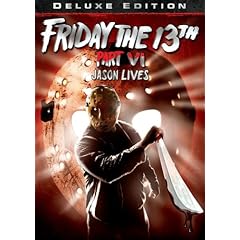 "BECAUSE GROWNUPS THINK IT'S FUNNY TO BE SCARED." There's a telling moment in the opening credits to Friday the 13th: Part VI -- Jason Lives. We've already seen Jason Voorhees improbably resurrected from his grave by two bolts of lightning, even though we were told in the previous installment that the guy had been cremated. What follows after Jason makes quick work of the disposable companion of would-be monster killer Tommy Jarvis gives a clue as to what writer/director Tim McLoughlin is up to. A visual parody of the James Bond opener with our masked anti-hero tossing a machete at the viewer instead of firing his berretta, it signals that this particular none-too-scary entry is gonna have a whole lotta winking in it. "BECAUSE GROWNUPS THINK IT'S FUNNY TO BE SCARED." There's a telling moment in the opening credits to Friday the 13th: Part VI -- Jason Lives. We've already seen Jason Voorhees improbably resurrected from his grave by two bolts of lightning, even though we were told in the previous installment that the guy had been cremated. What follows after Jason makes quick work of the disposable companion of would-be monster killer Tommy Jarvis gives a clue as to what writer/director Tim McLoughlin is up to. A visual parody of the James Bond opener with our masked anti-hero tossing a machete at the viewer instead of firing his berretta, it signals that this particular none-too-scary entry is gonna have a whole lotta winking in it.And so it does. Despite a body count that once again surpasses the titular 13, there's an air of goofiness to the proceedings that's exemplified by the presence of Ron Palillo in the victim pool. Jason butchers a Sweathog! Movie history in the making. Set an undisclosed number of years down the road from the earlier Fridays, the movie centers on Tommy Jarvis' (played this time by Thom Mathews, best known to horror fans as the young hero in Return of the Living Dead) doomed attempts to destroy the killer of Camp Crystal Lake. His first try involves digging up Jason's corpse, dousing it with gasoline and burning it to a crisp, but that trick never works. The very elements conspire to revive and protect the worm-eaten killer: once those lightning bolts revive him, it starts pouring to thwart Tommy's fire starting. Retrieving his hockey mask (which Tommy and friend have inexplicably brought with them), the implacable undead serial killer stomps off into the woods in search of new easy pickings. Of course, there's a fresh batch of camp counselors available for this bloody work. The good folks of Crystal Lake have changed the name of their burg to Forrest Green, and the change has brought back the tourists, too. Among these is a newly engaged couple who come across Jason in their car ("I've seen enough horror movies to know any weirdo wearing a mask is never friendly," the girl tells her beau), a group of corporate paint ballers and a comic cemetery caretaker who happens across Jason's opened grave and says directly into the camera, "Some folks have a strange idea of entertainment." Tommy, to his credit, attempts to warn the local constabulary that He Has Risen, but, like constant kids before him, isn't believed. Instead, the town sheriff (David Kagen) thinks that Tommy himself in doing the killings to make everybody think Jason's Alive, a fair enough assumption considering the number of times in the last movie that we were led to believe the same thing. Fortunately the sheriff's fetching daughter (Jennifer Cooke), for no good reason that we can see, sides with our hero, and the two work to trick the killer into returning to the bottom of Crystal Lake, where he presumably will rest in peace. It's not like this guy rose out of the lake before to go on a killing spree, is it? As for the requisite counselor slashings, McLoughlin ups the stakes by, for the first time, actually showing a whole group of living breathing kids at the camp. One pair of boys gets to crack wise during Jason's final assault on the camp ("So what were you gonna be when you grew up?" one asks his buddy), while a cute little girl gets to deliver an unheeded early warning. Nobody listens to anyone younger in these movies! Though the movie's killings are plentiful, they're treated both less explicitly and more cartoonishly than they were in earlier flicks. In one outlandish gag, for instance, a paint baller gets his face smashed into a tree, leaving behind a bloody smiley face in the trunk; in another, Jason lops off three heads with a single swath of his machete. Having established Jason's supernatural creds, the moviemakers decided to focus on "kills that were almost impossible for a person to do," as McLoughlin states in the DVD's "Making Of Friday the 13th –- Part VI" feature. The heightened unreality didn't make the ratings board go any easier on the flick, however, as a feature showing "Slashed Scenes" makes clear. Though the uncut killings were still pretty tame as these things go, the fx folk were still forced to trim their best gags. Paramount's "Deluxe Edition" DVD contains many of the usual bells and whistles, though there's one fresh moment entitled "Meeting Mr. Voorhees" featuring a series of storyboards depicting an originally planned appearance by the hitherto unseen husband to game show regular Betsy Palmer's Mama Voorhees. The moment doesn't really tell us much, though it does hint at future plots never to be developed. Wonder who they would've gotten for the role of Daddy V., anyway? Orson Bean, perhaps? Labels: psychotronic psinema # |Thursday, June 18, 2009 ( 6/18/2009 07:50:00 AM ) Bill S. 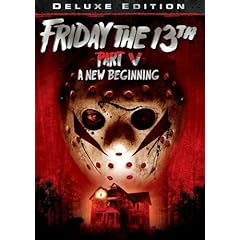 "LOOKS LIKE WE GOT US A MANIAC ON THE LOOSE, HUH, SHERIFF?" That the producers of Friday the 13th -- Part V had the audacity to subtitle this entry A New Beginning says a lot about the perceived gullibility of the slasher film audience. For instead of being a "new beginning" in the way that John Carpenter's Halloween: Season of the Witch attempted something different with his title franchise, director Danny Steinman's Friday basically returned to the central plot of the very first 'un. In both flicks, the mad killer proves to be the parent of a kid who's died due to their guardians' negligence. In the first Friday, young Jason "drowned" in Crystal Lake when a pair of horny summer camp counselors weren't paying attention to the boy; in Part Five, it's the death of a fat mental health patient at the hands of a rageaholic fellow camper that sparks the body pileup. "LOOKS LIKE WE GOT US A MANIAC ON THE LOOSE, HUH, SHERIFF?" That the producers of Friday the 13th -- Part V had the audacity to subtitle this entry A New Beginning says a lot about the perceived gullibility of the slasher film audience. For instead of being a "new beginning" in the way that John Carpenter's Halloween: Season of the Witch attempted something different with his title franchise, director Danny Steinman's Friday basically returned to the central plot of the very first 'un. In both flicks, the mad killer proves to be the parent of a kid who's died due to their guardians' negligence. In the first Friday, young Jason "drowned" in Crystal Lake when a pair of horny summer camp counselors weren't paying attention to the boy; in Part Five, it's the death of a fat mental health patient at the hands of a rageaholic fellow camper that sparks the body pileup.Both victim and killer are summering at Crystal Lake courtesy of the Unger Institute of Mental Health, though why the two teens got transferred from a locked institution to a camp that only appears to have two working counselors with a decidedly lax attitude toward letting their clients handle axes isn't explained. All we know for sure is that the camp is sparsely populated by a group of unstable teens who no one will particularly miss after they've been cut down. Our entry to Camp Pinehurst and its population of ever ready slasher victims is via Tommy Jarvis, who we last saw in The Final Chapter as a bespectacled Corey Feldman, though he's sprouted over the space of a year into a muscular teen played by John Shepherd. Tommy, we'll remember, "killed" Jason at the end of the previous film -- and has since spent his days institutionalized as a reward for this "brutal" act of self-defense. To establish that this rapidly aged figure is indeed Tommy, Shepherd wears a pair of wire-rim glasses at the outset, though he quickly discards 'em without so much as a blink. Tommy, subject to his own fits of rage and PTSD flashbacks, has come to Camp Pinehurst because -- well, we're not really told why either, though we learn that he's been fed tons of psychotropics during his institutional vacay. First thing he does when he unpacks at camp is pull a pocket knife out of his pants, and we know he'll get to use that blade later in the movie because no one thinks to inventory what the new kid brought with him. Later, we see him gazing at a photo of his sister, who also survived the previous Friday, though the movie doesn't bother to tell what's happened to her. Our traumatized hero keeps seeing flashes of a menacing Jason even though we're told that the big galoot is decidedly demised -- and cremated to boot. So the movie's big non-mystery once the actual killings commence becomes, "Is Tommy crazy or is somebody impersonating the legendary killer?" The answer to both questions proves to be yes, of course. Director Steinman, who also co-wrote the flick, increases the movie's body count for the first time beyond the titular thirteen, though he retreats from the previous outing's Savini-esque explicitness by keeping the actual moments of impact off-camera. The director makes up for this by upping the actress nudity screen time considerably, most noticeably in a scene where one busty victim lolls around nekkid in the woods, waiting for her doomed boyfriend to return. The girl gets it in the eyes with a pair of lopping sheers, a tweak at all the teenaged voyeurs in the audience, perhaps. While the bulk of the flick's victims are Tommy's fellow campers, our killer also finds time to take out a white trash Mama and her motorcycle moose of son -- characters so broadly drawn as to make Randy Quaid in Independence Day look subdued -- plus a jheri-curled black dude who gets it in a rickety tin outhouse. The latter is the older bro of Reggie the Reckless (Shavar Ross), a talkative black kid staying at the camp with his cook grandpa. Reggie is one of the few to make it to the movie's showdown, though unlike that wimp Tommy we don't get the sense at the end that he's been damaged forever by the experience. As with all the previous Fridays, the movie winds on an extended dream sequence, this time making it a dream-within-a-dream-within-a-possible-dream. The faux Jason's been disposed of, so the movie concludes by hinting that Tommy will be taking over the slash work next time. That doesn't happen, of course, since the Big J returns from the cremated ashes in VI, so the image of Tommy donning that hockey mask at the movie's end proves to be just one more cheat. Par for the course with these flicks, of course. Paramount's "deluxe" reissue contains many of the same types of features that have graced previous entries, though, unike the Final Chapter DVD, there isn't any found footage of the initially more graphic killings for our edification. For all its considerable flaws as movie, Part Five looks pretty spiffy: the woods surrounding Crystal Lake have never appeared more inviting. I remember seeing a Siskel and Ebert show from around this time where the killjoy critics complained about the fact that strides in moviemaking technology made even the lowliest exploitation fodder look good onscreen. I'm not unsympathetic to this idea since I continue to hold that the much less slickly mounted first film remains the peak of this overextended horror series. But if you're tired of the faux handheld video look favored by too many horror pics these days, the old-fashioned approach is almost a visual relief. Labels: psychotronic psinema # |Saturday, June 13, 2009 ( 6/13/2009 09:49:00 AM ) Bill S. 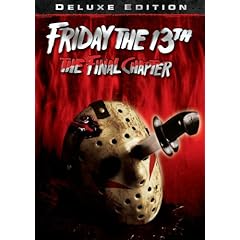 "HE CAN'T BE ALIVE!" Paramount's spiffed-up repackaging of its long and lucrative Friday the 13th series proceeds apace with entries four through six of the slasher saga. First of the threesome to receive the deluxe DVD treatment: the fraudulently named Friday the 13th: The Final Chapter. "HE CAN'T BE ALIVE!" Paramount's spiffed-up repackaging of its long and lucrative Friday the 13th series proceeds apace with entries four through six of the slasher saga. First of the threesome to receive the deluxe DVD treatment: the fraudulently named Friday the 13th: The Final Chapter.Directed by the efficient action exploitation filmmaker Joseph Zito (who lensed Chuck Norris in two of his most profitable low-budgeters, including the bombastic Invasion U.S.A.), Final Chapter is best known among horror aficionados for the return of makeup fx maestro Tom Savini, who did the hacks and slashes for the first flick but was working on other projects during the next two sequels. This proved a lucky break for Savini, since the short-term outcry against this type of movie material had producers tamping down the kinds of gore effects that were his métier. By the time the fourth outing was released, the furor had died down sufficiently for Savini to be able to ply his trade without too much post-production tampering. You get to see lots of his trademark blade-tips-protruding-from-a-victim's torso shots, the first being a fat hitchhiker who gets it in the neck while eating a banana. Apparently, acting like a horny teenager is no longer the only way to get marked for death in this series: being a lover of fresh fruit will do it, too. As with the previous installment, the flick picks up right where the last 'un ended. We're at the site of the earlier 3-D slashings, and Jason's seemingly dead body ("This the guy who's been leaving the wet stuff?" a compassionate paramedic asks when they come to pick up Voorhees' apparent corpse) is taken to the local hospital morgue. There, with no explanation whatsoever, the hockey-masked murderer returns to life, dispatching a dorky morgue attendant and a nurse before trudging back to Crystal Lake. Though his body's vanished and the two hospital employees are dead, nobody in a position of authority apparently thinks that maybe, just maybe, they should return to the original Scene of the Crimes. Back at the said scene, yet another carload of randy kids arrives to provide Jason with stab-worthy material. Among these is eighties moviedom's favorite discomfort-making geek, Crispin Glover, who bemoans his bad luck with women and is nicknamed a "dead fuck" by his obnoxious friend Ted. Glover's Jimmy ultimately gets to score with one of two hot twins, but he isn't given a lot of time to enjoy his new studly status since killjoy Jason quickly does him in after first impaling the guy's hand with a corkscrew. Still, Jimmy has one more memorable moment in the flick: the "dead fuck dance," which he spazzily performs to a generic hard rock track in a misbegotten attempt at impressing one of the twins. Glover's moves are so splendidly awful that the deluxe set includes outtakes of his frenetic footwork. They don't mention the full name of the dance on the outer DVD package, though; don't wanna freak out the customers at WalMart. The big subplot, one that will have repercussions through the next three movies, isn't focused as much on bunk-hopping teens but on the family next door: a separated cougar mom with her teenage daughter Trish (Kimberly Beck) and younger son Tommy (Corey Feldman), who is into horror movie makeup in a big way. It's little Tommy Jarvis who winds up "killing" Jason, but not before confusing the big lug by using his mad makeup skillz (which essentially involves shaving off most of his hair) to impersonate the hulking killer as a young "special boy." This hearkens back to Part 2's big showdown where that flick's heroine faked out Jason by pretending to be his decapitated mother, though how it's supposed to work this time is a pretty big stretch. ("I can't kill that kid -- he's me!") For a serial slasher with the uncanny ability to be anticipate every potential victim's whereabouts, the guy's pretty damn gullible. Unless I miscounted, this is the first 13th to actually live up to its advertized body count. Cougar mom's death is never really shown, doubtless to make way for a Diabolique-influenced ending not included in the final product, but I'm adding it, anyway. Can't really include Jason's own crowd-pleasing demise -- falling face first and slowwlly sliding down a machete -- since we all know that one ultimately doesn't take. As an offering in the series, Final Chapter is arguably a cut above either of the two sequels preceding it, in large part due to the considerable enthusiasm that its cast bring to the whole shebang. Glover's a treat, of course, though Feldman also gets to distinguish himself in terms of physical overacting when he displays his joy over the sight of an undressing vacationer. That he makes it to the end of the film intact after this small bit of voyeurism seems like a violation of the "rules" of slasherdom, but if we learn anything from flicks like these, it's that Life Ain't Fair. Paramount's "deluxe edition" contains the usual bonus material: two commentary tracks, yet another tedious low-rent "Lost Tales from Camp Blood" short, fannish features that include a "Slashed Scenes" segment revealing how some of Savini's bloody fx were done. Prime meat for the Fangoria crowd, which director Zito acknowledges in more than joking voiceover ref to the gorehounds watching this feature. We're also told that Glover "loved doing his death scene; he couldn't wait to do this," as we're shown him hamming it up with a cleaver in his face. Not a surprising bit of behind-the-scenes info, methinks. Labels: psychotronic psinema # |Tuesday, June 09, 2009 ( 6/09/2009 07:03:00 AM ) Bill S.  "IT'S GOT THE SLIME CARPET LAID OUT FOR US!" Co-produced by and starring rapper DMX, Carnivorous is a big-snake low-budgeter that pits the title lead (check out how the opening credits make it read as if the movie's title is DMX Carnivorous instead of just Carnivorous) and a group of disposable irritating teens against an inconsistently-sized CGI creature named "Lockjaw." "IT'S GOT THE SLIME CARPET LAID OUT FOR US!" Co-produced by and starring rapper DMX, Carnivorous is a big-snake low-budgeter that pits the title lead (check out how the opening credits make it read as if the movie's title is DMX Carnivorous instead of just Carnivorous) and a group of disposable irritating teens against an inconsistently-sized CGI creature named "Lockjaw."Said part snake/part alligator was first conjured up in the wilds by a southern boy named Alan Cade to dispose of his abusive drunk of a father. After stealing a demonic pencil from a local juju man named Crazy Kirabo, young Alan takes out his drawing pad and sketches an image of his redneck pappy getting his head chomped by Lockjaw. This naturally brings the voodoo loa to life and sends Daddy to a worthy unseen demise. Cut to twenty years later, and that imaginative little kid is now a balding married shlub living with his wife on the same family farm. Alan (Louis Herthum) pulls out the writing implement, called a Kulev Stick by the voodoo priest's now-grown grandson (DMX), after a group of vacationing teens heedlessly run his wife over with their pick-'em-up truck. These kids are so clueless that they don't even know they've hit the poor woman (later we're told that the truck has truly "awesome" shocks), while Alan is so sharp-eyed that he's able to pick out all five kids sitting in the truck for his summoning drawing. Whenever one of these privileged little snots gets chomped on by the big bad, their piece of the drawing turns all red. "You drew us to death; that sucks!" the least offensive of the quintet accuses the now guilt-stricken Alan. Name-above-the-title DMX doesn't do a whole lot in the movie until its unconvincingly mounted finale. At one point we see him pointlessly hacking his way through a field with his machete and then later buying a bazooka from two unexplained arms dealers. Gets to fire the bazooka at the beastie, of course, but since this is a magical creature, we already know That Trick Never Works. It's never really explained why he decides to help the teens in the first place -- or why his grandpappy didn't retrieve the Kulev Stick from little boy Alan after he'd used it the first time. All that matters is he's there to look Street in the middle of the rural South. Most of the movie's main focus remains on the doomed teen "pork loins," of course, who drink and carouse and make the obligatory arrogant anti-Southern slurs. ("Don't forget to brush your teeth -- where we're going, there aren't too many of 'em, y'all!") For you Friday the 13th buffs, there's even a death-while-coupling scene, though for it to work, the snake has to shrink down a bit. (Magical monster, right?) Another character gets beheaded by what I think is supposed to be the beast's tail, though the effect isn't all easy to suss out. "Don't forget," our hero tells the surviving teens just before the movie's unconvincing showdown, "at the end of the day, it's just a snake -- a really messed-up snake!" If I was given the cover art in a movie this fangless, I'd be messed-up, too. Labels: psychotronic psinema # |Tuesday, April 21, 2009 ( 4/21/2009 04:49:00 PM ) Bill S.  "IT'S THE WHOLE DEATH THING I'M NOT CRAZY ABOUT." Recently picked up a cheap copy of the two-disc "20th Anniversary Edition" of Fred Dekker's The Monster Squad (1987), a flick I hadn't previously seen, though I very much enjoyed Dekker's directorial debut, Night of the Creeps. An entertaining kids' horror comedy described by the writer/director as an attempt at blending "Our Gang comedies with Universal monster movies," Squad was an unfortunate box office flop when it first was released. Co-written by fledgling scripter Shane Black (who later blended the Three Stooges with cop actioner in Lethal Weapon), the movie also owes much to Richard Donner's The Goonies, though to my eyes, it's not as loudly abrasive as that 1985 Spielberg production. Mary Ellen Trainor shows up as a mom in both flicks, though. "IT'S THE WHOLE DEATH THING I'M NOT CRAZY ABOUT." Recently picked up a cheap copy of the two-disc "20th Anniversary Edition" of Fred Dekker's The Monster Squad (1987), a flick I hadn't previously seen, though I very much enjoyed Dekker's directorial debut, Night of the Creeps. An entertaining kids' horror comedy described by the writer/director as an attempt at blending "Our Gang comedies with Universal monster movies," Squad was an unfortunate box office flop when it first was released. Co-written by fledgling scripter Shane Black (who later blended the Three Stooges with cop actioner in Lethal Weapon), the movie also owes much to Richard Donner's The Goonies, though to my eyes, it's not as loudly abrasive as that 1985 Spielberg production. Mary Ellen Trainor shows up as a mom in both flicks, though.Squad concerns itself with a group of monster-mad kids in a small California town attacked by creatures. The quintet of beasties (Drac, Frankenstein's monster, Wolfman, Mummy and Creature from the Black Lagoon) is led by a caped Dracula (Duncan Regher), who has come to the New World to retrieve an amulet that he wishes to destroy so he can overturn the balance between good and evil. Though we're not exactly shown how the movie's creatures united, that's not important. What matters is this: Monsters May Take Over the World! And there's nuthin' but a group of 12-year-old misfits (plus one five-year-old girl) to stop 'em! Black & Dekker's screenplay at times shticks too closely to kid flick clichés -- Squad leader Sean's (Andre Gower) parents are struggling with their marriage; Fat Kid Horace (Brent Chalem) is the movie's comic grouser, though he comes through in a pinch more than once -- but is refreshingly economical in its storytelling. The film clocks in at 82-minutes, no small thing when you consider how bloated so many comedies are these days. A few of its plot points are more than a little rickety: most moviegoers will, I suspect, wonder how a 12-year-old is able to manufacture working silver bullets in shop class, though the bit that truly strained my credulity came earlier in the flick. In it, Sean has come into possession of noted vampire slayer Van Helsing's diary. Dracula wants said book, so he phones Sean's mother who takes down a message that a "Mr. Alucard" called about buying the book. Suspicious, our boy writes the name down on a piece of paper, fiddles with the letters and realizes that Alucard is Dracula spelled backwards. Half a mo', we think. We know that Sean's a classic monster movie buff: shouldn't he have recognized that obvious alias from Lon Chaney Jr.'s turn as the vamp in Son of Dracula? The heart of the movie belongs to character actor Tom (Manhunter) Noonan as the Frankenstein monster. The creature bonds with Sean's five-year-old sister Phoebe (Ashley Banks) and, much like John Matuszak's Sloth in The Goonies, performs a crowd-pleasing rescue in the movie's climactic showdown. The scene where the two meet is ironically framed by Dekker like the monster-and-child moment from James Whale's Frankenstein, though we never really worry for her safety with Noonan's creature. When Regher's sadistic Drac grabs the girl and holds her pudgy little face in his hands, that's a whole other matter. Phoebe's moment of peril is arguably the PG-13 picture's one true suspenseful scene. Though the rest of the squad has scenes of personal danger, only the youngest viewers'll most likely take 'em seriously. A lotta faceless town cops get trashed in the movie's finale and a few anonymous small town damsels are transformed into vampiresses, but the Squad itself emerges relatively unscathed. Can't say the same thing for the Wolfman, though, who gets kicked in "the nards," prompting the movie's big inappropriate laff line. Lionsgate's two-disc anniversary edition contains the by-now-inevitable director and actor commentary, plus an extended feature looking back at the making of Monster Squad. Though relatively low-budget, the film does boast fx and makeup work by two big names (Richard Edlund and Stan Winston, respectively); Winston, in particular, does an ace job suggesting without duplicating Universal's copyrighted monster images. A few action moments look like they'd have benefited from at least one more shooting, but like I say it all moves so quickly that you barely notice. And when Fat Kid Horace wounds the Big D. by slapping a garlicky slice of pizza on his face, you know you're watching horror kid flick history being made. For that alone, Monster Squad deserves to be rescued from the discount bins. Labels: psychotronic psinema # |Sunday, March 29, 2009 ( 3/29/2009 08:40:00 AM ) Bill S.  "FIFTY DOORS IN THE PLACE AND ONLY THIRTEEN KEYS." Fingering through the DVD discount bins, you sometimes can come across some genuine curiosities. Recently, checking out the five buck discs at a local Walgreen's, I happened on the low-budget old dark mansion flick, House of the Damned. Released in 2006 on Fox Home Entertainment Video, the 1963 black-and-white featurette (only runs 63 minutes) comes as a flipper disc in both wide and full screen versions. I recently viewed the wide screen "cinemascope" version and found myself charmed by it, though I suspect that some viewers, bamboozled by the movie's wholly deceptive tagline ("13 Keys to Unleash the Living Dead"), might be pissed off at the picture. "FIFTY DOORS IN THE PLACE AND ONLY THIRTEEN KEYS." Fingering through the DVD discount bins, you sometimes can come across some genuine curiosities. Recently, checking out the five buck discs at a local Walgreen's, I happened on the low-budget old dark mansion flick, House of the Damned. Released in 2006 on Fox Home Entertainment Video, the 1963 black-and-white featurette (only runs 63 minutes) comes as a flipper disc in both wide and full screen versions. I recently viewed the wide screen "cinemascope" version and found myself charmed by it, though I suspect that some viewers, bamboozled by the movie's wholly deceptive tagline ("13 Keys to Unleash the Living Dead"), might be pissed off at the picture.The movie concerns a California Spanish-style mansion with dungeon, that is on the verge of being put up for sale since its previous tenant -- a former tent show owner named Captain Arbuckle -- has disappeared mysteriously and ceased paying his lease. Struggling architect Scott Campbell (Ronald Foster) and his wife Nancy (Merry Anders, a regular on sixties TV series who also had a role in Women of the Prehistoric Planet) have come to the house as part of a possible renovation project. (The only thing vaguely architectural that we see him doing is going around the first floor with a measuring tape.) Because the mansion is, of course, out in the middle of nowhere, the two spend the night, expecting to be joined by Scott's lawyer buddy Joe Schiller (Richard Crane) and his shapely foreign wife Loy (Erika Peters). Joe and Loy don't show that first night, leaving our couple to be unnerved by a series of mysterious goings on in the house. While they are sleeping, a legless something makes its way into the room and swipes two of the thirteen keys that they've been given by a real estate. An investigation of the house uncovers only one still-locked door, however, though our spooked couple somehow manages to forget that there's a dungeon in the building until late in the movie. Later, when the lawyer's wife Loy is kidnapped by a hulking giant (Richard Kiel, a year after his appearance in Eegah), they still manage to forget about the basement digs until long after they've gone through the rest of the mansion. Atmospherically filmed by Maury Dexter (The Day Mars Invaded Earth, Maryjane, The Mini-Skirt Mob), House works more on being moody than frightening, though a red herring subplot concerning the mansion's institutionalized former owner contains a decent little jump scare. There's an odd little subtext in the script, pertaining to the two couples' marriages. Scott and Nancy, we're reminded more than once, have just celebrated their anniversary, while the lawyer and his missus are currently experiencing a rough patch thanks to the "excitable" wife's jealousy. Both marriages are meant to be compared and contrasted to the relationships between the house's true denizens, though the script doesn't really do all that much with this theme. Despite the movie's misleading poster blurb, the solution to all the dark night hi-jinx turns out pretty Scooby Doo-ish. (Soon as you learn the missing Captain Arbuckle once ran a traveling circus, you can see where the plot is going: the culprits are all sideshow human oddities!) The flick's troublemakers prove to be benign at heart; even the house's one dire moment -- the sight of a headless Loy reaching out for Nancy -- turns out to be an old-fashioned carnie gaffe. The whole thing wraps on a somewhat melancholy note, as the movie's mislabeled quartet of the "damned" shuffle up the dungeon steps to venture out into the sunlight. When one of them says they fear "the faces" of the outside world, the group's seeming leader (a none-too-imposing circus fat lady played by Ayllene Gibbons) states simply, "We've all been looked at before." An odd capper to this peculiar little low-budgeter. Labels: psychotronic psinema # |Thursday, March 19, 2009 ( 3/19/2009 10:33:00 AM ) Bill S.  "COME ON, THEN, MUTTON CHOPS!" Ever since Night of the Lepus, the idea of building a horror comedy around traditionally fright-free creatures is one that resonates in the hearts and bloody minds of wiseass horror buffs – and in the case of Jonathan King's Black Sheep (Dimension Extreme Films), the ironic subtext is magnified immensely by its country of origin. Filmed and set in New Zealand, home to "40 million sheep, four million people," the film concerns a dangerous flock of "Frankensheep" that run amuck after a pair of ineffectual "lunatic greenies" accidentally release a genetics lab's failed experiment. "COME ON, THEN, MUTTON CHOPS!" Ever since Night of the Lepus, the idea of building a horror comedy around traditionally fright-free creatures is one that resonates in the hearts and bloody minds of wiseass horror buffs – and in the case of Jonathan King's Black Sheep (Dimension Extreme Films), the ironic subtext is magnified immensely by its country of origin. Filmed and set in New Zealand, home to "40 million sheep, four million people," the film concerns a dangerous flock of "Frankensheep" that run amuck after a pair of ineffectual "lunatic greenies" accidentally release a genetics lab's failed experiment.The guiding force behind the lab is an unpleasant agribusinessman named Angus Oldfield; his nebbishy brother Henry (Nathan Meister) is returning to the family farm after a traumatic childhood incident spurred a profound case of ovinophobia. Angus, we're given more than a broad hint, has a none-too-healthy interest in the sheep on his farm, which is capped by a wondrously sick scene near the end of the film. (Almost as memorable as the flying penis from Street Trash.) Brother Henry has returned to the family farm to sell his half to his brother; the first time we see him as an adult, he's not so quietly freaking out over a flock that has innocently wandered onto the road. "My therapist said I should come," he explains. Later, of course, after we’ve seen the failed medical experiment rip onto the ear of a hippie animal activist (and said activist's transformation into an upright were-sheep), a farmhand's grisly demise and beaucoup attacks by snarling animatronic sheep, we can empathize with Henry's anxiety. In one of the movie's most visually memorable bits, we see a second flock running down the hilly countryside to attack a crowd of would-be business investors; the pastoral image is instantly contrasted by an ultra-bloody sequence where, among other things, we're shown two sheep engaging in a tug of war with a still-screaming victim's intestines. 'But I'm a vegetarian!" one of the bloodied investors proclaims. Hero Henry bands with a rowdily rough-hewn farmhand (Tammy Davis) and an animal activist named Experience (Danielle Mason), who provides more than her share of comic hippie bromides. "I should have known you were an Oldfield," she tells Henry during their initial meeting. "I can see it in your aura." Later, after the two of them have fallen into a pit of biogenetic offal, she elevates her opinion of our hero. As a horror splatter comedy, Black Sheep is one of those indy jobs that blurs the line between intentional and unintentional camp, while I suspect some of its jokes ring louder in New Zealand than they do outside its native land. Still, the movie's practical (as opposed to digital) effects are strong, and there's even a transformation scene that's a straight-up tribute to Rob Bottin and Rick Baker's work on The Howling and An American Werewolf in London, respectively. Dimensions' DVD, which I originally got from the cheap disc shelves at Wal-Mart, also contains a "Making of" feature with plenty of shots of giddy FX geeks playfully slathering on the fake gore, a blooper reel and some deleted scenes that don't really add much to the flick. If you're like me, though, and you prefer remaining in the dark about the mechanics of horror movie effects, you'll probably want to skip the extras. Except, perhaps, the quickie scene "Early Morning," which was shot for the DVD release and extends the joking sheep refs into a wall-shattering morning after gag. Glad they didn't include it in the movie. Labels: psychotronic psinema # |Saturday, March 14, 2009 ( 3/14/2009 09:22:00 AM ) Bill S.  "YOU'RE ALL SET FOR A CANNIBAL FEAST." Though its title has spent decades lodged in my brain, I only recently had the opportunity to view Jack Hill's 1968 exploitation classic Spider Baby (a.k.a. The Maddest Story Ever Told). A low-budget horror camp fest starring a very down-on-his-luck Lon Chaney (who clearly struggles to put a game face on it all), Baby concerns a family of wealthy in-breds who suffer from a syndrome that has them growing more infantile as they age. The three youngest -- sisters Virginia and Marilyn Merrye, plus imbecile brother Ralph Merrye (the inimitable Sid Haig, overacting to the hilt here) -- dress in children's clothes and are shielded from the world by former family chauffeur Bruno (Chaney). "They're what you might call retarded," Bruno explains at one point, though in actuality their affliction is much worse. Deep within the decaying mansion's basement, the elder family Merryes have all devolved into hairy cannibalistic pre-humans, though we're never really given too clear a look at 'em. "YOU'RE ALL SET FOR A CANNIBAL FEAST." Though its title has spent decades lodged in my brain, I only recently had the opportunity to view Jack Hill's 1968 exploitation classic Spider Baby (a.k.a. The Maddest Story Ever Told). A low-budget horror camp fest starring a very down-on-his-luck Lon Chaney (who clearly struggles to put a game face on it all), Baby concerns a family of wealthy in-breds who suffer from a syndrome that has them growing more infantile as they age. The three youngest -- sisters Virginia and Marilyn Merrye, plus imbecile brother Ralph Merrye (the inimitable Sid Haig, overacting to the hilt here) -- dress in children's clothes and are shielded from the world by former family chauffeur Bruno (Chaney). "They're what you might call retarded," Bruno explains at one point, though in actuality their affliction is much worse. Deep within the decaying mansion's basement, the elder family Merryes have all devolved into hairy cannibalistic pre-humans, though we're never really given too clear a look at 'em.This idyllic family scene is disrupted when a pair of relatives arrives, angling for a piece of the Merrye moneys. Peter (soap regular Quinn Redeker) appears to be the nice half of the duo, though he's not averse to taking any of the family fortune he can get, while his sister Emily (shapely Carol Ohmart, who gets to dance in front of a mirror in some sexy lingerie) is more mean-spiritedly avaricious. Also accompanying them: a sleazy lawyer with an Oliver Hardy mustache and his legal secretary Anne, the requisite good girl in peril. We also get to see an aging Mantan Moreland (Birmingham from the Charlie Chan features) as an unfortunate deliveryman stabbed to death by the spider-obsessed Virginia, who also slices off an ear and places it in a matchbox. Moreland's called to do his trademark fraidy cat skittishness, and that anyone would think to have him recreate this type of role in the mid-sixties (though released in '68, the movie actually was filmed four years earlier) is pretty amazing. Too bad he's gone after the first ten minutes. Hill (also responsible for such law-budget gems as Coffy, Switchblade Sisters and Swinging Cheerleaders) wrote and directed this odd little feature as a horror comedy. The broadest comic sequence is a dinner scene when our interloping visitors get to dine at the Merrye table: told that the three "children" all are vegetarians (since meat, apparently, speeds up the degenerative process), the four guests are fed a neighborhood cat that Ralph has caught in the yard. It's an effectively awkward moment. The movie's horror scenes are filmed with gusto, even if the extremely low budget keeps the director from showing us too much. There's a way-too-long sequence where the sleazy lawyer makes his way through the house, and the explosive climax definitely shows its budgetary limitations. But the family's climactic attack on Anne -- with Virginia pulling out a hacksaw to cut off the girl's foot so she can't get away -- actually had me worried for a few moments, even though I knew from the jolly introduction provided by hero Peter at the movie's beginning that she'd probably survive her visit to the Merrye Mansion intact. Probably not the "Maddest Story Ever Told," but a diverting slice of period cheese. Reportedly, a remake is in the works. Bet they blow it. Labels: psychotronic psinema # |Sunday, February 22, 2009 ( 2/22/2009 10:20:00 AM ) Bill S. 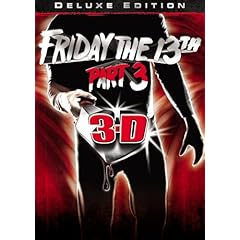 "I'LL NEVER FORGET THAT HORRIBLE FACE, NEVER!" With Friday the 13th -- Part 3, the popular, if critically maligned, horror series fully settled into its formula. Having set Jason Voorhees as its centerpiece slice-and-dicer, the only steps left were to 1.) establish his seeming indestructibility and 2.) get him a hockey mask so that makeup folks didn't have to work every day slathering on his demented creature face. The first is accomplished during the movie's final showdown between Jason (a somewhat slighter-looking Richard Brooker) and this outing's spunky heroine (Dana Kimmel). When Kimmel's Chris ties a noose around the killer's neck and knocks him off the upper loft of a barn, the act doesn't snap our stubborn psycho's neck. Instead, he lifts his arms and pulls himself up to get out of the noose. "You can't be alive!" Chris shouts, but we in the audience know differently. "I'LL NEVER FORGET THAT HORRIBLE FACE, NEVER!" With Friday the 13th -- Part 3, the popular, if critically maligned, horror series fully settled into its formula. Having set Jason Voorhees as its centerpiece slice-and-dicer, the only steps left were to 1.) establish his seeming indestructibility and 2.) get him a hockey mask so that makeup folks didn't have to work every day slathering on his demented creature face. The first is accomplished during the movie's final showdown between Jason (a somewhat slighter-looking Richard Brooker) and this outing's spunky heroine (Dana Kimmel). When Kimmel's Chris ties a noose around the killer's neck and knocks him off the upper loft of a barn, the act doesn't snap our stubborn psycho's neck. Instead, he lifts his arms and pulls himself up to get out of the noose. "You can't be alive!" Chris shouts, but we in the audience know differently.The hockey mask gets donned about an hour into the film -- after Jason takes it from the movie's obligatory joker ("I beg your pardon," said prankster says at one point in the flick, "I'm not an asshole, I'm an actor!") who'd used it with a spear gun to frighten a girl he wishes to impress. Our joker gets it at the hands of Jason, of course, as does the girl, who proves victim to one of the movie's cooler 3-D moments: a face-on spear gun shot that definitely got folks in the original theater audience ducking. This 3-D buff knows because he was there. The 3-D fx are Part Three's primary raisin d'etre, and returning director Steve Miner happily reupped the gore factor from the previous flick to accommodate 'em. Part Three wasn't the first horror movie to utilize three-dimensions to enhance its kill scenes -- that honor belongs to Paul Morrisey's campy Flesh for Frankenstein -- but it unsparingly took advantage of the technique. The film may look visually muddy, but when that spear comes your way, a hand-standing teen gets chopped in two or a victim's eyeball pops into the camera, it's undeniably effective. Watching it in regular dimensions, though, the stylized nature of the action becomes blatant. As the movie's actors hold pointy objects in your face for longer than they would in real-life, you can't help thinking of John Candy and Eugene Levy leaning back and forth into the camera with goofily menacing expressions on their faces. Too, viewing Part Three after sitting through the recent DVD "deluxe editions" of the first two Fridays, there's a sense that once the filmmakers decided to make their picture in 3-D, they gave up any other pretense toward innovation. One of the killings proves a direct copy of Kevin Bacon's throaty demise from the first flick, while the movie's finish unapologetically swipes Adrienne King's memorable canoe hallucination, only this time replacing kiddie Jason with a rotting Mama Voorhees. Miner and company don't bother to deny what they're doing -- before the killing, they show our doomed victim reading an issue of Fangoria with an article devoted to makeup man Tom Savini -- but that can't eliminate the sense of overfamiliarity. A couple of small story tweaks should be noted, though. In addition to slaying the usual horny teens and the occasional overly interested snoop, Jason has started to widen his overly moralistic path. First victims we see after a too-long intro using selected footage from the previous film are a pair of country storekeepers: a slovenly wife and an overeating husband. No longer content to settle with Lust as a primary factor in victim selection, Mr. Sinners-on-the Edge-of-an-Angry-Machete now slices the Gluttonous and Slothful. After he later dispatches a trio of Wrathful bikers, you half expect Kevin Spacey to pop up once the hockey mask's removed. Paramount's new "deluxe edition" DVD reissue comes with the flick in both its 3-D and plain formats -- and helpfully includes two cardboard glasses for those who want to brave the former. I sincerely tried the 3-D version, but found the experience even murkier than I remembered on my old-fashioned 26-inch Toshiba. (I did jump ahead to the eyeball kick, though.) The plain version of the film looks dirtier in places than either of the previous reissued Fridays, but not distractingly so. Still, if you've never seen this rascal in 3-D and have a better home entertainment set-up than this writer, that's the way to go. More than anything, the addition of that extra dimension announced the series' full transition from a story series into a logic-bedamned plotless amusement park ride. For the largely uncritical audience that continued to make the formula a hit, the shift doubtless went unnoticed. Labels: psychotronic psinema # |Wednesday, February 18, 2009 ( 2/18/2009 06:59:00 AM ) Bill S. 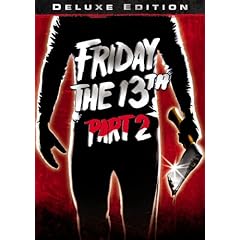 "BEING A CAMP COUNSELOR ISN'T THE GRAVY SUMMER JOB EVERYONE THINKS IT IS." For many slasher film aficionados, the Friday the 23th franchise doesn't truly take off until its second entry: when Jason Voorhees takes charge. Sean Cunningham's initial Friday, after all, only featured the iconic killer as a young boy dream creation; it's the first sequel that imagined him as full-grown, "some sort of demented creature, living in the wilderness" of New Jersey. "BEING A CAMP COUNSELOR ISN'T THE GRAVY SUMMER JOB EVERYONE THINKS IT IS." For many slasher film aficionados, the Friday the 23th franchise doesn't truly take off until its second entry: when Jason Voorhees takes charge. Sean Cunningham's initial Friday, after all, only featured the iconic killer as a young boy dream creation; it's the first sequel that imagined him as full-grown, "some sort of demented creature, living in the wilderness" of New Jersey.The Jason that we meet in Part Two hasn't been fully tweaked into the hockey mask wearing murder machine that we know from later installments, though. This half-formed Jason wears a burlap sack with one eyehole (must not do much for his depth of vision) and a surprisingly fresh pair of boots over his large feet. We see these boots a lot in the flick, since new series director Steve Miner keeps the camera on 'em during most of his appearances in the first two-thirds of the picture. The demented creature lives in a trashed-out trailer with a grungy toilet and a shrine devoted to his decapitated mother. The latter is respectfully festooned with burning candles and the occasional camp counselor corpse. Ah, the rustic life. First time we see Jason do his thing, it's for the purpose of dispatching Adrienne King's Alice, the sole survivor of the initial Friday. Per a feature included in the first flick's DVD set, the filmmakers originally wanted Alice back for a more substantial role in the sequel, but the actress' personal distress over being terrorized by a stalker fan kept her from participating in all but a few days of shooting. Her presence in the opener proves effective, though I'm still wondering how Wild Child Jason knew how to use a pay phone to terrorize poor Alice. The pre-title sequence also established Part Two as a more conventionally shot horror flick than its predecessor. It even pulls out one of the hoariest tricks in the horror movie canon -- the shrieking cat that jumps out at the heroine to a soundtrack sting -- just to get the audience tittering. This somewhat slicker approach ultimately works against the movie's scares, however. Aside from Alice's unexpected demise, there's not a single surprising moment in Part Two. Some of the blame can be laid at the feet of the moving rating system. Prodded by prudish critics like Gene Siskel (who, infamously, printed Betsy Palmer's address as part of a campaign against the first Friday), the MPAA was noticeably harsher in its rating of Two's killing scenes than it was the first. In place of Tom Savini's show-stopping grand guignol murder fx, quick cuts and suggestion were the order of the day. Thus, the killing of a couple mid-coitus was presented through the shot of a spear coming down, then a quick cut to the underside of the bunk where we see the bloody spearhead poking out. The actual moment of penetration was cut, significantly weakening the bit. Though Alice's scene reportedly occurs two months after the first Friday, the film's big story doesn't take occur until five years later. There, the first of many doomed attempts to open a summer camp on Crystal Lake in the aftermath of Mrs. Voorhees' rampage begins -- as the usual gaggle of horny students converge on the area to provide steady victims for our psycho killer. Among these are Ginny (Amy Steel), a Child Psychology major who'll use her book learning to deceive the immature Jason, and Paul (John Furey), the idiot who wants to open a summer camp for inner city youth within hiking distance of the place they call Camp Blood. Among the other potential victims are a wheelchair-bound counselor, a way-too-skinny skinny-dipping blond and her cute fluffy dog. When the pup meets up with Jason, director Miner immediately cuts to a shot of hot dogs on the grill. A couple of for-real grown-ups also buy it in this flick: Crazy Ralph, the prophet of doom who also showed up in the first outing, and an unfortunate cop who happens upon Jason's trailer and the sight of Ma Voorhees' decomposing head. Still, the primary body count remains them horny kids, though, interestingly, Ginny manages to survive the movie though we clearly know that she's been active with Paul. Jason even inexplicably leaves her alive, even after crashing through a window and grabbing her. Wha happened? Darned if we know since the movie's finale is pretty choppy. Last thing we see is a shot of Jason's shrine with a flow tracking shot moving in on Mama's face; we wait for something to jump out at us, but nothing does. A definite anticlimax. Part Two's "deluxe edition" DVD set also includes yet another entry in the ineptly shot "Lost Tales from Camp Blood" series, a piece on Friday's place in the horror con scene plus an interview with Peter M. Bracke, author of Crystal Lake Memories: The Complete History of Friday the 13th. It's from Bracke that we learn that over a minute of grisly fx footage was excised from this outing and that initial creators Cunningham, scriptwriter Victor Miller and makeup man Savini refused to be a part of the sequel because they thought the idea of Jason being the killer didn't make any sense. Initially, Cunningham & Miller wanted to turn the series into an anthology title, much like John Carpenter attempted with Halloween: Season of the Witch -- and we all know what a box office bonanza that turned out to be. And so the Friday the 13th series became The Jason Show. It'd take several more entries before filmmakers would introduce any supernatural elements to "explain" this unstoppable creation; for now, he's just a deformed man/boy with a lotta pointy things. "I doubt Jason would have even known the meaning of death," would-be shrink Ginny states at one point in Part Two, as she drunkenly reflects on the image of demented Jason watching his mother die. Clearly, the self-taught slasher learned its meaning over the years. Labels: psychotronic psinema # |Sunday, February 15, 2009 ( 2/15/2009 12:57:00 PM ) Bill S. 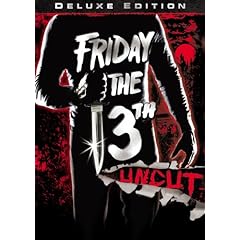 "YOU MAY ONLY SEE IT ONCE, BUT THAT WILL BE ENOUGH!" With a Michael Bay-produced remake in the theatres and two months of real Friday the 13ths lined back-to-back, it's an auspicious time for Paramount to reissue "Deluxe Editions" of its first three Friday the 13th flicks. "Kill . . . Kill . . . Kill . . . Uncut," the back of the box to the 'un trumpets, and that really sez it all. "YOU MAY ONLY SEE IT ONCE, BUT THAT WILL BE ENOUGH!" With a Michael Bay-produced remake in the theatres and two months of real Friday the 13ths lined back-to-back, it's an auspicious time for Paramount to reissue "Deluxe Editions" of its first three Friday the 13th flicks. "Kill . . . Kill . . . Kill . . . Uncut," the back of the box to the 'un trumpets, and that really sez it all.As scriptwriter Victor Miller notes in two separate bonus features, the primary intent behind the first Friday was to "rip off Halloween." Director/producer Sean Cunningham already had prior experience taking better films and turning 'em into durable low-rent fare -- his 1972 Last House on the Left, done with a young Wes Craven, was a crassly energetic drive-in remake of Ingmar Bergman's classic art flick The Virgin Spring -- though nobody expected Friday to spawn the franchise that would rise from the depths of Crystal Lake. As Porky's was to Animal House, so Friday the 13th was to Halloween: a dumbed-down amalgam of the elements that made the original low-budget sources so successful. In Friday's case, of course, the formula was simplicity itself: strand a batch of young and randy teenagers away from adult authority and then put them at the mercy of a seemingly omnipresent killer. (The only adult authority we meet before the denouement is a comic relief cop who acts like he's wandered in from some sixties drive-in hillbilly comedy.) Let the closest-to-virginal -- even if she's not averse to a game of Strip Monopoly -- teen girl survive for the big face-to-face showdown with the killer. Kill off all the rest. Cunningham even managed to snag the child of Hollywood royalty for a role (Bing's son, Harry Crosby, who gets an arrow in his eye), though the part was not the ticket into a major career that Halloween would be for Jamie Lee Curtis. Paramount's new DVD and Blu-Ray reissues of Friday the 13th Uncut reportedly restore ten seconds of footage to the film, though it's difficult to detect where these once-excised seconds are in the uncut version. Presumably, they're a part of makeup maven Tom Savini's crowd-pleasing kill effects, but I couldn't state this for certain. Though most viewers recall the big onscreen fx -- the full-on throat slashing of Robbi Morgan's hitchhiker victim, the arrow-through-the-throat demise of a young and studly Kevin Bacon, the decapitation of Betsy Palmer's mad Momma Voorhees -- the fact is that a majority of the movie's bloody demises occur off-camera. And while the trailer attempts to give the impression that thirteen different people buy it in the flick (they even repeat surviving plucky heroine Adrienne King twice in the trailer's phony body count), Friday's actual death count proves significantly lower. The point of it all, of course, is plain ol' Barnum-esque sideshow exploitation. Much of the fun behind the Savini-orchestrated death scenes is in getting the audience to go, "Whoa, how'd they do that?" It's a "magic show," director Cunningham notes during one of the set's bonus interviews, one that current CGI-generated horror flicks can't match since everybody knows the big visual moments have been created in some techie's computer. As a movie, Friday the 13th is economical and fairly artless, though Miller and Cunningham (who'd gotten his start directing "educational" skin flicks like The Art of Marriage) do a decent job setting up the mechanics of their big kills. A sequence with the movie's camp counselors attempting to corral a snake in their cabin, for instance, helps establish the space beneath the bunks that will make the death of Kevin Bacon's Jack possible as well as the presence of a machete that'll prove Missus Voorhees' undoing. At times, the movie's low-budget restrictions even work in its favor. Where later entries in the series, for instance, used composer Harry Manfredini's Bernard Herrman swipes as stingers for a batch of false scares, the first flick's more parsimonious use of movie music adds to its effectiveness and results in some surprisingly effective moments. Friday's characterization is minimal, to say the least, but the inclusion on the DVD of a "bonus" short entitled "Lost Tales of Camp Blood -- Part One" establishes that Miller & Cunningham knew enough about storytelling to at least provide some recognizable character types (the goofy guy who's always playing pranks on the rest of the cast, the pot-smoking party girl, the crazy coot who delivers an unheeded warning, etc.) In contrast, "Lost Tales" doesn't make the slightest effort at establishing its two victims before it snuffs them out. For all the lambasting that the original received at the hands of mainstream movie critics, at least it worked to hook its teenage audience. As someone who saw the first Friday the 13th in an old and odiferous Central Illinois movie house the year it came out, I'll admit to having a small soft-spot when it comes to this flick. The movie may be cheap, but has it has a go-for-broke honesty that few of its slicker followers can muster. I can still remember jumping during its Deliverance/Carrie-inspired final dream sequence: the one that showed us Jason Voorhees as a moldering mongoloid child corpse leaping onto Adrienne King's canoe to drag her into the depths of Crystal Lake. "He's still out there," the freaked-out heroine tells us at the close of this exploitation classic. He still is. Labels: psychotronic psinema # |Friday, January 16, 2009 ( 1/16/2009 10:05:00 PM ) Bill S.  "WE ALL HAVE OUR SECRETS." Fred Olen Ray is a busy guy. In addition to his work creating low-budget horror movies like the inimitable Hollywood Chainsaw Hookers and Evil Toons -- and wrestling under the nom-du-ring of Freddie Valentine -- Ray is a prolific creator of equally cheap soft-core skin flicks under the name of Nicholas Medina. Regularly stuffed into the late hours of movie cable channels, Medina's oeuvre is typified by the DVD version of Voodoo Dollz (Retromedia), an eighty-minute series of hot girl-on-girl sex scenes held together by the sketchiest of plots. "WE ALL HAVE OUR SECRETS." Fred Olen Ray is a busy guy. In addition to his work creating low-budget horror movies like the inimitable Hollywood Chainsaw Hookers and Evil Toons -- and wrestling under the nom-du-ring of Freddie Valentine -- Ray is a prolific creator of equally cheap soft-core skin flicks under the name of Nicholas Medina. Regularly stuffed into the late hours of movie cable channels, Medina's oeuvre is typified by the DVD version of Voodoo Dollz (Retromedia), an eighty-minute series of hot girl-on-girl sex scenes held together by the sketchiest of plots.The movie concerns a buxom "schoolgirl" named Christina (Christine Nguyen), who is kicked out of the Collinsport School for Girls after being caught in flagrante with a flat-chested classmate by the school's headmistress. "In all my years at this school," the outraged headmistress (a too-briefly-seen Michelle Bauer) states, "I've only seen something like this thirty or forty times!" Because she's "untouched by the hands of men," Christina gets shunted off to the Dunwich School for Girls where she's assigned a room with a neophyte voodoo practitioner Maria (Charlie Laine). Roomie Maria is in serious lust with the all-girl school's "only guy for miles around," studly gardener Jeff (Alexandre Voisvert a.k.a. Voodoo). But she has two rivals in blond bimbettes Jilly and Sandra (Beverly Lynne and Nichole Sheridan). Utilizing a mime-faced voodoo doll, snippy Maria regularly arouses the latter without ever letting her achieve full orgasm. Fortunately for the enthralled Sandra, Christina shows up to help the poor girl. Medina/Ray also tosses in a miniscule bit of plot concerning Dunwich schoolmistress Miss Dambahla (Monique Parent) and her shapely henchwoman Miss Santana (Hawaiian adult film queen Syren), who have plans to sacrifice our "bad girl" heroine to a voodoo deity whose name I couldn't quite catch. This leads to a thrill-free climax with "virgin" Christina tied to a cross in the school's basement/dungeon and the otherwise useless Fred showing up to rescue her. The movie concludes with one of the least convincing conflagrations in low-budget history. But, really, you don't come to a flick like this expecting anything more than what it offers: lots of scenes of pretend schoolgirls doffing their uniforms and writhing together on-camera to a waka-waka guitar. "Older" thespians Parent and Syren get their own steamy pretend sex scene, and there's also a prolonged shower sequence where Miss Santana makes like the lads from Porky's and peeps on a slickly lathered Christina. But the primary focus remains on them naughty schoolgirls -- which is as it should be. "We're all outcasts," Maria tells Christina when they first meet. "You know: the girls nobody wants." Judging from the extensive adult film resume that each one of these ladies brings to this picture, you know that statement ain't true. Labels: psychotronic psinema # |Monday, December 29, 2008 ( 12/29/2008 07:42:00 AM ) Bill S. "YOU WILL BE REPLACED/YOU WILL BE. . . RE. . .PLACED." So I'm watching a DVD of James Gunn's Slither this weekend, and I get a brief object lesson on the perils of bringing political criticism to a horror flick. The movie, for those who haven't seen it, is about a plague of outer space "worms" that infest most of the inhabitants of a small town. Serving as one hive mind, they enter humans (and animal) bodies through the mouth and transform their victims into mutated raw-meat-eating zombies or bloated living egg sacs filled with even more worms. ("It's a conscious disease," one of the characters notes.) Though each victim shares the consciousness of the worm's first victim, a balding rich geezer played by Michael Rooker, they also display flashes of their own former personality - which the writer/director plays for some unsettling comedy. The movie is good gory fun, though it did have a joke in it that I kept thinking about once the end credits finished rolling. In a later scene, one of the still-surviving characters comes across a group of the transformed townsfolk, all of which are devouring raw meat and the bodies of unfortunate former pets and possums. "Are you trying to judge me?" a bloody-mouthed biddy demands. "Damn Republican!" The line made me laugh when I heard it, but, afterwards, I started wondering whether scriptwriter Gunn wasn't trying to squeak a satiric point into the movie about the ditto-headed nature of liberals. This is a man, after all, who helped to layer a Biblical End Times motif onto the remake of Dawn of the Dead. Perhaps he was trying to slip a little ideological joking into his popcorn picture? If so, the nature of his material worked against this intent. Much like the original Invasion of the Body Snatchers can be viewed as both a comment on the dangers of Communism and McCarthyism, the group think dramatized in Slither works as a play on any form of thought-free collectivism. (It wasn't a liberal, after all, who came up with the phrase "ditto-head.") It may be a case of story and characters being bigger than the writer's own narrow political perspective; it may be I was reading more into Gunn's little joke than he intended. Either way, I still dug the movie. . . Labels: psychotronic psinema # |Monday, October 31, 2005 ( 10/31/2005 01:12:00 PM ) Bill S. "THE EYES ARE ALIVE; THE EYES ARE ALIVE!" – When I first read the title to the silent creeper, Eyes of the Mummy (1918), I immediately started recalling Universal's 1932 Karloff outing, The Mummy: the monster standing upright in his sarcophagus, some poor schlub of an archeologist innocently sitting mere feet away from an awakening Im-Ho-Tep, a close-up on the eponymous mummy's face showing its eyes fluttering open. It was one of the creepiest moments that beloved old monster movie, and I figured there had to be a comparable moment in this Ernst Lubitsch-directed feature. I was wrong. Recently broadcast by TCM as one of its "Silent Sunday Features," the film centers around a dark love triangle between a British painter named Albert (Henry Liedtke), an exotic and free-spirited Egyptian maid named Ma (bushily eyebrowed Pola Negri) and the villainous dark-faced Arab (Emil Jannings) who has been holding the girl a prisoner in the Burial Chamber of her namesake Queen Ma. Said burial chamber, located just a reasonable camel's ride from Cairo, is said to be cursed ("Anyone who enters meets with misfortune,") which naturally piques the vacationing painter's curiosity. He rides across the desert to Queen Ma's tomb, where we first meet Jannings' Radu, lying on the sand in front of the entrance. Our hero enters the darkened chambers (the light mysteriously turning on and following the characters as they move across the screen) where Radu is waiting to ambush him. The Arab shows Albert a coffin with a face in bas-relief and two eyes peering through the holes – then he attempts to stab our dashing young hero. A scuffle ensues, and Albert shoots his attacker. Opening the coffin to find an entryway to a hidden chamber, he discovers the beauteous Ma cowering in fear. The young girl tells him she was abducted by Radu "a couple of years ago" while she was gathering water. The scene where her abductor gallops up and grabs her in the river is so ploddingly directed you can't help wondering why Ma doesn't escape the clutches of this water logged baddie (his horse clearly has difficulty negotiating the water). But it appears the blackguard has some powerful (if ill-defined) Svengali-esque hypnotic powers that can stop the girl in her tracks. After Albert whisks the young girl away to safety, the vaguely wounded Radu staggers across the desert in pursuit, to be found by a slow-moving expedition of wealthy Britishers. Radu swears loyalty to the head of the expedition for saving him and becomes his manservant. We all know that the villain is gonna meet up with Ma when she and her rescuer return to the British Isles. Suffice it to say, he does, though not before we get scenes of Ma being schooled in European culture, making an awkward debut in British society and capturing the attention of a variety show producer by performing an "exotic" dance. She becomes a hit on-stage, and it's here that manservant Radu re-discovers Ma. Our heroine passes out in the middle of her athletic dance moves after her nemesis apparently shoots some wicked thoughts down from the balcony. The movie ends tragically, but you're not quite sure how. When Radu breaks into the house and menaces our heroine with a knife that we could've sworn he'd left in a painting of Ma just a few minutes before, she passes out then unexplainably expires in his arms. Did Radu stab her during the brief cut away to the girl's desperate husband; did she die of fright or did he just will her dead? When the villain, now suddenly distraught over the death of his former hostage, turns the knife towards himself, the director fades away to the movie's hero, then shows him dashing onto the scene to find both bodies splayed upon the floor. "It's over!" our hero says into the camera, while the befuddled modern audience goes, "What's over?" Say what you will about the greater explicitness of today's movies, at least you know what's going on in 'em. Lubitsch, who'd already made something of a name for himself in Germany directing comedy shorts, was reportedly none too thrilled to be directing a melodrama for his first full-length feature, and this disinterest shows. The only moments that linger in this other pallid film are the charming Pygmalion-styled sequences featuring Pola Negri as her husband-to-be attempts to prepare her for society. In one scene, the young actress bounds across the set to leap into her fiancé's arms, leaping on a settee with such athletic glee that you wish the couple were in a different movie. In some pre-credits production notes that apparently were added to the movie during a later re-release, the writer makes reference to Negri's famous "Slavic temperament" and perhaps this is what the director is attempting to capture. The actress is certainly more watchable than Jannings, whose primary moves in this flick involve sneering threateningly or looking bug-eyed into the camera. Turner Classic Movies, when it ran this silent flick in October, aired it right ahead of Mummy's Boys, and, as strained as that movie comedy may've been, I'd definitely had more fun with Wheeler & Woolsey than I did Emil (First Actor to Win An Academy Award) Jannings. At least in Boys you got something approximating a mummy on-screen . . . (NOTE: For a much more sympathetic response to this film, check out the Pola Negri Appreciation Site.) Labels: psychotronic psinema # | |
|
|