| Pop Culture Gadabout | ||
|
Wednesday, February 05, 2014 ( 2/05/2014 10:14:00 PM ) Bill S.   “YOU’RE JUST A NORMAL LITTLE KID! YOU MUST BE INCREDIBLY LUCKY!” The first in a science comics trilogy designed to teach young readers about human biology, Gomdori Co.s’ Survive! Inside the Human Body (No Starch Press) is a rollicking children’s sci-fi comic that also works as a study tool. Inspired by the sixties era flick Fantastic Voyage  (which memorably gave us the sight of a wet-suited Raquel Welch being attacked by antibodies), the Korean manhwa centers on Geo, a young boy “King of Survival” who accidentally winds up in the body of his friend Phoebe, after she swallows a miniaturized mini-sub carrying our hero and the ship’s inventor Dr. Brain. Sent into the girl’s digestive system, the only hope is for our duo to make their way through her body without falling victim to Phoebe’s teeth, stomach acid or the various inhabitants – like a passel of pesky hookworms – living within the young girl’s guts. While Phoebe remains oblivious to the presence of a mini-sub inside her, Dr. Brain’s high-strung assistant Kay struggles to keep the girl from doing anything that might jeopardize our miniaturized explorers, resulting in a series of humorous body function jokes that you know will go over big with young student readers. At one point, we see Kay digging into a Korean chamber pot, hoping that he will find the miniaturized sub there. He doesn’t, since our duo are also set to explore the circulatory and neurological systems in subsequent volumes, though we do get a pixilated glimpse into the chamber pot. The main focus is on Geo and Dr. Brain in that mini-sub, of course, with the latter pontificating on each area as they pass through or are threatened by it. In one chapter, for instance, when their tiny sub is threatened by stomach acid, they protect themselves by coating the sub with an enzyme produced by the only bacteria capable of surviving in the stomach. Scripter Seok-young Song has a knack for combining frantic over-the-top comic adventure with biological fact. There are text sections that also elaborate on the science in between each chapter of story, though I’ll be honest and admit that I skipped these on my first read-through as I was more invested in what Song threw at his heroes than in the learning thing. Artist Hyun-Don Han presents it all in a cartoony yet informatively detailed style. His use of hyperbolic body language – when Phoebe belches, opening the way from her stomach to the duodenum, she really belches. Unlike Japanese manga, Korean manhwa is formatted to be read from left to right, though it does engage in many of the same visual conventions (our cast sweats profusely when stressed, for example). No Starch Press, which describes itself as providing “The Finest in Geek Entertainment,” has been publishing educational Eastern comics for several years now (see their Manga Guides series of books), though to this reader’s eyes, the Survive! books are the most aesthetically successful in their blend of kinetic action and learning matter. Recommended for the parent who wants their 8+-year-old to get a leg up on human biology – provided you’re not the type to get thrown by your kid snickering over poop jokes.
(First published on Blogcritics.) Labels: sixty-minute manga # |Saturday, January 18, 2014 ( 1/18/2014 07:56:00 AM ) Bill S.   “I GUESS I’M HAVING FUN, BUT DOES THAT MEAN I’M A PERVERT, TOO?” The second volume in Nao Yawawa’s supernatural romance, Moon and Blood (DMP) follows up on the development of its budding relationship ‘tween teen girl heroine Sayaka and teen vamp Kai Kuryuu: a non-unexpected plot move though readers less familiar with the ways of modern shojo manga may have a WTF moment over the book’s central sequence, a high school drag contest where our dreamy boy bloodsucker proves to be the fairest of them all. Before we get to the big event, though, we need to deal with Sayaka’s brother Natsuki, who was starting to suspect that the family’s houseguest is a vamp. Believing that Kai put the bite on him for some late-night sustenance (when the actual culprit was Kai’s shape-shifting senpai Ai), he holds a makeshift cross up to our nonplussed hero – to no discernible effect. Obviously, all those Hammer Films got it wrong, though we’re fairly sure Natsuki won’t be dissuaded by this momentary setback. As for the drag contest, it becomes a comic competition between Kai and his hopeless rival Takeshi, though there’s no doubt at all which pretty boy will win. High school jock Takeshi earns the nickname “Anne of Green Gables,” presumably for his braided wig hair, while Kai is crowned Queen of the School. The entire school gets worked up over the event, so we get pages devoted to costume selection, makeup tips, et al. One problem for our cross-dressing lead: the high school festival is held outside and looks as if too much time in the sun can be debilitating – so at least part of the legends appears to be true. If the drag comp subplot seems a distraction from the mini-series’ basic storyline, Yazawa gets back on track in the volume’s last ten pages with a declaration of growing love, a big kiss and the appearance of two characters from Ai’s demon hunting human past who blow his cover. “That guy isn’t human. He’s a vampire . . . A monster,” demon hunter Haru tells Sayaka right after her flash of teen passion. The ways of high school romance are rocky indeed.
(First published on Blogcritics.) Labels: sixty-minute manga # |Saturday, November 30, 2013 ( 11/30/2013 05:31:00 PM ) Bill S.   “I FOUND A NICE LOOKING FAMILY.” Add to the list of modern entertainment centered on a girlishly spunky heroine and a boyishly dreamy vampire, Nao (Wedding Peach) Yazawa’s shojo manga mini-series Moon and Blood (Digital Manga Press). Released by DMP in both 72-page print and eBook editions, the teen-rated series concerns Kai Kuryuu, a youngish (as these things go) vampire who stays with an unwitting family after his vampire sensei (a Lolita-esque figure named Ai) puts the bite on the family’s widower father. (“At the very least, the father was tasty,” the elder vampire says.) Kai, much to Ai’s disgust, apparently likes to “live” with humans, though we’re not told what happened to the last family who put him up.
As for our heroine, blond teen Sayaka, she first meets the family’s new guest as she’s coming down for breakfast in her pajamas: flustered at first, she quickly becomes intrigued by this seeming teen-boy, who also shows up at her school as a new transfer student. Kai’s appearance also piques the interest of Sayaka’s girl classmates; the jealousy of Takeshi, a blond sports geek who has had a crush on our heroine since childhood – and the curiosity of her bookish brother Natsuki, who we see with a volume of Vampire Hunter D Moon & Blood’s slim first volume doesn’t allow room for a whole lot of character development or history, though we do get a taste of Kai’s past as a young human. A demon hunter, reluctantly drafted into the family business, Kai was bested by vampire Ai after she transformed into a large demon cat and slashed his throat. Recognizing that the dying boy hadn’t been given any choice in his calling, she offers to give him the “vampire’s kiss” to keep him from dying. Now the two travel together, with spending much of her time in the form of a regular-sized housecat. The most fully realized figure, though, in the first book proves to be Sayaka, whose moments of awkwardness and girlish fantasies get amusingly captured by Yazawa. The artist’s handling of her cast is brightly expressive, and if we have perhaps one too many cartoonish renderings of our heroine for this Western reader, it is in keeping with the generally lighthearted tone of this paranormal teen romance. Next volume in the series promises a drag competition at the high school: can’t wait to see how Yazawa fits that into her supernatural storyline.
(First published on Blogcritics.) Labels: sixty-minute manga # |Monday, July 29, 2013 ( 7/29/2013 10:00:00 PM ) Bill S.   “YOU’RE NOT ALONE, YOU KNOW.” It was the cover to the first volume of Nobuaki Tadano’s 7 Billion Needles (Vertical, Inc.) that first caught my attention: several panels showing a young headphone wearing girl as she is zapped into a skeletonized form, her headphones falling away from her bony body. “What’s going on here?” I wondered – and how did it relate to the four-volume series’ title? My interest was definitely piqued. Our young cover girl is an introverted high school student named Hikaru Takabe – and her cover moment occurs right at the book’s opening. On an overnight school field trip, Hikaru has an alien encounter on the beach: burning up “without a trace” when a meteor-shaped craft swoops down in front of her. The next thing she knows, she’s sitting in science class with no memory of how she got there. Hikaru, we quickly learn, has been rebuilt and resurrected by the extraterrestrial visitor responsible for her demise. Merging with her body, the alien – which calls itself Horizon – has come to planet Earth in search of a murderous creature named Maelstrom. Like Horizon, Maelstrom is a plasma entity capable of taking over Earthlings’ bodies. But where Hikaru’s visitor appears to have good intent – despite that seemingly inadvertent decimation of the young girl’s body – and is reluctant to take full control of his host body, his quarry is much more bloody minded. Horizon is forced to prod his unwilling host into seeking out the second alien, which the asocial young girl is reluctant to do, especially since it means, you know, going up to other people and talking to them.
Inspired by s-f master Hal Clement’s Needle Though the manga’s title refers to the old saw about looking for a needle in a haystack, it doesn’t take long before we learn that the murderous Maelstrom has indeed taken refuge in another student’s body, a formerly timid young teen named Shunsuke. Hikaru’s half-hearted efforts at playing detective lead to a shadowy confrontation between the two, which results in a (temporarily) severed arm and the villainous alien going after any schoolgirl whose silhouette vaguely matches Hikaru’s. Tadano doesn’t shy away from the grislier aspects of the slaughter, though he takes more than one attack to reveal the specifics of Shunsuke’s transformations. This is fully in keeping with old-fashioned horror traditions – tease and don’t show the full-blown creature until the big showdown – and it works here. Volume one ends with a big-scene confrontation in a school gym that definitely has me wondering where Tadano is going to take things next. Though it has its horrific aspects, 7 Billion Needles also contains some engagingly light-hearted exchanges – first between Hikaru and her pedantic passenger, but also between our girl and a pair of fellow students she unintentionally befriends along the way. Tadano’s art is up to the task of both its action and character demands, and if a few of the schoolgirls at first look too much alike, this ends up becoming a plot point. I liked the occasional panels where we’re shown a cacophonous crowd of students or city dwellers, each with their own thoughts or dialog; the device reminded me of the interstitial moments on TV’s Person of Interest where we’re given a regular reminder of the noisy flow of humanity.
Vertical’s English-language version of this manga mini-series was released in 2010-11, which means that some of the print volumes these days are currently harder to come by (though not the kindle edition
(First published on Blogcritics.) Labels: sixty-minute manga # |Monday, December 17, 2012 ( 12/17/2012 06:54:00 PM ) Bill S.   “WHEN YOUR LIFE GETS ‘RESET’” A decidedly odd blend of philosophical fantasy and cat-lover’s whimsy, Risa Motoyama’s Start With A Happy Ending (DMP) is a teen-rated shojo collection of fifteen short pieces following the same basic formula. In each story, the protagonist passes on suddenly and is reincarnated as a cat for the space of a week. These poor souls have been granted this brief respite by a bearded benevolent cat god for having once shown kindness to a needy feline. Seeing their past lives from a cat’s-eye view, each character is given the chance to either complete some unfinished business or get a fresh perspective on the life they’ve led. Thus, in the opening story, “Limited Time,” a young girl who has lost her love of life rediscovers it when she comes back as a kitten. In the second, “Complex,” an office girl too closed off to let the rest of her co-workers know her, learns the advantages of opening yourself up to the world (“The only person didn’t appreciate me was me.”), a lesson that she presumably will be taking into her next life. “Just as life is an accumulation of days,” the wise cat god tells a newly departed game developer, “the soul is an accumulation of the lives it has lived.” If Motoyama occasionally moves her stories along by giving her host cats’ abilities that extend beyond the believable (in “Complex,” her kitty is able to tap out the password to the deceased soul’s work computer), she still manages to be cleverly use their essential cat-ness to ground her fantasies. In ”Freedom,” for instance, a deceased mother who had been overly controlling in her daughter’s life learns a lesson when her host body’s owner throws away the clothes basket that she had learned to love as a resting place. “You didn’t even ask me?” the stunned kitty says, appalled at her owner’s presumptuousness. Motoyama’s art is flatly cartoonish – at times to the stories’ detriment – though I have to admit it won me over by the end of this charming opening volume. Looking like the work of a talented young girl who’s been doodling with her pen to avoid thinking too much about an unrequited crush, it’s well suited to a work so ruefully focused on the pitfalls of the introvert life. As an entertainment which coaxes its readers to reconsider the paths their lives might take, Start with a Happy Ending seems wholly apt for this time of year: It’s a Wonderful Post-Life.
(First published on Blogcritics.) Labels: sixty-minute manga # |Tuesday, October 02, 2012 ( 10/02/2012 06:17:00 AM ) Bill S.   “I HAVE A THING FOR DOCTORS. ESPECIALLY YOUR KIND.” Doesn’t take long for the reader to realize just how seriously messed-up the world created by TogaQ and Kichiku Neko (a.k.a. “Guilt/Pleasure”) is in their “mature content” yaoi manga In These Words (Digital Manga). Following a brief text piece describing a handsome young’s kidnapping and imprisonment at the hands of a sadistic stalker, we’re shown the first of several graphic scenes featuring a bound male being taunted and sexually mistreated by a mysterious figure. When our hero Asano Katsuya wakes from what we learn is but one of many recent nightmares, we don’t know if the sordid scene we’ve just witnessed is mere imagining, a premonition or a posttraumatic flashback. Our bespectacled protagonist is a psychiatrist who recently helped the police capture a grisly sado-sexual serial killer with twelve known victims to his name. Now said killer, Shinohara Keiji, is only willing to talk to the man who profiled him, so Asano is sent to an isolated undercover holding facility that resembles the Bates Mansion to grill Shinohara. There, interviewer and subject engage in a back-and-forth with the killer growing more grotesquely flirtatious toward the shrink. Though all twelve of his victims were sadistically abused by their captor, none were sexually assaulted. Given the opportunity, Shinohara brazenly states, he would have his way with Asano, though. As this disturbing relationship builds, In These Words regularly flashes to its captivity scenes which steadily grow more explicit. The focus remains primarily on our two-man cast, though two other male figures -- youngish cop Shibata and burly guard Iwamoto -- fulfill basic horror tale secondary roles. (If you guess one of ‘em won’t make it to the end of the first volume, then you know your serial killer horror.) The book’s heavily gray-scaled art (the credits don’t clarify which of our two collaborators actually did the illustrating) gives the whole tale a fifties noir flavor, while the attention to character nuance during the interrogation scenes is particularly strong. There are no cartoonish fillips in the main story, though the book amusingly appends a series of cutesy “chibi” gag strips to the book to keep things from ending on too solidly grim a note. Still, the book definitely is not for younger readers or anyone who might be upset by panels depicting clear digital penetration. The first volume -- which features our hero holding onto a bleeding skull in an “Alas, poor Yorick” pose on its cover -- ends with the promise/threat that the dreadful scenes we’ve already glimpsed will be doubled down in later books. “Guilt/Pleasure” for those who consider Titus Andronicus the entertainment equal of Hamlet. (First published on Blogcritics.) Labels: sixty-minute manga # |Wednesday, July 25, 2012 ( 7/25/2012 02:41:00 AM ) Bill S.   “ALL I HAVE TO DO IS HANG AROUND HER AND I CAN KISS MY MONEY PROBLEMS GOODBYE.” Ever since I began my manga explorations, I’ve made an effort to check out as many manga genres as I could. But it wasn’t until recently that I availed myself of the opportunity to examine a work of hentai (a.k.a. erotic) manga. I was aware it was out there, of course, and had even skimmed over some of it online. But Chihiro Harumi’s Velvet Kiss (Project-H) is the first full-blown example I’ve read. A four-volume sex comedy, the premiere entry in the series comes shrink-wrapped with a large “Warning: EXPLICIT 18+ Only” label on its cover. The label is an appropriate one. The hero of Velvet Kiss is a hapless young office worker named Shin Nitta. After a lucky day at work where even the office vending machines seem to be paying off, Shin is dismayed to learn that he’s been tricked into signing a document saddling him with an 80 million yen (just over a million U.S. dollars) debt. This debt will be frozen, he’s told, on one condition: that he befriend and become a companion to a spoiled young buxom beauty named Kano. Our patsy hero (who never even wonders if this absurd piece of paperwork will hold up legally) has been set up, of course, though to what purpose is clearly meant to be the series’ mystery. Much of the focus in the first volume, then, is on Shin’s introduction to Kano and her world. The girl lives in a hotel, has a bevy of wastrel friends and appears completely unfettered by money worries. She’s also sexually assertive, and through the course of the first book we get a variety of sweat-drenched sex scenes. If Velvet Kiss’ comic set-up is slight, writer/artist Harumi manages to embed a few sly themes within all the smuttiness. Foremost is Shin’s uncritical fixation on woman beauty (“It’s like gazing upon an entirely different world,” he says as the story opens, “and I don’t really mind what they’re like on the inside.”), a belief that will be tested the longer he gets to know Kano. In its way, the hentai manga has its roots in American screwball comedies of the thirties -- the type featuring class-steeped squabbles between couples we know will be clinching by the movie’s end. We never saw Carole Lombard buck nekkid in any of those flicks, of course. Harumi’s art is crisp and up to the demands of its extensive sex scenes. If all of her sexy babes seem to be of a type (at one point, I was reminded of the old Mad comics parody of Archie which joked about how “different” Betty and Veronica looked), few hentai readers, I suspect, will complain. I did have an odd moment midway into the book where it looked like four color pages were printed in gray scales. The shift made Kano’s hair look darker and for a brief flash I had to wonder whether Shin had changed partners in the midst of the act. As a simple story, Velvet Kiss comes across more character-driven than a newcomer like myself might have expected: there’s a comic scene, for instance, where Kano makes our hero watch a horror video with her over Shin’s protests. “I guess I got my money’s worth since you’re so scared,” she states after watching her companion’s reaction to the movie. “It’s fun seeing a grown-up get scared or freaked out at stuff like this,” she adds. We suspect that this won’t be the only time that Shin will feeling the fight or flight impulse in this oddly appealing series. (First published on Blogcritics.) Labels: sixty-minute manga # |Sunday, July 15, 2012 ( 7/15/2012 07:30:00 PM ) Bill S.   “IT’S CREEPY, BEING PAIRED UP WITH A GUY.” Based on a YA prose series by Satoru Kannagi, Only the Ring Finger Knows (DMP/June) is a yaoi (boy love) romance centered on teenage relational signifiers. Set in Ryoukuro High School, the story is told from the perspective of junior Wataru Fuji, who discovers after taking off a ring to wash his hands in the restroom that he shares the same style band as the ultra-popular senior Yuichi Kazuki. As we’re told in the manga’s opening, matching rings are “all the rage” in school: paired rings on the right hand ring finger are a sign of friendship; paired rings on the left hand ring finger indicate you’re a couple. If you keep your ring on your middle finger, it’s a sign that you’re single or “currently seeking.” When the two students accidentally switch rings at the sinks in the boys' room, news that the two share matching styles sweeps around the school. Tall and dreamy Yuichi, who seems to be open-hearted with everybody in school -- including the army of schoolgirls with major crushes on him –- becomes “cold and hurtful and aloof” with Wataru. The high school senior so vigorously denies his interest in Wataru that we just know there’s something going on, while the junior’s attempts at easing the situation only make things worse. If we never doubt where it’s going to end -- artist Hotaru Odagiri makes our leading duo too boyishly beautiful not to become a couple -- Only the Ring Finger Knows contains enough romantic misunderstandings and miscommunications to move things along briskly. The manga avoids making either character too broad (if Yuichi is “aloof,” he isn’t really mean-spirited.) While both leads start out asserting that they’re straight, neither one much agonizes once they realize who it is they’re actually attracted to. Whether this is reflective of modern Japanese culture or a genre convention, this occasional yaoi reader couldn’t say, though you just know that most American male adolescents would react quite a bit differently. Though she castigates herself in an afterword for having a “slow hand,” artist/adapter Odagiri proves an experienced manga creator with nine previous series to her credit. Her visual proficiency shows in her command of the characters’ body language -- a vital skill in a story steeped in romantic feints and withdrawals. When we finally arrive at this well-wrought manga's big climactic moment, we thoroughly accept it. Which is what you ultimately want in a romance comic, no matter what the gender of each participant. (First published on Blogcritics.) Labels: sixty-minute manga # |Sunday, June 03, 2012 ( 6/03/2012 06:29:00 PM ) Bill S.   “YOU WERE BORN TO PROTECT THAT JEWEL!” This manga exploration biz can get pretty daunting at times. Get hooked on too many series, and it becomes harder to find the time to delve into something unfamiliar. Recently, I started delving into a 56-volume series that’s been mega-popular as both manga and anime adaptation, though: Rumiko Takahashi’s InuYasha. Originally running from 1996 to 2008, Takahash’s epic manga fantasy first debuted in American via paperback collections presented in the much-maligned “flipped” format. (Where original manga are laid out to read from right to left, American publishes initially were uncertain of readers’ willingness to “read backwards” and thus shuffled the panels so the works would conform of Western reading practices.) With Viz Media’s VizBig Edition’s current reprints of the saga, though, Takahashi’s work has been happily returned to its original compositional format. Reprinting the first three paperback (tankobon) collections in a larger trade omnibus, the VizBig InuYasha definitely looks to be the proper package for sampling this hit series. The first VizBig volume was released in 2009, and at this writing the publishers are up to volume ten. I’ve gone through the first two big books and can see the appeal: InuYasha is an enjoyable blend of heroic fantasy, romance and comedy -- with some effective dashes of horror manga thrown into the mix. Set in 1997 Tokyo and Japan's feudal past, the story revolves on Kagome, a middle schoolgirl who lives with her grandparents by a well in a sacred shrine. After our heroine is given a keychain attached to an artifact called the Shikon Jewel, a demonic lady centipede creature emerges to grab our heroine and pull her down into the well. Kagome finds herself in the Sengoku Period, a time in which demons live more openly, and her keychain gemstone turns out to be a demon magnet known as the “Jewel of Four Souls.” In contact with a magical being, we’re gold, the jewel can bestow great power.
Our heroine’s rescuer proves to be the title lead, a dog- Thus, we have the basic set-up for the rest of the book: our heroine is capable of traveling to the past and present through the well -- catching the attention of evil magical beings in both worlds. Along the way, she and InuYasha are joined by a young fox demon with shapeshifting abilities and a talking flea. The final storyline in the first VizBig edition turns on a Noh-like mask called the Mask of Flesh, which possesses anyone who wears it, transforming them into a multi-limbed beast with a penchant for devouring its victims’ heads. InuYasha’s heroine proves up to facing the Big Bads and is more than a match for the surly half-demon. Their relationship is half boy/girl and half master/pet (when she’s first given the prayer beads, Kagome’s first command for InuYasha is to “sit!”) though we already know from the first three books that it will become something deeper as the series progresses. The growing bond between the two is the primary glue that holds the series, though a few of the secondary characters (the Naruto-like fox demon Shippo, for one) prove appealing. Takahashi’s art is another big draw in this engaging series: crisp and bright, it is capable of carrying comedy and slam-bang action as well as dark horror. A few sequences of the latter rather surprisingly reminded me of Charles Burns and Junji Ito in more than one panel -- not what I was initially expecting. But that appears to be what the celebrated manga-ka is attempting with this series: a genre-busting work that plays with and remains faithful to the conventions of shonen manga. By my reckoning, there should be 19 volumes in the VizBig reissues ‘til we get to the end in two years or so. Looks like I’ve made another hefty commitment. (First published on Blogcritics.) Labels: sixty-minute manga # |Thursday, May 17, 2012 ( 5/17/2012 05:37:00 AM ) Bill S.   “A PAINTING THAT’S THE OPPOSITE OF THE MONA LISA’S BEAUTY” The fourth in a series of graphic novels revolving around the Louvre Museum, Hirohiko Araki’s Rohan at the Louvre (NBM/ComicsLit) stands as the first work in this commissioned series not produced by a French artist. A manga creator known for JoJo's Bizarre Adventure,  , Araki has taken a character from that series, artist Rohan Kishibe, and plunked him in the middle of a dark ghost story abut a cursed painting. The story opens ten years earlier when our hero is a young man studying to become a mangaka (manga artist). While staying at his grandmother’s inn over the summer, Rohan meets a mysterious and alluring widow who both inspires his art (“An editor told me my female characters weren’t at all sexy . . . “ he explains when he’s discovered sketching her, “I was drawing you to train myself a little.”) and tells him a story about a work that’s “the darkest painting in the world.” Painted in Japan over 300 years ago with a “pigment of a hitherto unknown blackness,” the work’s artist was executed and his painting stored in the bowels of the Louvre. A chance remark ten years later sparks the now successful mangaka’s curiosity about this most “evil” painting, so he travels to Paris to uncover it. His quest results in the painting’s curse being unleashed on a quarter of innocents -- not to mention Rohan himself -- as just a glimpse of it releases the hatred of each viewer’s ancestors. Araki’s depictions of the ghostly attacks beneath the Louvre are darkly grotesque and effective, a strong counterpoint to the brightly hued images of the aboveground museum. The book‘s effete hero (early during his visit, he chastises some tourists for not being respectfully dressed in the midst of so much great art) proves an engaging character, though not having read the original series where he made his debut, this reader wanted a little more information about his self-described paranormal ability to “read people like a book in both the proper and figurative sense.” Unlike one of its earlier manga releases (the evocative Stargazing Dog  ), NBM presents Rohan at the Louvre in the traditional right to left format. Araki’s art contains a strong Western comics influence -- his figures reminded me of 70's Marvel more than once -- and contains none of the visual short-cuts that can prove alienating to those readers less in sync with manga conventions. Reading this beautifully mounted book, my curiosity about the mangaka’s series JoJo was decidedly piqued. I already know that I’m eager to read any future “Musee du Louvre Editiones” that will be coming out through NBM. (First published on Blogcritics.) Labels: sixty-minute manga # |Sunday, January 08, 2012 ( 1/08/2012 04:00:00 PM ) Bill S.  “THIS MUST BE WHAT THEY CALL FATE. I GUESS.” It’s been a while since I’ve impulsively picked a new manga title to read, but a chance viewing of a YouTube clip from its anime adaptation got me seeking Oh!Great’s Tenjo Tenge  (Viz Signature) recently. Fortunately for my manga explorations, the series has been reissued in large volume “Full Contact” Editions collecting two of the original smaller-sized paperbacks. A “mature” readers series about a high school heavily populated with fight clubs, the manga features gobs of gratuitous violence, obscenities, flashes of nudity and fulsome breasts that look like they’re yearning to burst free of their confines. Full-blooded entertainment, in other words. Set at Todo High School, an institution where all of the students possess martial arts savvy, Tenjo Tenge focuses on the members of the Juken Club, which is “seen as one of the weakest martial arts clubs on campus.” This situation, we suspect, is about to change with the arrival of two new street-brawling students, spiky-haired Soichiro Nagi and dread-locked Bob Makihara. Their appearance on campus sparks more than one fracas and draws the attention of the Executive Council, a group of arrogant upper classmen who also have it in for the Juken Club. The first act of the aggression by the council is to send a bespectacled creep named Ryuzaki to kidnap and sexually assault Bob’s girlfriend Chiachi. Though Soichiro at one point arrogantly declares, “I’m supposed to be the hero of this story,” the first two books of Tenjo Tenge devote just as much space to other members of the Juken Club. First, antenna-haired Maya Natsumi is the club’s leader: when we first see her, she looks like a little girl, but when it comes time to fight, she transforms into a scantily-dressed large-breasted woman with mega fighting abilities. “When you’re as skilled as I am,” Maya immodestly states, “it’s a piece of cake to pull of a transformation like this.” (We later learn that she’s not the only one capable of such transmogrifications.) Her sister Aya is a trace more modest -- in both personality and dress -- though she is the possessor of a great power known as Dragon Eyes, which enable her to see into the future and exert her will through humans and inanimate objects. As in Naruto, for instance, this great power itself has the potential of corrupting and taking over its wielder. Aya falls in love at first sight with Soichiro when he comes crashing into her shower during a fight with Maya, much to the chagrin of Takayanagi, her straight arrow fellow club member. As the series opens, he meets the possessor of the Dragon Eyes for the fist time and himself is instantly smitten. “At that moment,” he narrates, “time stopped dead for me, and I couldn’t look away from her eyes.” The poor sap -- just one of the victims what looks to be an increasingly more entangled storyline full of star-crossed relationships. In place of chapters, Oh!Great’s series is divided into “Fight”s, an apt label since each episode features at least one face-to-face confrontation. A lot of these are accompanied by imposingly titled moves (“Whirling Cuff,” “Mount Tai Avalanche,” “Heart and Mind Six Harmonies”) that may be pure nonsense but sure sound cool -- plus plenty of verbal posturing. Some of this is done tongue-in-cheek by the manga artist -- who wittily couples his martial arts melodrama with adolescent histrionics. In one scene, for example, Takayanagi’s head is pierced by a word balloon after Aya calls him a “second-rate martial artist.” The taunt pushes Tak into kicking the ass of his opponent, of course -- but the moment remains an amusing one. Tenjo Tenge has seen two editions in the U.S. The first, published by the now defunct manga line CMX, was criticized by fans for being heavily censored. Viz Signature’s shrink-wrapped edition, in contrast, contains an abundance of sweaty naked female body shots and obscenities, along with lots of over-the-top violence. Not a series for younger readers or the prudish, but definitely a treat for those of us who happily cut their teeth on R-rated grindhouse kung-fu. (First published on Blogcritics.) Labels: sixty-minute manga # |Thursday, November 10, 2011 ( 11/10/2011 06:36:00 PM ) Bill S. 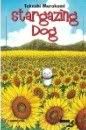 "WHEN ONE'S MESSED UP, EVEN THE STUPID FISH KNOW IT." From its very opening -- police find a junked out vehicle with two bodies, a long-dead male and a more recently deceased dog -- you know that Takashi Murakami's Stargazing Dog (NBM) is going to end on a melancholy note. And so this best-selling manga does, though writer/artist Murakami also manages to imbue his effectively sentimental dog tale with enough lightness to keep it from bludgeoning you. The story of Daddy, a somewhat dim patriarch who loses his job, home, and family -- but never the company of his loyal pup Happie -- Stargazing Dog tracks Daddy's misfortunes through the canine's naive eyes. To Happie, all that matters is the time he spends with his owner. When Daddy loses his job, for instance, the dog is overjoyed to have walks in the daytime; when the two travel south, living out of Daddy's car, all the dog sees is a “fun road trip.” Just being in Daddy's presence is sufficient. Everything else is just details. With its opening panels of dragonflies buzzing around the trashed car to its penultimate scene where a bedraggled Daddy and Happie look up at the night sky, Stargazing Dog has a visual sweetness that carries you through even its saddest moments. The key to it all proves the title character, of course, who views Daddy's downfall through a childlike/canine perspective. As Murakami notes in an “Afterword,” the tragic flaw of Happie's master proves his inability (or perhaps unwillingness) to adapt to the changing world around him. Yet, ironically, it's the constancy of his dog who provides his salvation. “I lost everything,” the human tells his companion at one point, “but as you are sitting next to me, I'm strangely happy.” The title story is followed in NBM's edition by a 50-page sequel, “Sunflowers,” about a social worker named Okutsu who is driven to learning the story behind the nameless vagrant and his dog. In so doing, he recalls his own life living with a pair of elderly ailing grandparents and the dog they'd given him for the day they passed away. In this piece, the meaning of the book's title is explained. “It's an expression for a person who hopes for too much,” Okutsu notes, adding that it's human nature for all of us to do so. In the end, the companionship of Daddy and his dog stands for something that is attainable in our lives -- even in an era when so many other dreams are being dashed. No wonder this book resonated so much in its native land. “I myself was also saved by my own dog,” Murakami writes in his “Afterword.” We don't doubt him at all. (First published on Blogcritics.) Labels: sixty-minute manga # |Wednesday, September 21, 2011 ( 9/21/2011 05:43:00 AM ) Bill S.  “THE UNIVERSE IS SO MYSTERIOUS.” Having taken on stats, calculus, even the theory of relativity, the crew behind the Manga Guide series have elected to think bigger. Kenji Ishikawa and Yutaka Hiiragi’s The Manga Guide to the Universe (No Starch Press) tackles the huge huge questions: the theoretical origins of the universe, its shape and size, the possibilities of extraterrestrial life. As with other titles in this series, the lessons are presented via cute manga teens and a wise teacher, though unlike The Manga Guide to Statistics, our teacher isn’t as comically nerdy. The typically negligible plot serving as a set-up for our manga lecture centers on the Kouki High School Drama Club’s efforts to put on a performance for the school’s arts festival. If the small club can’t cobble together a show, the school will shut down the club, so brainy senior Yamane, headstrong junior Kanna and new American exchange student Gloria strive to work up an adaptation of “The Tale of the Bamboo Cutter.” An ancient folk tale about a princess from the moon, the story leads our drama-minded threesome to try and concoct an “outer space romance.” To research the play’s sci-fi elements, they enlist the aid of Kanna’s older brother Kente, who takes them to one of his professors. It’s Prof Sanuki who schools our quartet on the nature of the universe: the first question is whether the Earth is the center of the universe. As in the other Manga Guides, the professor’s lessons are presented through comic interactions and histrionics on the students’ part, plus sudden costume changes and metaphors. The professor uses more than one sports prop to demonstrate size and distance, which particularly appeals to the athletic Yamane. The usual heavy text pages are interspersed between each manga segment; in several instances they consist of play-like dialog between the students as they hack out topics like Heliocentric Theory, the Big Bang and our expanding universe. Since the book culminates in our cast putting on their play, this approach seems apt. Yutaka Hiiragi’s shojo art is light and amusing, capable of portraying his winsome characters as well as the theoretical visuals used to convey the professor’s take on the universe. Kenji Ishikawa’s script examines the history of scientific thought from Galileo to Hubble -- also appropriate since so much of what we “know” today remains largely theoretical. Unlike many of the earlier volumes in this series -- which focuses on topics so specific (e.g., Databases) as to push away many manga readers, Manga Guide to the Universe has plenty of broad appeal. A strong entry for this charming and informative EduManga series. (First published on Blogcritics.) Labels: sixty-minute manga # |Sunday, June 05, 2011 ( 6/05/2011 07:33:00 AM ) Bill S.  “IN MUSIC, COUNTRY DOESN’T MATTER.” With the spring announcement that mainstay American manga publisher Tokyopop was closing up shop in the states, the wisdom of cracking open the first volume of a recently launched T’pop series is slim at best. Yet Koge-Donbo’s Pavane for a Dead Girl is such a strange misfire that I can’t help wanting to look at it more closely. “What were they thinking?” the stunned manga reader wonders after they’ve reached the end of the first volume. Damned if I could tell ya. Set at the end of the Meiji Era at the start of the twentieth century, Pavane concerns Takenomaru Sagami, a young violin prodigy living at the Marianne Music Academy, a school for girls overseen by Takenomaru’s adoptive father, himself a former musician. Gifted with both preternatural beauty and the ability to play the violin “like a dazzling jewel overflowing with love and radiance,” Takenomaru has a dark secret. His looks and talents are “gifts from heaven” that have been bestowed at a price. To keep them he must regularly gather the Tears of Maria for the Great Angel. This entails finding young girls who will be willing to sacrifice themselves by allowing the young musician to remove “a crystal of feeling” from their hearts. Though the details of this process aren’t shown in the first volume, it’s pretty clear that it’s at the expense of each girl’s life. We’re shown this in the first half of volume one through Nanao Kaga, a cute-eyed young girl who has come to the big city music academy in search of a musician she calls the “Prince of Harmony.” Though the back of this self-billed “romance/fantasy” makes it look as if Nanao is going to be the series heroine, in actuality she’s Marion Crane to the violinist’s Norman Bates. Second half of the first book is devoted to our anti-hero’s back-story, wherein we learn how he got to make his less-than-heavenly deal -- and also discover the roots of the deep misanthropy which provides him the capacity to extract the Tears of Maria from young innocents with a sword and his bare (surprisingly bloodless) hands. At heart, then, Pavane is a horror manga, even if its packaging and art don’t give that impression. Shojo artist Koge-Donbo is known for creating cute and highly romantic manga (Pita-Ten), not gothic fare like this. Her art is so light-hearted, her heroines so visually childlike, that it works against the story’s themes. Even when we’re provided a flashback to our Bryonic protagonist’s damaged youth to learn why he hates and despises the world, the renderings of our young boy hero don’t quite bolster this -- though the image of a small pox riddled Takenomaru come close. On more than one occasion, reading this book, I found myself thinking back to the manga adaptation of The Ring, another instance where art and subject matter were not in sync. A very strange little title, then, that makes me curious (almost in spite of myself) as to where Koge-Dondo intended to take her handsome anti-hero. Too bad the publisher appears to have gone the way of Takenomaru’s first victim. . . (First published on Blogcritics.) Labels: sixty-minute manga # |Wednesday, May 25, 2011 ( 5/25/2011 05:52:00 AM ) Bill S.  “THE MORE I’M WITH YOU, THE LONELIER I FEEL.” When I finished the opening story in Hiro Madarame’s mature readers manga, Scarlet, I’ve got to admit my first response was to re-read the back of the book. Billed as “romance/comedy,” the yaoi manga opens on a decidedly un-comic note: a scene in which a love struck student lies bleeding from a box cutter wielded by the boy he loves. This is comedy? This is romance? A series of short stories about male/male couplings, Scarlet focuses on the power dynamics in its heroes’ believably flawed relationships. In the title story and its follow-up, “Scarred,” we see the volatile pairing of two classmates, Akio and Ryo. The latter is immature and unreliable, a serial cheater whose “European” good looks bring out all his girl classmates. Smitten Akio repeatedly forgives these dalliances, but his devotion is severely put to the test after one of Ryo’s jealous flings convinces him to violently cut off the relationship. The duo’s relationship endures, however, and in “Scarred” we get to watch the twosome in the aftermath of Akio’s assault. “I guess I’m also an idiot for not being able to let you go,” Akio says at one point, and we the readers can’t really disagree with him. A less troublesome pairing gets depicted in three subsequent shorts, “One Night Stand,” “One Night Stand Again,” and “Toki’s True Feelings.” In these, Toki, “a plain sort of man who blends so well into the back people don’t even notice me,” is liberated from invisibility by a one-night stand in a gay bar. This brief encounter ends up being with a man who works in the same building as Toki, which forces the closeted introvert to become more open about his desires. It’s a slow process for Toki, but Madarame ends her little trilogy on an optimistic note. The third set of stories, “My Lover” and “Project: Naoki Makeover,” proves the slightest entry in the book, though it does contain one disturbing sexual moment where its cool guy hero takes advantage of his sleeping nerd lover. The tales in Scarlet are mildly explicit: we get more than one lovemaking scene in the book, though the artist backs away from detailing anything too clearly. As an artist, Madarame shifts between lithe-lined renderings of her lovely boy/men to simplistic cartoons a bit too much in the Akio/Ryo stories (particularly when Ryo gets histrionic), though she thankfully tamps down that tendency in later stories. Yaoi fans who come to this stuff for the images of pretty-eyed boys won’t be disappointed. As a look at flawed romance, Scarlet has its moments, though this reader came away from all three of its couplings wishing that we’d been given more of each story. Madarame would go on to produce a better-known manga entitled Cute Devil, so perhaps this collection is best seen as her still-somewhat-tentative take on material she’ll explore more fully in her later works -- hopefully, without any box cutters involved. (First published on Blogcritics.) Labels: sixty-minute manga # |Friday, April 22, 2011 ( 4/22/2011 06:58:00 AM ) Bill S.  START ME UP, BABY, AND I’LL NEVER STOP: Nowadays, if you spy some kid boredom doodling in class, chances are the images they’re scratching on their lined notebook paper will be manga/anime influenced. None-too-surprisingly, many manga publishers have strived to tap into this potentially creative market by putting out manuals on how to create manga. Twenty-five years ago, the emphasis was on How to Draw Comics the Marvel Way, but that was a whole different generation of comics readers. DMP’s 2006 addition to the pool, the anonymously edited How to Pen & Ink: The Manga Start-up Guide, focuses on the mechanics of crafting black-and-white inked panels. Though occasionally advice is given on other aspects of manga storytelling – setting up a compelling storyline and characters, letting, mechanical shading -- the focus remains on the nuts and bolts. This is exemplified by an appendix where 71 artists list their favorite tools (pen nibs, ink, manuscript paper, etc.) right down to the erasers. More than a little obsessive? Perhaps, but I can see many would-be manga-ka poring over the tiny print at the back of this book. For those of us who just want more general info, the more readable material comes in the book’s beginning: where a trio of manga artists (Yashuhiro Nightow, Oh! Great, and Satoshi Shiki) are interviewed about their lives and work as professional comic artists. The book's central section, a series of strips depicting a round-headed cartoonist’s misbegotten attempts to create his/her own manga series also proves amusing. Those more serious readers will doubtless light on the Q & A pages – which work to introduce readers to technical terms, tricks of the trade and some basic drawing tips. If much of the last should have already been learned in Basic Art class (perspective, anyone?), perhaps our fledgling artist should’ve spent less time doodling and more just listening to their teacher, eh? (First published on Blogcritics.) Labels: sixty-minute manga # |Thursday, April 07, 2011 ( 4/07/2011 06:41:00 AM ) Bill S.  “AFTER THE DELINQUENT LIFE I’VE LED, I FELT I COULD DO ANYTHING.” On the cover of the first volume, Mafuyu Kurosaki looks like your typical high-spirited shojo heroine -- all big smiles in her school girl outfit. But the lead of Izumi Tsubaki’s Oresama Teacher (Viz/Shojo Beat) has a somewhat darker edge to her. The former head of a “straight-up delinquent” gang, she’s been expelled and shipped to a private school on top of a mountain with maternal instructions to “act like a lady.” For Mafuyu, this is no easy task: on her way to her new school, she happens upon a three-on-one street fight. She intervenes on behalf on the outnumbered party, little knowing that a.) the older man will turn out to be her teacher at her new school and b.) he also has a connection to her past. A comic romance, Oresama Teacher initially had me considering it as a distaff switch on Great Teacher Onizuka. The two manga series share the same core element: an ex-delinquent struggling to stay on the straight-and-narrow. Though in this case the former gang-banger is the student, as the story progresses, we learn that her teacher Takaomi also has his own colorful past. If this shojo romance isn’t as broadly slapsticky as G.T.O. (though it has its moments of physical comedy), both series get mileage out of their protagonists’ conduct disorderly personalities. In one memorable sequence, for instance, our hyper heroine struggles to sit still in class for the first time in her life, counting the minutes as they creep past. This reader could definitely relate. Complicating Mafuyu’s resolve to change her fighting ways are her handsome teacher’s knowledge of her once wicked ways, plus the presence of another exiled delinquent, Hayasaka, who feels our girl’s “bloodlust” her first day in class. It’s Hayasaka who articulates the emotional high of the fight life: “I. . . feel good when I’m fighting. I forget all the bad stuff. At least I feel like I’m not the me that I used to be.” All three of the book’s main characters are trying to affect a major change in their lives: even the seemingly impervious Takaomi has become a teacher when we’re told “it doesn’t really suit” his personality. “There was something I couldn’t do unless I became a teacher,” he explains, though what this something could be is a story mystery. Tsubaki depicts this all with a light hand, occasionally tweaking shojo visual conventions (at one point, Mafuyu asks if a character seen flowers in the background and the artist obligingly provides them in the panel) as well as the manipulative male storyline. Teacher Takomi proves to be a major game-player throughout the first volume -- and at times comes across borderline creepy toward his new student/childhood acquaintance. “In public, he’s a great teacher,” our heroine notes at one point, “but his real personality is horrible.” If that’s not prelude to a budding teacher/student romance, I don’t know what is. (First published on Blogcritics.) Labels: sixty-minute manga # |Sunday, March 13, 2011 ( 3/13/2011 03:40:00 PM ) Bill S.  “NO, NOT SHAME! YES! TOTALLY OCD!” Between this new series and Tachibana Higuchi’s Portrait of M & N, the neophyte manga explorer might start wondering whether today’s shojo romancers have begun looking to the DSM for story ideas. Like the masochist and narcissist leads in M & N, the hero of Touya Tobina’s teen-rated comedy Clean-Freak: Fully Equipped (Tokyopop) is definitely diagnosable. An obsessive-compulsive germ-o-phobe, Sata Senda descends into hyper-neurosis as a third grader on a trip to the amusement park. Touching all the poles leading to a roller coaster, he’s horrified to discover that a kid ahead of him has picked his nose and robbed his snot on a pole. “It was a formative moment of horror in my life,” Sata tells us, though we suspect that if it hadn’t been that particular incident, it would’ve been something else. Cut to three years later, and our manga-sized Adrian Monk has become an intensely closed-off sixth grader, covering himself with face masks and rubber gloves, walking around in progressively more outlandish protective gear. He’s comfortable with his outsider status until a cute classmate, Anna Aiuchi, starts to pay attention to him, leading to a series of small steps forward and panicky retreats on our hero’s part. When Aiuchi temporarily leaves to go overseas, Sata once more tries to revert to his solitary stance, but the damage has been done. Other students -- the self-consciously immature Yui Anzai, for instance -- begin making overtures toward friendship, and Sata finds that he ultimately can’t rebuff them.. As a comedy, Clean-Freak frequently oversteps the lines of plausibility (that our hero, for instance, is even allowed to carry bottles of spray disinfectant through the school strikes this reader as a stretch), though its basic theme -- that social involvement can whittle away at dysfunctional self-absorption -- remains a valid one. If the humor doesn’t always pay off as strongly as it could, that might just be this western reader’s response to the art. Tobina’s figures at times are less substantial than necessary, particularly during the series’ many slapstick moments. Still, there are plenty of droll bits. In one of the first volume’s funnier sequences, our hero reluctantly becomes involved in the care of a hyperactive pregnant rabbit. A panel featuring a stylized image of the bun bounding around proves agreeably goofy, as are several shots where the freak-out bare-handed Sata tries to hold onto the pregnant creature as Yui gives him off-base advice. (“Don’t! Her babies are gonna fall out if you hold her like that!”) Life is messy, and in that mess lies comedy. If Clean-Freak was willing to be a trace less neat, though, I suspect its comedy quotient would increase substantially. (First published on Blogcritics.) Labels: sixty-minute manga # |Saturday, February 26, 2011 ( 2/26/2011 09:29:00 AM ) Bill S.  “I’LL SHOW YOU SOME YOKAI MAGIC.” The newest entry in Shonen Jump’s boyish fantasy line, Hiroshi Shiibashi’s Nura: Rise of the Yokai Clan (Viz Media) has an opening nearly as ungainly as its title. Centered on Rikuo Nura, who we first meet as a third grader, the series charts the early adventures of a lad who is one quarter demon as he tries to straddle the human and yokai world. Raised by his full-blooded yokai grandfather, who is supreme commander of the Nura Clan, young Rikuo initially is enthralled by the idea of becoming a part of the supernatural world. His love for his grandparent blinds him to the fact that yokai -- supernatural creatures who thrive on fear -- are many times more irritating nuisances than they are all-powerful beings. Grandpa Nurarihyon’s idea of “yokai magic,” we’re shown in the opening chapter, is just as likely to involve a dine-and-dash as it is any more scarifying acts. While there are more truly fearsome yokai out in the world, the majority of them appear to be more goofily grotesque than frightening, like manga versions of a Basil Wolverton cartoon. At times, especially in the initial episodes, the crowded panels of yokai frequently threaten to distract us from our hero. The first volume divides its focus between the yokai-crammed home where Rikuo is being raised and his time in a human school setting, though through much of the first volume, at least, the latter segments prove less focused and interesting. The two worlds collide when Gagoze, one of the nastier yokai out there, attacks a school bus in the hopes of killing Rikuo before he can take over for his grandfather. The assault rouses our hero’s one-quarter-yokai blood, transforming him into a tall, longhaired sword-wielding warrior for short bursts of time. Though his subjects by and large all look monstrous, transformed Rikuo doesn’t, perhaps because of his quarter human heritage. Having established its central set-up, Nura skips four years ahead, showing our hero as a bespectacled seventh grader much less starry-eyed when it comes to his yokai destiny: a fairly typical tween-ager, in other words, pushing away from the life his primary parent has chosen for him. At school, he’s followed by Yuki-Onna, a yokai servant sent to watch over him, who looks like a schoolgirl but has an uncomfortable habit of calling him “master” at inconvenient times. When one of his classmates founds the Kiyojuji Paranormal Patrol, both our hero and Yuki get pressed into joining the extra-curricular club, in part to keep an eye on Keikain, a young girl exorcist specializing in banishing yokai. She has come to the small town because it’s well known for a high level of supernatural activity and she wants to banish as many yokai as possible so that she can inherit her grandfather’s legacy. While Rikuo has doubts about his place in his family, then, his potential nemesis appears much more self-assured. The first book of Nura takes some time to find its footing -- which doesn’t seem unusual for a shonen manga serial like this (think of the first rough episodes of Naruto, for instance). But by the end of the opening volume, Shiibashi has honed in on his hero and fleshed out his classmates enough to keep our interest. There’s even a hint that transformed Rikuo will in time effect a change on his clan, though you know that there’ll be plenty of resistance from the old-liners like Gagoze (who dresses like the Vault Keeper in the old EC horror comics) in volumes to come. A promising series, which has already sparked its own anime adaptation, Nura has the potential to be either a strong coming-of-age fantasy or a visually arresting mess. Either way, it could still provide an entertaining read. (First published on Blogcritics.) Labels: sixty-minute manga # |Wednesday, February 23, 2011 ( 2/23/2011 06:32:00 AM ) Bill S.  “YOU COME UP WITH THE MOST OUTRAGEOUS IDEAS.” Three volumes in and Eiki Eiki’s romantic political comedy Millennium Prime Minister (DMP) has significantly shifted its story focus. The first volume, you may recall, concentrated on the relationship between 25-year-old Japanese p.m. Kanato and 16-year-old schoolgirl Minori. In the third, it takes half the book before the latter even makes an appearance. Instead, the book concentrates on Kanato’s smitten former senior aide Sai, who’d run off at the end of the second book. Sai, it turns out, has a hitherto unknown family connection to the p.m.’s biggest political rival, who of course wants to use the broken-hearted boy to thwart Kanato’s political agenda. We’re given a hint of the p.m.’s plans for reform, but not enough that they make any sense to the reader. “Did you understand any of that?” young Minori is asked after Kanato broadcasts his agenda. “Not a single thing,” Minori answers, while writer/artist Eiki lets us off the hook by including an on-panel note that says, “Representing the reader’s view.” If Kanato’s reform politics remain muddled, the yaoi manga artist’s sexual politics in MPM remain clear: the primary focus is on handsome well-dressed men balancing the political and personal -- with the personal winning out. While Sai’s shifting camps has clear strategic ramifications, it also, for instance, pollutes the once friendly relationship between Kanato and the reporter Matsumoto, who not-so-incidentally appears to have his own attraction toward the 18-year-old former aide. You never saw these kinds of entanglements on The West Wing, now, did you? (First published on Blogcritics.) Labels: sixty-minute manga # | |
|
|
 on his desk. (Good product placement, DMP!) Natsuki’s fears regarding their new houseguest don’t appear entirely unreasonable: he seems to spend a lot of time walking outside after dark and barely eats anything that he’s offered at the family dinner table.
 . 7 Billion Needles takes a plot that that has inspired a multitude of sci-fi horror yarns since the 1950’s and spruces it up with sharp characterization. Hikaru proves an inspired creation: an unlikely savior of her planet whose alien contact could be her own emotional salvation provided she is able to survive once her visitor leaves her body.
 ). With only three more volumes to go, though, I know I’m sufficiently hooked to want to seek the rest of this series. Smart sci-fi and believable characterization: that’s rare enough in any style of graphic novel. . .